


Election Verification Polling
EDA has conducted and commissioned numerous independent exit polls and voter surveys in counties across the nation during the 2006 midterm and 2008 presidential election cycles, providing an independent means of evaluating the validity of official election returns generated by trade-secret software owned by private corporations. In the absence of direct citizen observation of the vote-counting, or credible election auditing practices, these polls provide a valid means for independently assessing the veracity of intrinsically unverifiable electronic voting results. We continue to refine these methods and will, with your volunteer participation and funding support, continue to conduct exit polls and voter surveys in strategically selected locations in forthcoming elections.
Election Forensic Analysis
In computerized elections, citizens are denied access to the very evidence --ballots marked by voters-- necessary to confirm or deny the validity of officially reported election results. EDA has developed methods for independently assessing reported election results by comparing official precinct and county election returns to historical election baseline data, voter registration figures, pre-election tracking polls, and independently commissioned exit polls on election day. This multifactor analysis comparing reported election results to independently verifiable external measures can identify suspect patterns and internal contradictions in the election results indicating probability of accidental mistabulation or deliberate fraud to a very high degree of statistical certainty.
Media Messaging and Public Education
The unacceptable risks of computerized voting are rising into public awareness, but much more public education and advocacy will be needed to institute change in the U.S. electoral system. EDA is building media messaging capacity to provide consistent, corrective information and to issue alarms as necessary on a national scale.
Legal Action
Election Defense Alliance advocates a proactive, pre-emptive response to pervasive breaches in election security and obstruction of the public's right to know. We are devising legal tactics and assembling evidence to support legal intervention before, during, and after elections to enforce effective security procedures and uphold the public's right to monitor electoral processes and inspect public documents without obstruction.
Support for Local Organizing
Because we recognize that all elections are local, Election Defense Alliance emphasizes electoral integrity action at the level of local electoral jurisdiction. We support those efforts by developing research, fundraising, and publicity capacity on a national level and then channeling those resources where they can be applied most effectively: at the county and township level where elections are conducted.
Legislative Policy
Although we regard decentralized electoral administration and local citizen vigilance as the best prescription for election protection, EDA recognizes the present opportunity to repair damage wrought by HAVA (the Help America Vote Act of 2002) and avert similarly misguided and harmful federal legislation now and in the future. We will warn against ill-advised nonsolutions, recommend effective measures to counter electronic voting dangers, and promote handcounted paper ballots and manual audits as the solutions necessary to restore electoral integrity.
Click here to return to donation page [1]
Tell the New York state judiciary to uphold our constitutional right to a transparent, secure, theft-deterring electoral system. New York voters do not consent to voting on undetectably mutable, software-driven voting machines.
To learn more go to Election Transparency Coalition blog [4].
See what you can do to prevent our birthright from being stolen.
Click here for 12.15.07 Press Release [5] on Amicus Brief Click Here to Download the Amicus Brief [6]
With respect to statewide voter list, the complaint notes that, among other things, the has failed to (1) publish any rules or regulations governing the statewide voter list, (2) take the necessary steps to contract for the development of a statewide voter database, and (3) establish the necessary agreements with the Social Security Administration to match voter registration information.
• Status:
The U.S. Justice Department sought a preliminary injunction on March 6, which was granted by the court on 23, 2006. The court ordered the State Board of Elections to file a remedial HAVA implementation plan by April 10, 2006, and provided ten days to respond, later extended to eighteen days. State filed its HAVA plan with court on April 10, and Plaintiffs’ responded on April 18th agreeing to the plan. On June 2, the court ruled that the Board’s HAVA plan would bring the state, over time, into full compliance and set a series of deadlines for implementation and reporting. Currently before the court is a motion to intervene by a diverse coalition of civic organizations that is concerned about the adequacy of the state’s plan.
• Parties: This lawsuit was filed by the Voting Section of the Department of Justice against the New York State Board of Elections, its co-executive directors, and the State of York.
This declaration may be downloaded in PDF format at the link below [38]
IN THE UNITED STATES DISTRICT COURT FOR THE NORTHERN DISTRICT OF NEW YORK
_______________________________________________
UNITED STATES OF AMERICA, Plaintiff DECLARATION OF NANCY TOBI
v
Case No. 06-CV-0263 (GLS)
NEW YORK STATE BOARD OF ELECTIONS;
PETER KOSINSKI and STANLEY L. ZALEN,
Co-Executive Directors of the New York State
Board of Elections, in their official capacities; and,
STATE OF NEW YORK,
Defendants
_______________________________________________
Pursuant to 28 U.S.C. sec 1746, NANCY TOBI, declares as follows:
My name is Nancy Tobi and I am filing this declaration on behalf of myself and the New Hampshire Fair Elections Committee, of which I serve as Chair. I am a founder of Democracy for New Hampshire (DFNH), the Chair of the New Hampshire Fair Elections Committee, and the Legislative Coordinator for Election Defense Alliance (a national organization). All of these organizations are nonpartisan, 100% grassroots organizations. Democracy for New Hampshire was founded in February, 2004, and its Fair Elections Committee was founded one year later, fulfilling the second part of the DFNH mission statement:
Democracy for New Hampshire is a nonpartisan big-tent organization that promotes grassroots community involvement in the democratic process in New Hampshire. DFNH works to protect the foundations of our democracy and the integrity of our political process and supports fiscally responsible, socially progressive candidates who speak honestly about policy choices.
The Fair Elections Committee statement of purpose is:
The New Hampshire Fair Elections Committee is dedicated to protecting, preserving, and enhancing those aspects of the NH election system that are unique, transparent, secure, and exemplar. The FEC aims for open and accessible election processes, while implementing processes to prevent, pursue and prosecute proven instances of election fraud.
Election Defense Alliance mission is:
The purpose of EDA is to help build and coordinate a comprehensive, cohesive national strategy for the election integrity movement, in order to regain public control of the voting process in the United States, and to insure that the process is honest, transparent, secure, verifiable, and worthy of the public trust. To accomplish this purpose, EDA will provide resources, strategic planning and coordination opportunities for a nationwide network of citizen electoral integrity groups and individuals already working at the national, state, and local levels. The urgent goal of these activities is to rapidly expand and multiply the effectiveness of the election integrity movement by connecting existing groups and encouraging the creation of new ones. EDA seeks to provide connection, coordination, and focus, to eliminate duplication of efforts, to create a clearinghouse for the sharing of materials and other resources, and to facilitate coordinated decision-making about strategic priorities and tactical approaches in the election integrity movement.
I have been involved in grassroots activism promoting election integrity since 2003. I serve as citizen representative on the New Hampshire HAVA State Plan Committee and Disability Task Force. In my home state of New Hampshire, I have worked with other citizens, legislators, and the NH Department of State to improve our election integrity including drafting and successfully lobbying for passage of legislation, implementing new procedures, and promoting, leading, and participating in numerous citizen educational forums and events. I have been invited to speak at national conferences, including Keene State College’s recent November 2007 Citizenship Forum, a Summer 2007 Election Integrity Forum in New York, DemocracyFest 2006 (California) and 2007 (New Hampshire), the WeCount2006 Conference (Ohio), and the 2005 Third Party Conference (New Hampshire), at which I was invited to speak about HAVA. I have been interviewed on radio shows in New Hampshire, Ohio, Pennsylvania, Texas, and Oregon. I was invited to speak on a panel about New Hampshire’s election systems on New Hampshire’s political television show “Political Chowder”. I organized an election integrity track at the 2007 DemocracyFest, which featured nationally known authors, activists, New Hampshire’s Secretary of State Bill Gardner, and representatives from the NH Departments of State and Justice. I organized an election integrity forum in December 2006 in New Hampshire, also featuring nationally known authors and our New Hampshire Secretary of State. I have met with election activists around the nation to discuss and dialog solutions to our national, state, and local election problems. I have organized and led nonpartisan working groups consisting of grassroots activists, election officials, and lobbyists, towards the improvement of proposed national election reform legislation. I have written numerous op-eds, essays, and booklets about the Help America Vote Act, democracy and elections, and New Hampshire election systems and methods for hand counting. Most recently, I have released the Hands-on Elections Handbook (2007), which includes hand count administration and reconciliation methodologies developed by the New Hampshire Department of State.
New York’s State Constitution of 1777 makes the observation that a vote cast on a tangible ballot preserves democracy better than one cast in the air:
“ VI. And whereas an opinion hath long prevailed among divers of the good people of this State that voting at elections by ballot would tend more to preserve the liberty and equal freedom of the people than voting viva voce…”
The New York Constitution has since been amended to allow lever machines. But in 1777, the framers of New York’s Constitution, engaged in a war against an oppressive unitary power, understood the need for checks and balances to ensure integrity of the mechanism of democracy: the vote. They further prescribed the ballots be placed in boxes, with a chain of custody overseen by sheriffs to the secretary of state, and the ballots canvassed by a joint committee of the legislature, until March 27, 1799, when the system of inspection and canvassing by local wards was introduced, ensuring more citizen oversight of the process.
Computerized
voting equipment began to be used in America's elections in the mid-1960s; it exploded in use after the 2000 election, due to the infusion of HAVA monies to states, which used these funds to purchase billions of dollars of computerized voting equipment.
With the advent of computerized voting, a new form of voting viva voce has made its way into the nation’s elections, with the lion’s share of America’s total ballots now being counted - and often cast - in the Ethernet. Adding to the non-tangible nature of this system, computerized elections brought the privatization of our elections as well. Eighty percent of the nation’s ballot and votes—the mechanism by which all other rights are secured—are now the private property and trade secrets of corporate computerized voting machine corporations.
These for profit corporations counting 80% of the nation’s ballots, use secret and proprietary vote counting technology. In other words, instead of publicly observable vote counting, as recommended in New York’s original Constitution, and still guaranteed in numerous other state constitutions, and as required by Section 8 of the federal Voting Rights Act, most of the nation’s votes are being counted in secret, outside of the public’s oversight. With DRE technology, this situation is exacerbated because both the casting and the tabulation of the vote are transformed into proprietary Ethernet data, owned by the corporation that manufactures and programs the DREs.
But even with optical scan technology, which uses voter marked paper ballots, the count itself is secret and proprietary, in direct violation of the Voting Rights Act, many state constitutions, and the very tenets of democracy itself. A democracy requires citizen oversight and checks and balances. With proprietary and privatized elections, this is lost. Citizens and even candidates are denied access to inspect and verify the public votes now transformed into privatized election data.
This lack of citizen oversight would be egregious in any voting system, including in a hand count voting system. It is particularly egregious in a computerized system, where the risks for tampering are magnified by the very nature of computer programming. With one line of code in the Ethernet viva voce election, the outcomes for entire elections can easily and invisibly be changed, especially when those computerized systems also control the final central tabulation, as is the case in most places in the country (New Hampshire uses optical scanners, but manually tabulates the central vote count).
News accounts in every national, state and local election since the proliferation of computerized voting are rampant with stories of election “glitches”. This benign and rather cute sounding word obscures the very real dangers of relying on computerized voting. Computer “glitches” are not programming hiccups. They are either programming errors, bugs, or deliberate fraud. Because of the tenuous nature of Ethernet viva voce elections, it is difficult to tell the difference. But regardless of whether or not a computerized election “glitch” is intentional, the ramifications are enormous. These “glitches” cause the wrong people to be seated in office, given power over the voters whom they don’t actually represent (because they were not actually elected). These “glitches” have prevented schools and fire departments from receiving the funding desired by voters. These “glitches” have changed the course of human events in incalculable ways. And despite the plethora of documented cases across the nation, we really have absolutely no idea how often these “glitches” occur or have occurred. This situation is not just antithetical to a system of democracy with checks and balances, it is unconstitutional.
The combination of computerized Ethernet viva voce elections and the loss of citizen oversight due to the privatized corporate control of elections is serving a death blow to our nation’s very system of democracy. This is not to be taken lightly. Further expansion into computerized and privatized elections should be avoided at all costs. Fortunately for our nation and our democracy, there is another way.
Despite the countless news stories of election outcomes called into question because of computerized voting equipment failure, or worse, suspicions of tampering and fraud, and despite the millions and billions of American taxpayer dollars have already been spent, and continue to be spent, on computerized voting equipment, we don’t hear a lot about major problems happening on the hand count election front.
So it may be surprising to learn that a significant percentage of the nation’s voting jurisdictions still enjoy hand-counted paper ballot elections. The Election Assistance Commission’s 2004 election Day Survey reports the following data regarding national use of hand counting on election night.
Hand count elections are being held across the nation. Significant hand count states include the following:
Many opponents to hand counting cry “chaos will ensue!” But unlike computerized elections, which call for expensive programming, indeed create chaos at the polls with breakdowns, lack of sufficient machines (due their high costs), and which alienate many poll workers in their complexity, running a hand count paper ballot (HCPB) election can be the most orderly and respectable method for administering elections. Proper hand count elections simply require good management: you manage process, you manage people, you manage paper, and you manage numbers. Hire a good manager and a good accountant for every district, and your hand count elections will be orderly, secure, accurate, reliable, and dependable.
With the right methodology and management in place, election costs come down and the integrity of the election goes up. New Hampshire has identified two accepted and widely used methods for hand counting paper ballots. The sort and stack method is considered more effective and efficient than the read and mark method. With hand counting, as long as you have 2-4 people on a team you have built in double checks. You don't necessarily need to rely on post count audits because you are doing simultaneous verification then and there on election night.
Many local election officials are afraid to give up their machines because they fear they will not have enough help to hand count our elections. Or they fear even if they have enough people, they will be the “wrong” kind of people. But our communities are filled with the “right” kind of people. We just need to reach out to them. In fact, many of our communities have built-in recruitment centers. In every city and town, there are community organizations. Church groups, Rotary Clubs, Neighborhood Watch groups, TA’s, High School social action or community service groups, these are just a few that come to mind. With seventeen year olds eligible to be poll workers in most states, and community service often a high school requirement, this is a match made in heaven.
Usually, in New Hampshire, all it takes is 25 people to help count up to 3,600 ballots with roughly 15-20 contests in any given polling place to run a hand count election. This is an easy number to recruit, and in New Hampshire community members line up to volunteer for this honored tradition of being sworn in as ballot counters on Election Night.
In New Hampshire we have learned that it is possible to hand count large numbers of paper ballots, even complex ballots. One New Hampshire town counts up to 3600+ ballots on election night. This is an important data point because the national average number of ballots in any precinct is less than 1000. In other words, New Hampshire hand count towns can manage up to 3 or 4 times the national average of ballots processed in any given precinct. (In New York, election law restricts elections districts to no more than 1,150 voters.)
Because of our large legislature, New Hampshire also has some of the more complex ballots in the nation (many multi-member districts). For instance, a New Hampshire multimember House district might have up to 26 candidates running for 13 seats in a single district. This is an extreme circumstance resulting from the large legislature in New Hampshire, more than likely not reproduced anywhere else in the world. Many, if not most, of our districts are multimember races with 2,3, 4 or more seats per district in a single contest, with typically at least twice as many candidates (if both the major parties run a candidate Democrats and Republicans). In a district with four representatives, there will likely be at least eight candidates running in that race. So to count using sort and stack, you'd have to count this single race eight times plus the write-ins, overvotes, and undervotes. So you would count 11 stacks for this single race. This gets complicated, and is the reason many of our towns fall back to the read and mark method, which procedures can easily be found in the New Hampshire Secretary of State’s Election Procedure Manual, and which can also produce a secure and accurate hand count.
Using New Hampshire numbers and estimates derived from decades of experience, we are able to estimate what it would take to hand count the two federal races in the New York State 2008 General Election. The management and staffing estimates for hand count elections may be found in the NH Department of State training presentation available on the Democracy for New Hampshire website.
The NH Department of State estimates that it takes six seconds per contest to hand count ballots using the accurate and efficient sort and stack method. For the 2008 General Election in New York, with only two federal races, this translates to twelve seconds per ballot. At 100% turnout for any given district, this would mean 1,150 ballots counted at twelve seconds each, for a total time of 13,800 seconds, or 3.8 hours. A team of four people, which provides two counters and two observers, could complete such a count in less than two hours. Voter turnout is rarely 100%, so this number could be adjusted based on turnout estimates.
Additionally, another team of four people could simultaneously manage reconciliation activities, counting number of blank ballots at poll opening, number of ballots cast, number of votes cast, and number of voters checked in. This four person team would also allow for two accountants and two observers. All of these counting and reconciliation processes could easily be accomplished publicly in full citizen oversight, at one long table, and in much less than two hours upon closing of the polls.
As mentioned previously, New Hampshire does manual central tabulation, to ensure checks and balances of that part of the election process. At close of the count and reconciliation, local jurisdictions communicate their numbers to the Secretary of State's office for centralized tallying, where the reported results from each city and town are manually entered into a spreadsheet.
An important thing to note about hand count systems is they are self-authenticating. With proper management, you can hand count your ballots using teams of 2-4 people, meaning 2-4 sets of eyes on every count, every tally mark, every contest, every ballot. Using the sort and stack method, this means that 3-4 sets of eyes have the chance to see every mark on every ballot twice: once during the sorting process and once again during the counting process. The ballot markings, therefore, are seen 4-8 times under this system. This means that even a two-person team has an opportunity to review the ballot markings four times, making the sorting and counting members of the team simultaneous observers.
With this type of self-authenticating system, you do not need the complex and
expensive audit protocols proposed for computerized elections. In a well run hand count election, post election auditing is best implemented by making recounts accessible and financially feasible.
Because these hand count methodologies integrate reconciliation into the process of counting, the self-auditing mechanisms are quite advanced and ensure a high level of integrity for the system overall. In this way, the "auditing" occurs
during the first count itself, when it matters, because this, after all, is the count that declares the winner (as opposed to machine "audits" promoted in some national legislative proposals, and in various state laws, which are intended, albeit weakly, to identify problems with the system but not intended to affect outcomes).
Lastly, the feasibility of running hand count elections is proven in the State of New Hampshire and elsewhere in the nation. Specifically, five or so well managed self-auditing teams of 2-4 people can count roughly 1000 ballots with 15-20 contests in less than 2 hours. For New York districts, with no more than 1,150 voters, this is eminently do-able.
All told, with final reconciliation of registration checklists, number of ballots in and out, etc. the whole process is complete in less than 3 hours on election night. In terms of cost, the fact is that many New Hampshire counters are community volunteers (all sworn in to office on election night). It is considered an honor to be a vote counter. But even when paying its counters, New Hampshire has found the local hand count method - using teams of three - costs 7 cents per contest on a ballot, meaning $1.05/ballot for a typical 15 contest general election ballot. The State of NH, which conducts 10-30 manual recounts every
election cycle, estimates cost for hand counting at around 7 cents per race on the ballot. This assumes 3-person teams, each person getting paid $10/hr.
What this means is that it doesn't matter how large is the population of a state or county. What New York needs to consider is how many ballots are processed in any given district, and whether or not there is the political and community will and the infrastructural integrity to conduct hand count, observable, self-authenticating, elections.
In New Hampshire, we have more than 200 years of experience successfully administering hand count paper ballot elections. 45% of New Hampshire’s polling places still count our ballots by hand. The New Hampshire Department of State has generously shared their expertise in this methodology, and it is included in the Hands-on Elections Handbook, released in the summer of 2007. This Handbook, and accompanying PowerPoint presentations given by the NH Departments of State and Justice may be freely downloaded at the website: www. DemocracyForNewHampshire.com and used to train election workers in the proper methods for hand counting paper ballots. This fully HAVA-compliant method for running elections is very manageable if the right conditions and methods are implemented.
To prepare for a hand count election, consider the following elements in your planning process:
Today, Americans around the nation are lining up to restore our democracy. Organizations like the NH Fair Elections Committee will assist in sending volunteers to New York to help hand count New York’s elections should the Court
order same.
I declare under penalty of perjury that the foregoing is true and correct.
/s/
___________________________________
Executed on December 11, 2007 NANCY TOBI
| Attachment | Size |
|---|---|
| NANCYTobiDeclaration.pdf [39] | 49.97 KB |
Only New York's lever voting system or its previous hand-count system satisfy the constitutional requirement that we be able to see how our votes are counted. Fight to preserve New York's constitutionally compliant lever voting system. Sign this petition in support of the litigation to declare invisible vote counting unconstitutional.
New York VOTERS (Voters for Open, Transparent, Electoral Reliability and Security) Campaign to Save our Secure Electoral System
WHEN, IN THE COURSE OF HUMAN EVENTS, it becomes necessary for freedom-loving people to stand up to their governments when their governments act in opposition to their constitutional rights and in a manner corrosive to their sovereignty, a decent Respect to the Opinions of the Nation requires that they should declare the Causes which impel them to take this position.
WE HOLD THESE TRUTHS TO BE SELF-EVIDENT, that all People are created equal, that they are born with certain unalienable Rights, that among these are Life, Liberty and the pursuit of Happiness. — That to secure these rights, Governments are instituted among People, deriving their just powers from the consent of the governed,— That whenever any Form of Government becomes destructive of these ends, it is the Right of the People to alter or to abolish it.
OUR GOVERNMENTS HAVE TURNED AGAINST THE PEOPLE, in enacting or approving of laws which deprive the People of our constitutionally protected right to vote. The right to vote is the primary right by which all other rights are protected. To deprive a person of this right is to reduce one to slavery, for slavery consists in being subject to the will of another.
NEW YORK’S CONSTITUTION has been interpreted by the highest court in the State as recognizing that essential to the express right to vote and the express right not to be disenfranchised are essential implicit constitutional rights, including the right to a transparent process so that the People can know their votes were accurately counted cast. The right to an open, transparent electoral process, which enables its citizens to be able to evaluate the performance of their government in safeguarding its elections, is further protected by First Amendment rights, also guaranteed by New York’s state constitution.
TRANSPARENCY ALLOWS CITIZENS TO SEE OPENLY into the activities of their government, rather than permitting these processes to be cloaked in secrecy. The protection of the ballot box and tallying of vote totals must be conducted as openly as possible, so that citizens are confident that the results are accurate and that the government elected reflects the consent of the governed.
NEW YORK’S LEGISLATURE ABROGATED OUR FUNDAMENTAL RIGHT to know that are votes are being counted as cast by authorizing the use of concealed, non-transparent, software-driven vote counting systems to be implemented in the State of New York. This unconstitutional usurpation of power is supported by the Executive of the State of New York and the Attorney General.
NOTWITHSTANDING THE OVERWHELMING EVIDENCE from dozens of computer scientists proving that software-driven voting systems are vulnerable to undetectable tampering and are incapable of providing trustworthy, secure or reliable election results, the State of New York is forcing the People to replace our secure lever voting machine system with un-securable, vulnerable-to-tampering, software-driven machines.
NOTWITHSTANDING THE DEVASTATING EVIDENCE accumulated from the experiences of the nation wherein every state installed these theft-inviting machines sold by the small cartel of irresponsible vendors selling their secret, proprietarily programmed, shoddy, defective machines to run our public democratic elections, New York is proceeding with its plan to abandon its reliable, transparent lever voting system and replace it with the same shoddy, dysfunctional equipment that has been shown to be so vulnerable to massive, outcome-determinative miscounts and theft of our elections.
WHEREAS THE EXISTING LEVER VOTING SYSTEM PROTECTED our constitutional franchise from dilution by fraud by preventing known opportunities for tampering, New York’s newly enacted laws unconstitutionally force New York Voters to cast their votes on unreliable, undetectably mutable, secretly programmed software-driven machines, thereby disenfranchising New York Voters by exposing the election results to unseen tampering and known opportunities for tampering.
WHEREAS THE EXISTING LEVER VOTING SYSTEM PROTECTED our constitutional franchise by providing an observable, open means by which the public could observe and know the lever voting machine securely and accurately counted our votes, New York’s newly enacted laws unconstitutionally prevent the People from observing how the software-drive machines unreliably and unsafely count our votes, concealing the very transparency required by New York Voters so that we may evaluate our government’s obligation to securely and fairly count all our votes.
WHEREAS THE EXISTING LEVER VOTING SYSTEM PROTECTED our constitutional franchise by providing the People with reliable evidence of how the votes were counted on election night as well as evidence of fraud, mutable software-driven voting systems deprive the People of the reliable physical evidence we are constitutionally entitled to in order to hold our government accountable and to be able to vindicate our right in a court of law.
WHEREAS THE EXISTING LEVER VOTING SYSTEM PROTECTED our constitutional franchise by detecting, deterring and revealing fraud, the software-driven system being forced on the Voters of New York, destroys and conceals evidence of fraud, thus providing no deterrence against dilution of the franchise by fraud and further depriving the People of the evidence required to prove whether their consent was reflected in the election outcome.
WHEREAS THE EXISTING LEVER VOTING SYSTEM PROTECTED our constitutional franchise by providing New York Voters with a secure, verified, accurate count on election night, before exposure to post-election influences could corrupt the count, the new legislative scheme deprives us of the completed count delivered under the watchfulness of public scrutiny, instead permitting the election-night count to be the product of knowingly unreliable mutable software, which is then checked by a partial hand-count only after the election is over, after the winner has been announced and after the protection against tampering provided by the ongoing public surveillance of the poll site is over -- after which post-election ballots may also be the product of tampering.
WE, THE VOTERS OF NEW YORK, DO NOT CONSENT:
WE, THE VOTERS OF NEW YORK, have implored our government to uphold its responsibility to protect our constitutional franchise in every manner available to us. We have provided the aforesaid evidence to State of New York, through the State Board of Elections and our elected representatives, the Executive’s office and the Attorney General’s office, but have been rebuffed and ignored.
WE, THEREFORE, THE VOTERS OF NEW YORK, APPEAL TO THE JUDICIARY, the only remaining branch of government that has not ignored our pleas, to protect and secure our lawful rights, in the Name, and by Authority of the VOTERS of New York, as reflected herein, to declare New York’s Legislature’s and the State Board of Elections’ laws and regulations – as they require us to surrender our constitutionally guaranteed right to vote and our constitutionally guaranteed right not to be disenfranchised and our constitutionally guaranteed right to a knowable and transparent electoral process – abhorrent to our constitution and to our rights as a self-governing people.
Click Here to View Signatures
[41]
• Newshounds - Comb the press for articles on New York's election technology, then post comments and contact the reporters.
• Bloggers - Reach hundreds of New York readers with your commentaries on the case and critiques of mainstream coverage.
• Fundraisers - We only need a half a million dollars to pursue this; totally doable.
• Board of Election Monitors - Obtain weekly feedback on how the ballot marking devices are fairing, personnel and training issues, costs, etc. Our county election commissioners need support.
• Local Liaisons - Contact local political committees (Dems, Repubs, Greens, Libertarians) and civic organizations (advocacy groups, churches, clubs, unions). Voting matters to everyone!
• Teachers/Professors - This is the ultimate civics lesson, defending voting rights guaranteed in the New York constitution. Bring your students to witness.
• Court Gallery - Attend court hearings so the judge and newsmedia can see the public's commitment to election transparency.
• Pro Bono Attorneys - This is a trailblazing lawsuit and we'll need devoted legal talent to prevail.
• Videographers - Document this story as New York sets precedent for the nation, reaffirming the right to vote as the civil right that protects all others.
By Andrea Kelly, Arizona Daily Star, May 24, 2008 TUCSON, AZ-- A Pima County Superior Court judge has ordered county officials to release a series of elections database records requested by the Democratic Party more than a year ago. The judge's ruling also requires release of databases for all future elections. After the December trial, in which the Pima County Democratic Party and the county argued as to whether the records were public and, if so, whether their release posed a security risk, Judge Michael Miller ordered the release of databases for the primary and general elections in 2006. That was only part of the party's request for electronic database records. In January, the Pima County Board of Supervisors decided to also release the database records for the May 2006 Regional Transportation election. Following that decision, the party asked for a new trial to consider the release of the rest of the records it requested, which included all of the Diebold GEMS and Microsoft database election files. It is those which the judge has released in his latest order. The county Democratic Party says the decision sets a national precedent for open government and election integrity. "Ultimately if you're going to have electronic voting and electronic election records, you need to have electronic oversight. People from across the country interested in election integrity issues have contacted the party about this case, Rabago said. The Pima County Board of Supervisors will likely discuss the ruling with attorneys at its next meeting June 3, said Daniel Jurkowitz, deputy Pima County attorney. The previous release included about 300 computer database files, and fulfillment of the full order will bring that number to about 1,100, Jurkowitz said. In court, the county said releasing the records could put the county elections department at risk of a security breach. But the Democratic Party argued that there was no specific risk, and that allowing more people to see the records reduced the possibility of fraud. Richard Elías, chairman of the Pima County Board of Supervisors, said the ruling reflects the desires of the public. "I think the people spoke through the Democratic Party, and the judge heard that and made a good decision," said Elías, a Democrat. "This is a good victory for all of us who want to see elections run more carefully." He said the county elections process has changed dramatically in the last few years and has led to more security, and he hopes that continues. Miller's ruling requires the release of data on future elections to occur when the election is officially canvassed. This is important because state law limits election-results challenges to the five days following the official canvas. Republican Supervisor Ray Carroll said the Democratic Party's victory extends to any concerned citizen. He said he would have released the records in the first place, and The judge has not yet ruled on a request that the county pay the Democratic Party's legal fees, which run into the hundreds of thousands of dollars. He took the issue under advisement after a hearing earlier this month.Pima County is Ordered to Release Data on Elections
The ruling comes after months of court hearings and decisions.
It's as simple as that," said Vince Rabago, chairman of the Pima County Democratic Party.
has voted for releasing the records.
by Associated Press
March 18th, 2008 @ 5:17amCounty attorneys will ask Judge Michael Miller Tuesday morning to prohibit the Democrat's attorney Bill Risner from deposing additional witnesses to buttress local Democrat's contentions that the county is overstating concerns that release of electronic databases [45] from past elections would pose a risk to the security of future elections. . . . [ AP story continues below video ].
They suggest security [45] flaws and potential hacking involving the same Diebold-GEMS elections system used in the county that was also used in numerous jurisdictions nationwide.
In December 2007, the judge ruled the county must turn over some of the databases sought by the Democrats, but not all.
The Pima County Board of Supervisors in January expanded on Miller's order to release databases from the 2006 primary and general elections to also include the electronic records of the May 16 Regional Transportation Authority election held that year.
Risner has since asked the judge to amend that ruling and compel the county to release all the electronic election databases in its possession or to allow a new trial over the issue. The judge is to rule on Risner's request for an amended decision or new trial at an April 21 court session.
Risner said he wants depositions taken against new witnesses before that hearing. In his ruling in December 2007, Miller cited security concerns raised by county attorneys as part of his reason for not releasing all the county's electronic elections databases.
The lawsuit seeking those databases was filed by the Pima County Democratic Party to gain access to county elections records to check for signs of tampering with the county's Diebold-GEMS vote system, or through software used to tabulate ballots cast in those elections.
Information from: Tucson Citizen, http://www.tucsoncitizen.com [48]
© 2008 The Associated Press. All rights reserved.
By Jim March and John R Brakey
The election integrity community is about to get something unique: access to the raw "electronic debris" from the three major elections of 2006. The files in question are created by the Diebold central tabulator system and were used to control how the elections operated and take in the data on votes.
What's unique is that for each of the three elections, we're going to get ALL such files, not just the "final result" file.
Each election contains up to 40 or more files. They can be viewed as "time slices" of the progress of the election: the initial setup, the intake of the mail-in vote day by day, the election-day processing and the post-election provisionals and final canvass.
We can finally do a real audit.
Better yet: we can design an automated software tool that does comparisons and tracks trends over time, reporting on such issues as timestamps, "Did the parts that aren't supposed to change get hacked?", "Do the multiple copies of vote totals in each file always match?" and much, much more.
Any "funny business" in there could reveal itself in any number of ways. To take just one example: The candidate IDs aren't supposed to be tampered with once the vote intake begins. Were they? Do the internal timestamps within the files show any changes once the election began? We've never had the ability to analyze this stuff, until now.
Once the tool is built, it will report changes that seem "wrong" once loaded with the file set for any election. Human eyeballs will have to follow up to determine if there was a real issue, but the key is that in AZ election challenges must follow within five days of the canvass.
An automated, open-source software tool usable by anyone can be used to chew through the volume of data needed and where necessary, trigger challenges by ANY candidate or party within the legal limits for filing.
This is a win for every party, every candidate, and every voter nationally. Once the tool is built and the need for analysis becomes obvious, access to these records in other states and soon, other voting system vendors, will turn into a standard method of ciitizen election oversight nationwide.
And anyone with a penchant for cheating will have to worry that "we the people" will be watching.
Download the Judge Miller Advisement Ruling here [52]
The following text and video dispatches are from John Brakey, co-founder of AUDIT-AZ and the EDA Co-coordinator for Investigations, introducing a groundbreaking investigation and lawsuit to compel release of the public election data (VOTES) stored inside the Diebold electronic voting system for Pima County, Arizona.
http://www.electiondefensealliance.org/pima_election_integrity_trial_videos [53]
http://www.electiondefensealliance.org/pima_county_appeals_decision [54]
News article from front page of the Tucson Citizen, 12/6/07:
Tape may confirm whether results were altered
GARRY DUFFY and BLAKE MORLOCK
Tucson Citizen
Potentially important evidence is missing in the Pima County Democrats' lawsuit against the county Elections Division regarding how votes were handled in a 2006 election.
No one seems to know what happened to a computer tape record of the May 16, 2006 Regional Transportation Authority election.
The tape was sent to the the Arizona Secretary of State's Office after the election last year and reportedly was returned to the county.
MORE: http://www.tucsoncitizen.com/daily/local/70793.php
-----------------------------------
by blogger Michael Bryan: http://www.bradblog.com/?p=5399#more-5399
Voting Counts by Dave Devine 11/29/2007
Democrats' accusations of security breaches by the Pima County Elections Division go to trial next week.
"At a trial beginning Tuesday, Dec. 4, attorney Bill Risner is expected to paint an extremely unflattering portrait of internal security within Pima County's Elections Division.
Risner--representing the local Democratic Party--hopes to secure outside oversight of vote-counting procedures, and is asking Judge Michael Miller to order the county to provide copies of its election databases to all major political parties."
http://www.tucsonweekly.com/gbase/Currents/Content?oid=oid%3A103686 [56]
_____________________
Voting GEMS by Mari Herreras 11/29/2007
A lawsuit regarding election procedures has raised tensions at Pima County headquarters:
http://www.tucsonweekly.com/gbase/Currents/Content?oid=oid%3A103687 [57]
______________________
The Pima County Election Integrity Blues by Michael Bryan of BlogForArizona.com 11/15/2007
A very well-written, comprehensive review of the case
http://arizona.typepad.com:80/blog/2007/11/pima-county-ele.html [58]
_____________________
_____________________
Click here [59] for radio interview with John Brakey and Jim March describing their investigation and court case (60 minutes, recorded on the weekly Election Defense Radio program, 11/30/07.
Podcast Archive: http://www.electiondefensealliance.org/election_defense_radio [60]
____________________
ALSO SEE:
Advisement Ruling Ordering Disclosure of 2006 Election Data:
http://www.electiondefensealliance.org/files/Pima_Court_Ruling.pdf [52]
Forensic Report on GEMS Unsuitability:
http://www.electiondefensealliance.org/files/iBeta_Election_Forensic_Rep... [61]
"The GEMS software exhibits fundamental security flaws that make definitive validation of data impossible . . ."
Report to Pima County Supervisors Recommending Election Security Overhaul:
http://www.electiondefensealliance.org/files/Pima_Election_Security_Repo... [62]
How the 2004 Election was Stolen on Optical Scanners: John Brakey and the "Hack and Stack"
http://electiondefensealliance.org/2004_AZ_manual_hack [63]
Exclusive Advance Preview: David Griscom: Election Fraud in Arizona, A Microcosm of National Election Theft [64]
Chapter from forthcoming book, "Loser Take All" edited by Mark Crispin Miller
The right of We THE PEOPLE to access a computer database is pivotal to the upcoming three-day trial, December 4-6, Pima County Democratic Party vs. the Board of Supervisors.
Our elections must rest on verification, NOT blind trust.
Until now, no one has been asking questions or holding the election department accountable.
Public access to information reduces temptations for insiders to cheat during high stakes elections.
If WE THE PEOPLE prevails in this important case, the decision will set an important precedent that it is vital for WE THE PEOPLE to be able to analyze the electronic debris left over from high-tech voting going all the way back to the year 2000.
William Bill Risner Esq., the Pima County Democratic Party, its Election Integrity Committee (PCDP-EIC), and AUDIT-AZ are fighting for the peoples' right to see that elections are conducted transparently and fairly so that we can lay to rest doubt about anyone's motives or actions.
Margaret Mead was right: "Never doubt that a small group of thoughtful, committed citizens can change the world. Indeed, it's the only thing that ever has."
Be a committed citizen and stand with us and Bill Risner in court:
Tuesday, December 4th, 2007 at 8:30 a.m.
Pima County Superior Court
Judge Michael Miller 6th Floor
110 West Congress
Tucson, Arizona
Hope, Peace and Democracy,
John R Brakey
[email protected] [65]
520-578-5678
Cell 520-250-2360
| Attachment | Size |
|---|---|
| iBeta_Election_Forensic_Report_Pima_Co.pdf [66] | 35.43 KB |
| Pima_Court_Ruling.pdf [67] | 6.13 MB |
| Griscom_Election Fraud in Arizona_Loser Take All.pdf [68] | 362.34 KB |
| Pima_Election_Security_Report_101907.pdf [69] | 7.03 MB |
In today's Tucson Citizen we get three views on the RTA election investigation and recount. Please take the time to read and comment. We're not done investigating.
-- John R Brakey, EDA Investigations Coordinator
Bill Risner, counsel for Pima County Democratic Party:
Full transparency is the answer in achieving solid results and public trust
"Our primary concern by far, however, is future elections."
http://www.tucsoncitizen.com/ss/fromcomments/115236.php [70]
=========================
AZ Attorney General Terry Goddard:
"Establishing election procedures that are secure, accurate and transparent is fundamental to maintaining public confidence in our democratic process."
Nearly identical recount by hand shakes allegations of wrongdoing [71]
http://www.tucsoncitizen.com/ss/opinion/115234 [71]
=========================
Chuck Huckelberry, Pima County Administrator:
"This remarkable accuracy is a testament to the integrity and diligence of Elections Director Brad Nelson and Computer Specialist Bryan Crane, as well as the elections staff."
Improvements in voting process, refuting fraud a win-win for county [72]
http://www.tucsoncitizen.com/ss/fromcomments/115235.php [72]
======================
Published Monday, April 27 in the Tucson Citizen
By Bill Risner
The Pima County Democratic Party is in unanimous agreement that the accurate counting of our votes is fundamental, critical and non-negotiable. Some 1,500 of our volunteers work at each election to ensure the honesty of those elections.
The recent RTA ballot count by the Attorney General's office was a by-product of that effort but, by no means, a central focus. The central problem is that we use a computer system that makes cheating easy and detection difficult. The RTA was endorsed by the Democratic Party. Our concerns had nothing to do with the plan. It had everything to do with the sworn affidavit in which the computer operator confessed to rigging the election on the instruction of his county bosses.
That reported confession combined with our analysis of the database that revealed multiple anomalies consistent with such rigging required an investigation, in our view, to settle a supremely important question. Local newspapers and the Republican and Libertarian parties joined in our request for a serious investigation.
Since the ballots had been in the custody of Pima County officials for the past two and a half years, the issue of whether those ballots were the original ballots was a necessary issue to resolve.
Pima County owns a ballot printing machine and the 'GEMS' election software still contains all the printing instructions for that election. The original ballots were printed on an offset press by the Runbeck Company and Pima County's ballot printing machine uses a laser printer. We asked the Attorney General to conduct a forensic examination itself, or to allow us to look at the ballots with a microscope to confirm that they were all offset-printed. The Attorney General refused both requests.
We noted that the simple non-destructive examination of sample ballots would serve our mutual goal of public confidence. Despite the presence of the microscope during the one-and-a-half weeks that the ballots were being counted, the Attorney General never permitted the examination of any ballots. We regret that he chose not to resolve that obvious issue since it was both important and easy to resolve.
However, our primary concern, by far, concerns future elections. The value of examining past election practices is to ensure that corrections and safeguards are in place for future elections. The entire election process is dependant on doing it right in the first place. The common problem shared by all citizens in Pima County is that it is easy to cheat using our computer system and very difficult to do anything about it. The 'easy-to-cheat' issue is agreed upon by all knowledgeable observers. Interestingly, those who know the most about computers are the least comfortable with them counting our votes using secret software instructions. Some sample quotes explain the problem.
--Pima County Attorney's Office Chief Civil Deputy, Chris Straub:
"Because it can be easily manipulated, the bottom line in this whole thing is we're only going to catch the stupid people, all right, because one could also alter the audit logs. One could do anything."
--iBeta report to the Arizona Attorney General:
"During testing it was discovered that the GEMS software exhibits fundamental security flaws that make definitive validation of data impossible due to the ease of data and log manipulation."
--David Jefferson, Ph.D.:
"The security mechanisms that are there are 'in general hopelessly inadequate to prevent manipulation of ballot records or vote totals by anyone with even a very short period of access to the system."
--Arizona Election Director Joseph Kanefield:
"This is no secret. These issues have been known by not only our office but election offices all over the country."
The 'easy-to-cheat' problem must be combined with the impossibility to challenge any election. State law requires that an election challenge be filed within five days of the approval of the canvass with specific details as to why the outcome would have been different. The paper ballots cannot be examined. The electronic database cannot be examined within that narrow time frame and can be easily altered in any event.
Finally, the courts have no jurisdiction after the five-day period. Therefore, it is impossible to challenge any crooked election. We know it is impossible and so do the election computer operators.
The answer is to use a graphic commercial scanner to scan all the ballots after they are counted and to make the totality of the ballots publicly available on the internet or other electronic means. Those ballots can then be counted by any person, candidate or political party using open-source free software.
--Bill Risner is a personal injury specialist trial attorney who has represented the Pima County Democratic Party in election matters.
Yesterday (4.16.09) in Pima County Superior Court, Judge Luis Castillo dismissed trespassing charges filed against election observer John Brakey by the Pima County Elections Director, Brad Nelson. In so ruling, Judge Castillo also said Nelson was "over-reaching" when he had Brakey arrested during the Pima County primary audit of 2008.
This video is part of the EDA TV videolog collection online at: http://eda-tv.blip.tv/ [73]
The URL for this particular video is: http://blip.tv/file/2004617/ [74]
BACKGROUND:
While monitoring a handcount of ballots from the September 3rd Arizona primary, in his capacity as an official election observer for the Democratic and Libertarian parties, EDA Investigations Co-Coordinator John Brakey was arrested and ejected from the Pima County election headquarters on orders of Pima County Elections Director Brad Nelson.
Brakey had noticed that several of the incoming bags containing ballots from the precincts had unsecured or missing seals. The seal failures appeared to be the result of pollworkers not knowing how to properly lock them.
Brakey then wondered whether the serial numbers on the bag seals matched the serial numbers recorded by the precinct pollworkers when they sealed the ballots. One question led to another, and Brakey ended up in handcuffs.
Video: http://electiondefensealliance.org/2008/09/john_brakey_arrested [75]
These clips are part of the Pima/RTA election investigation story soon to be released as Fatally Flawed [76], a feature documentary film produced by EDA in association with Sound and Fury Productions, Inc.
See the trailer here: http://eda-tv.blip.tv/#1987293 [77]
============
Update 4/17/09: Letter from Attorney Bill Risner, John Brakey's legal counsel
Justice of the Peace Jose Luis Castillo entered a judgment of acquittal on the trespassing criminal charges against John Brakey yesterday afternoon. No defense witnesses were necessary as the case was dismissed at the end of the prosecution case. The judge specifically noted that Mr. Brakey's efforts were helpful to improving ballot auditing procedures. Importantly he found that Brad Nelson had "overreached" in ordering Brakey arrested.
John Brakey was a Democratic Party observer when arrested. I am proud that he stood his ground against the bully Brad Nelson. Here is what happened, according to Brad Nelson's testimony.
Brakey had been an observer on two prior occasions and was able to ask questions of party auditors.
Nelson had conducted an orientation session of party auditors during which Brakey was "confrontational" when he raised his hand and asked if they could count a county race.
Nelson did not mention to the auditors during the orientation that auditors should look at the seal numbers on the yellow sheets or the bags.
Noting those seal numbers is important.
Brakey asked some auditors to check and note whether the yellow sheet seal record matched the bag seals.
Brakey's question was helpful and pertinent.
The information Brakey requested resulted in changes in the procedures in the future which was beneficial.
Brakey had informed Nelson of the benefit of recording that information prior to speaking to the individuals but Nelson did not say anything to any auditors.
Nelson had a personal rule that a party observer could not ask any questions of any auditors. It was not in any writing of his nor in the Secretary of State manual.
A statute allowed Nelson to kick out anyone who "disrupted" the count.
When Brakey spoke to party auditors no ballots were on any table.
Nelson concluded that Brakey was disrupting "the process" because as soon as the auditors were sworn in the process had begun, and especially when the bags were brought into the room, even though they were just sitting on the tables.
Nelson was responding to a "complaint" of Republican Party chair Judy White that Brakey had asked a question without Nelsons approval.
My conclusion is stronger than the judge's measured conclusion that Nelson had "overreached." He needs to be fired. He is not merely a serial liar. He has serious personality control problems that disqualify him from working with political parties. He is simply a power mad lunatic, at a minimum.
-- Bill Risner
Pima County RTA Investigation: Who Are The Suspects?
By John R Brakey Thursday, April 09, 2009
This week Arizona Attorney General Terry Goddard is supervising a recount of the (2006) RTA transit bond election as part of a criminal investigation to discover whether results from that election were rigged. The truth lies within 105 boxes of ballots.
As election integrity activists, we verify and seek only the truth regardless of the outcome. We think of ourselves as partners with our elected officials in search of solutions that will subject future elections to proper public oversight in order to ensure their integrity.
"One person, one vote" is the basis of our democracy. We shouldn't have to wonder if our votes are being counted correctly; but it's also true that only through our active exercise of our rights will our democracy survive and flourish. Citizenship is every person's highest calling. The responsibility of citizenship, I've learned, is practiced with what I like to call the Four C's: Character, Capacity, Credibility, and Civility.
At times, it seems that to be an election observer, a little Courage is needed as well. For the privilege of doing our civic duty as citizen observers, monitoring the Maricopa election workers through a glass window as they hand count ballots from the 2006 RTA election, we must walk through a gauntlet of security checks, many times, daily.
We have to wonder why this level of surveillance is necessary in a public area? What threat do we represent? A system that intimidates citizen participation is not what good government was meant to be.
We should not have to feel like we are the suspects. Let there be no doubt, that is how others and I were made to feel in the public viewing area. Our bodies and belongings were thoroughly searched every time we entered the area. We were constantly watched by two sheriff's deputies and an additional (armed) man from the attorney general's office. We experienced a constant, calculated insult as each of us was followed everywhere by a 'minder' from law enforcement, even to the bathroom.
Even though we viewed the count through a window that prevents any close-up look at the ballots and does not allow us to hear anything inside the counting area, we were not permitted to use cell phones or modems. We have to wonder why. When practicing good citizenship, one should not be treated as or made to feel like a suspect.
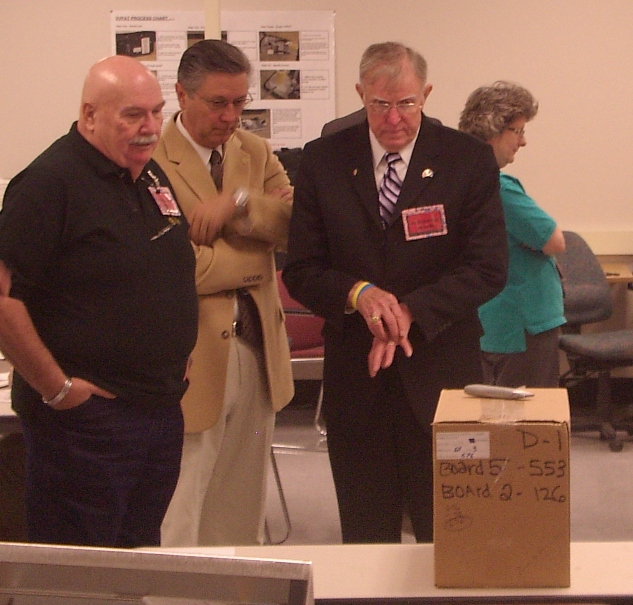
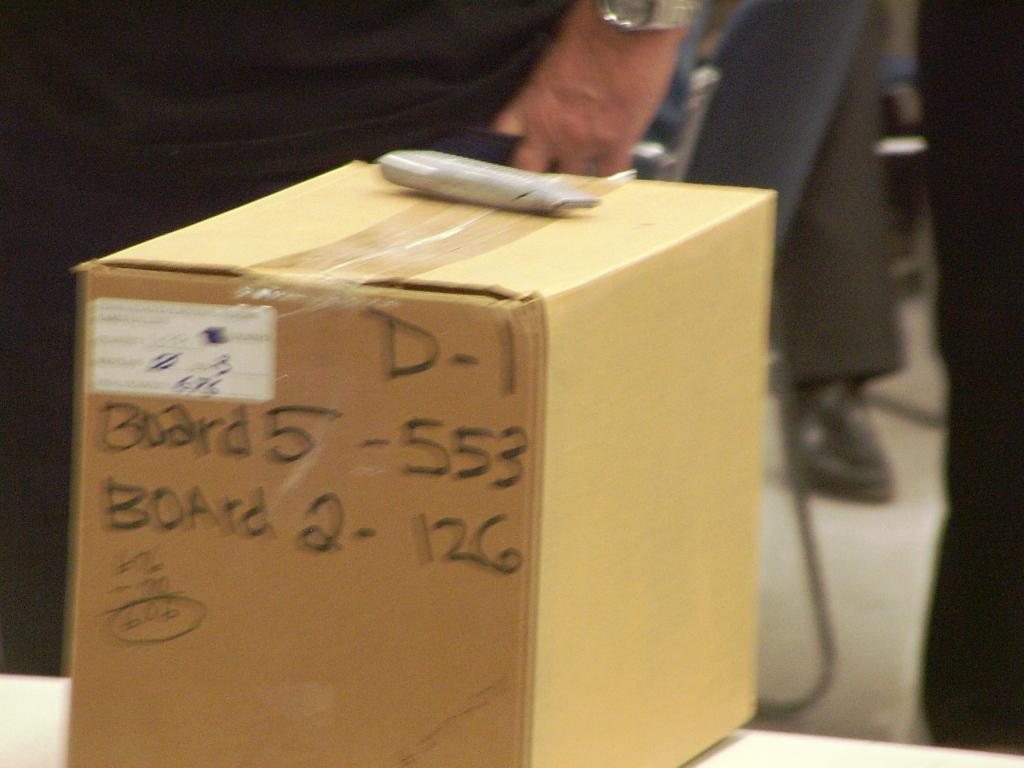
Republican Party recount observer Bob Hancock (left) and Democratic Party observer Ben Love (right) behold evidence of the AG's shoddy ballot custody (see closeup of improperly sealed ballot box below) while themselves being closely monitored by an unidentified officer (middle) from the attorney general's office -- one of five plainclothes AG officers armed with handguns tailing every election observer both inside and outside of the ballot counting room. Under Attorney General Goddard's procedures, official recount observers are prohibited from taking any notes (even pens and paper are banned) and in fact, are not even allowed to stand close enough to read the ballots, poll tapes, or any other evidence that they are supposedly there to witness and verify.
Yesterday (4.7.09) observers Hancock and Love were told by the attorney general's officer in charge of the recount, Special Agent Meg J. Hinchey of the Special Investigations Division, that the Pima ballots have been held in the Maricopa County Election Department since Attorney General Goddard secretly ordered them removed from Pima County in February. That announcement contradicts previous declarations by the AG's office and Maricopa Elections Department that the attorney general's office has been in possession of the ballots. Attorney General Goddard is the only one who really knows for sure where the Pima ballot evidence has been for the past two months, and he has yet to give any public accounting of the ballot chain of custody.
One of the greatest things the founders of our country did in setting up the functioning of our government was to establish the idea that the government acts as our servant. Each time we show up to observe our elections, we reinforce this principle. Emerging from the court case, Pima County Democratic Party v Board of Supervisors, was the unassailable fact (acknowledged by Attorney General Goddard) that we're voting on a "seriously flawed" voting system.
The Pima County Elections Department must account for the aberrant facts and anomalies [78] unique to the 2006 RTA election. It is disappointing, at this late date, that no one from the attorney general's office has ever interviewed Jim March, Dr. Tom Ryan, or Mickey Duniho about our findings regarding the facts and anomalies pertinent to the RTA election.
 It is our hope that the collective work of many concerned citizens exposing these problems will lead to their correction -- not by replacing the present fatally flawed Diebold system with another vendor's equally secretive computerized voting machines, but by making the electoral system fully transparent and accountable to the voters.
The soon-to-be-released documentary film, Fatally Flawed [77], tells the story and points to solutions. Soon it will be all about solutions. As we pursue the truth in this matter, let's stay mindful of where the scrutiny and suspicion ought to stay focused.
John Brakey
[79]
Co-founder of AUDIT-AZ (Americans United for Democracy, Integrity, and Transparency in Elections, Arizona)
Election Defense Alliance Co-Coordinator for Investigations [80]
Mobile: 520 339 2696
E-mail [81]
From J. T. Waldron, director of "Fatally Flawed", a documentary co-production of Election Defense Alliance and Sound and Fury Productions, Inc. :
"Copies of the rough cut for "Fatally Flawed" have been circulating all last week.
The film includes an ending with the statement:
"After the count, Attorney General Terry Goddard announced that his office found no evidence of tampering of the RTA election."
Cynically, perhaps pragmatically, we didn't anticipate having to change the ending. This was a precarious time, actually, because it was very doubtful that [Pima County administrator] Chuck Huckleberry would have to go down. I just couldn't see it.
But I could not predict that Goddard would stonewall so blatantly on the poll tapes and forensic analysis of ballots.
Why would he not look at poll tapes and forensic data to evaluate the value of these ballots as evidence?
We do know that:
1. Goddard had the opportunity to perform these tasks.
2. Goddard was informed of the necessity to perform these tasks.
3. The choice by Goddard was to avoid these tasks.
There's more to this missing ballot saga that we are interested in finding out about soon."
About This Film
"Fatally Flawed," is a true detective story about a transit bond ballot measure passed under suspicious circumstances in Pima County, AZ in 2006.
Tell-tale evidence of insider election rigging was uncovered by the team of EDA Investigator John Brakey and Jim March of Blackbox Voting. Working with a coalition of election integrity activists and political parties, Brakey and March have doggedly pursued a 3-year investigation, resulting in a series of court actions focused on the public's right to examine the ballot evidence.
Persistent unanswered questions in the case led to a criminal investigation by the Arizona attorney general, involving a recount conducted under conditions that made meaningful public observation impossible.
There is more to this story than meets the public eye. The denouement of Fatally Flawed is in the making as of this moment.
31 Facts and Anomalies Pertinent to the Pima County RTA Election
1. On the day of the RTA election (Tuesday, May 16, 2006) there was a very high and unusual number of failures of Diebold precinct-based optical scan voting machines. Pima County tried to cover up these machine failures. On election night, the Pima Election Department reported to the newsmedia that 35 precinct optical scanners had failed. A county memo two weeks later stated that 75 machines had failed. Now it appears from examination of the election database that 149 scanners failed.
2. A Microsoft Access manual was seen and photographed in the vote tabulation room on election night by former Representative Ted Downing. Use of MS Access on an election computer was and is illegal. Downing described a Microsoft Access manual being referenced by election department technician Bryan Crane in blatant violation of election law. Downing then called Donna Branch-Gilby, at that time the Chair of the Pima County Democratic Party, and asked her to bring a camera. Donna came with her husband, Bob Gilby, and took pictures of the Microsoft Access manual sitting open next to the central tabulator.
3. Because of the problems and unusual procedures Downing had observed during the election night count, he requested that Pima Election Director Brad Nelson make a backup of the election database, put it in an envelope, sign it, and take it to the sheriff's office to be held in secure custody. Nelson refused.
4. The audit logs show that the database was NOT backed up on election night. Election night backups had been performed in virtually every other Pima County election. The database was not backed up until three days later, on Friday May 19th at 5:00 pm, after all election results had been published.
 5. The Pima County Election Division purchased a 'crop scanner' computer-hacking tool ten months before the RTA election. This tool had no other purpose in the Election Division than to illegally alter the programming of precinct voting machines. The Cropscanner is a known hacking tool that can reprogram memory cards used in the precinct optical scanners. See video from the HBO movie, Hacking Democracy: http://video.google.com/videoplay?docid=8186883351933387074
[82]
6. After Downing and other observers left the county election center on election night (we know from the databases saved on the 19th) the re-uploading of memory cards was fast and furious after 10:19 pm and continuing until 3:15 am. Sixty-seven memory cards were reloaded for a second time. The next morning (May 17th) at 9:14 am one more card was reloaded a second time. Then on Friday, May 19th, eight more cards were reloaded. On Saturday, May 20th, 23 other memory cards were reloaded for the second time, overwriting the previous precinct results. Altogether, 93 out of the 368 precinct memory cards used in the election were reloaded to the voting system. In the 2004 general election --involving a much more complicated ballot -- there were fewer than three memory card reloads.
 7. What does this all adds up to? A very high failure rate of memory cards would be the only thing that could legitimately explain all these uploads. Failure rates this high should have caused the county to blame Diebold - but they didn't. Why? Because it appears to be a self-inflicted problem and they knew it! Something was going wrong.
8. Audit logs show that Crane had a consistent pattern of always backing up databases after any work was completed and before shutting down GEMS. In view of this procedural pattern, it is highly unusual that he didn't backup the database on the morning of May 17th.
9. Comparison of the database from May 19th and another database saved on Saturday May 20th reveals many discrepancies. Among these, we see precincts where replacement memory card data were fed in that either added to the vote totals or, in some cases, subtracted ballots. Ballot purging can't happen without a significant paper trail which is nowhere in evidence. What we can't see clearly is what happened to the database between May 16th at 4:00 pm and May 19th at 5:00 pm. The audit log only records when an operator enters the voting system through the GEMS front door. However, the backdoor is easily accessed using MS-Access.
10. Pima County Administrator Charles Huckleberry has known about the back door to the Diebold voting system since 1996. That's when Huckleberry authorized Bryan Crane to use that back door to merge two databases by hand using MS-Access, thus bypassing all of Diebold's minimal security. That operation was done to merge precinct punch card data with Global/Diebold optical scanning system votes processed in GEMS. This information is from the archives of the Arizona Daily Star. The operations Crane used to effect this database merger are not in the Diebold system manuals or in any certified voting system procedures.
11. Former and current long-time Pima election department employees have stated that just before the RTA database was built, Election Department Director Brad Nelson expelled all employees from the tabulation center except Bryan Crane, Mary Martinson, and Tomas Kalesinskas.
12. As insane as it sounds, it was a common practice for Bryan Crane to take the election databases home.
13. Election Division staff printed unauthorized vote total summary reports after the first day of early ballot scanning and after Crane began an unusual procedure that led to the destruction of the original Early ballots vote tallies database from 'day one'. Crane then illegally printed two copies, ten minutes apart, of the election 'SUMMARY report,' a detailed outline of who's winning and losing.
14. By law, these reports are NOT to be printed until one hour after the polls close on Election Day. If the voting system needs to be checked, the proper procedure is to run a 'Cards Cast Report'. To summarize, Crane ran what looked like normal actions on 5/10/06 and made a 'snapshot backup' of the file when counting was done for the day. On the morning of 5/11, he WROTE OVER the 5/10/06 database, destroying its integrity. He then printed two illegal copies of the 'who's winning and losing' summary report, ten minutes apart.
15. Diebold audit logs obtained by court order and examined by investigators Brakey and March show a pattern of printing illegal copies of election summary results going back as far as 2002. The illegal peeking and printing was usually done during the first third of the election counting period. Further counting was not done until printing became legal after close of polls at 8:00 pm on election night.
16. Court testimony established that this illegal early-vote counting had been going on as far back as 1998, even before the audit log had that feature enabled.
17. Bryan Crane told Pima County Judge Michael Miller that this was a normal practice and that every morning when running early ballots, he would prep a backup for that day. Yet examination of the Diebold GEMS audit logs showed this had been done only a few other times since 2000. In actuality, Bryan Crane did backups just before lunch and before he went home at night. Watch this 13 minute video clip that shows Crane lying to Judge Miller!
http://video.google.com/videoplay?docid=7304338799617243809 [83]
18. Again, before the second day of RTA early ballot scanning, Election Division staff erased the first day's database backup by overwriting it. This would have required responding to two warning messages, one from GEMS and one from Windows. Then two election summary reports of who's "winning and losing" were printed with 13,618 ballots counted.
19. This pattern of illegally taking home election database backups, then overwriting data and printing summary reports, is the model for hacking an election. First a false database is created or obtained. Next, the false data is used to replace existing data. Last, the winning and losing summary reports are printed to confirm that the hack was successful.
20. Election systems expert Michael Shamos of Carnegie Mellon advised the AG investigator of possible RTA fraud and recommended handcounting the ballots, echoing advice from local election activists.
21. The AG Investigator lied to Shamos in an e-mail, claiming that 'local naysayers' were onboard with not looking at ballots. The opposite was true, and the investigator knew it because he had engaged in a shouting argument with those local naysayers over the issue.
22. Examination of RTA election database evidence conducted by the i-Beta laboratory under contract to the attormey general's office should have included looking for possible swapping of yes and no votes, but did not.
23. County staff directed all aspects of the i-Beta testing. They directed the supposedly independent examiners to look at irrelevant items and to disregard potentially important ones.
24. A whistleblower has come forward stating in a sworn affidavit, that Bryan Crane told him privately that he had 'fixed' the RTA election under direction from his bosses.
25. Democratic Party observers were prevented from investigating cables connected to the tabulation computer after the RTA election, with the excuse that this alarming security violation didn't matter because it had been a nonpartisan election.
26. A record copy of the ballot layout files held by the Secretary of State for use by the Attorney General in any fraud investigation was never examined during the attorney general's RTA investigation, even though it was potentially key evidence that could have indicated fraud. Instead, the AG's office returned this crucial evidence to the prime i suspects running the Pima County Elections Department -- who then "lost" it.
27. Through their lawyers, the Pima County Board of Supervisors claimed there was a substantial risk that all election employees who had any role operating election computers would 'take the fifth' and refuse to answer questions, based on a fear of criminal prosecution.
28. The Pima County Board of Supervisors has never requested an internal investigation of the Pima County Elections Department.
29. Neither Brad Nelson nor Bryan Crane nor any Election Department employee has been reprimanded for any violations of rules or procedures.
30. Jim Barry retired from his job as the County Administrator's assistant in early 2005 and was immediately hired by Pima County to do a precinct-by-precinct study of how Pima voters had voted in the preceding four bond elections, with "other duties" as assigned. Mr. Barry was paid $75,000 by the county for this contract, while at the same time collecting $12,000 from a pro-RTA group for helping them with the RTA campaign. See video: http://video.google.com/videoplay?docid=1282511168148207359 [84]
31. The RTA passed by a surprisingly large margin (approximately 60/40). Sales tax increases for roads had lost badly in four previous elections, by an approximately inverse ratio. On the fifth attempt, the RTA measure's previous unfavorable ratings among voters were reversed by about 40 points.
======================================
The above evidence researched and submitted by:
John Brakey [85]
Co-founder of AUDIT-AZ (Americans United for Democracy, Integrity, and Transparency in Elections, Arizona)
Election Defense Alliance Co-Coordinator for Investigations [86]
Mission of EDA and AUDIT-AZ:
To restore public ownership and oversight of elections, work to ensure the fundamental right of every American citizen to vote, and to have each vote counted as intended in a secure, transparent, impartial, and independently audited election process.
.
Thomas Jefferson's Powerful Words:
Source: http://www.fatallyflawedthemovie.com/pages/story.html [87]
Summary:
The following is an introduction to a series of election fraud investigations and ensuing court cases in Pima County, AZ, spearheaded by investigators John Brakey of EDA, Jim March of BlackBoxVoting.org, attorney Bill Risner, and a host of election activists including AUDIT-AZ and the Arizona Democratic and Libertarian parties. The events are being recorded on video in the development of an EDA-sponsored feature documentary film, "Fatally Flawed [88]."
John Brakey became an elections investigator shortly after an eye-opening experience as an elections observer in 2004. In his home county in Arizona, pollworkers were "stacking the vote" by using a phony provisional list. When Brakey questioned the pollworkers about their procedure, the pollworkers suggested they "take a look in the back room." In this largely Hispanic district a few die-hard Republicans (re-registered as Democrats) apparently had in mind their own brand of democracy and were ready to "beat it into John Brakey."
Brakey later teamed up with Dr. David Griscom, (Adjunct Professor of Materials Science & Engineering, University of Arizona) to thoroughly analyze the inconsistencies within the 2004 elections in Pima County, Arizona. Lessons from 2004 prompted a greater awareness when it was needed most, in 2006.
After encountering considerable resistance to public scrutiny from the Elections Division of Pima County, Arizona, the Democratic Party had to sue the election asministrators of that county to examine critical public election data. The court ruled in favor of the Democratic Party and instructed the Pima County Elections Division to hand over the database files. These database files include computer databases from elections in between the years of 1996 and 2006.
A detailed analysis of the data files obtained in the 2007 public records suit provides substantial evidence of elections tampering by the Pima County Elections Department in the May 2006 election. That election included the RTA (Regional Transit Authority) Question 1 and 2 involving $ 2 billion dollars of taxpayer funding.
Sufficient, convictable evidence of foul play exists despite attempts by the Pima Elections Division to hide, alter, and suppress this evidence. The Pima Elections Division electronically manipulated existing database files, lost evidence containing an 'untainted' version of the database files, and illegally obtained possession of the database files during the legal process.
Suppression of evidence first occurred on the election evening of May 16th, when Ted Downing was serving as an election observer. Ted Downing contacted Donna Branch Gilby, the Democratic Party Chair, and she arrived with her husband, Bob Gilby. Through the glass of the tabulation center, they took a photograph of an instruction manual for Microsoft Access software.
The Access software can be used to manipulate election database files outside of the official GEMS tabulation software. At this time (between the hours of 8:00 PM and 9:00 PM), Downing and Gilby requested that a 'snapshot back-up' be taken of the data. Elections Director Brad Nelson refused. The time required to perform a 'snapshot back-up' is approximately two minutes. The last 'snapshot backup' was performed approximately 4 hours earlier, when the department finished scanning the mail-in ballots. Analysis of the electronic database shows a significant departure from the routine in how the elections data was handled in the previous five years.
This departure from the routine started on the same evening that Donna Branch Gilby and Ted Downing made known their suspicions about the integrity of the elections data. A huge number of precinct votes were processed on election night (after the election observers left the premises) and into the following morning. Contrary to routine practice and basic data security, no final daily backup was made after the votes were processed. In fact, no backup was ever made for the following three days. The number of precincts processed within this time period was as few as 118 and as many as 149 (out of 368). Additional mail-in and provisional votes trickled in throughout the week.
The most fundamental safeguard against compromising elections data is to create a back-up file on a routine basis or after a significant amount of processing takes place. Under normal circumstances, back-up data of the mid 2006 election would exist in these database files between the dates of May 16 and May 19th. This lack of any back-ups at the end of election night processing and in any of the three days that followed is caused by one of two reasons. The first reason is that Brian Crane, a Pima Elections IT staff worker, broke from a routine of at least 5 years and somehow forgot his habit of making back-ups of the data. Second, the backups were being created without an audit log trace and moved onto another drive. Analysis of the database logs confirms that Brian Crane had the means to make a database copy with no audit log trace.
An untraceable copy of the database was created by Crane on the 20th of May. That database copy remains on a hard drive entered as court evidence. If these database backups made outside the audit log trace were created between the 16th and the 19th of May, they would have to be removed from the drive at some point before the drive was acquired through a subpoena. The first public records request occurred much later in the year (September 14th), so the Pima County Elections Division was afforded sufficient time for any data manipulation.
The Arizona Secretary of State's office, however, had a copy of the RTA database that could not have been altered. By November of 2006, the Pima County Democratic Party had organized a whole crew to scrutinize the Pima County Elections. Around the same time, the Pima elections office requested that the Arizona Secretary of State return all of the elections data they held as back-up through the years.
All the back-up tapes from years of elections were shipped back to Pima County in a box. According to Pima County, the one tape in the box containing the unadulterated RTA database file was missing and never found. Pima County does have in possession, however, computer database files from elections within the years of 1996 and 2006. They may not be as pristine as the 'Secretary of State' tape that was lost, but enough information exists as proof of tampering.
Before it was analyzed by outside parties, this 'snapshot' of data was transferred to two identical drives and placed into a single box. This box was transported with security to the Pima County vault under a court order. The Democratic Party is grateful to have this data, because it risked a similar form of disappearance. Pima County employee John Moffat had removed the box of drives from the vault in violation of a court order. Fortunately, the Democratic Party's legal team quickly made this discovery and obtained the data without additional tampering.
The Pima County Elections Division has operated for years without any kind of public scrutiny or oversight. New demands for transparency appear to have prompted drastic measures involving the control and removal of evidence. In the days prior to this demand for transparency, tampering of the database files appeared to be absent any concern for outside searches into the databases. Arizona Attorney General Terry Goddard hired an outside organization called iBeta to analyze the RTA database log entries.
As the iBeta report put it: "The basis of the investigation is that there are log entries that point to tampering - but it is far easier to remove evidence of tampering from the logs than to actually tamper with the vote totals in the Microsoft Access database that the GEMS software uses. So it does not follow that someone with the knowledge to manipulate the GEMS data would neglect to alter the log file to remove the evidence of the manipulation."
The iBeta report is referring to a form of computer manipulation that requires the confirmation of two warning prompts. The changes appear to be deliberate and the unaltered log entries seem to be an oversight. Database logs also indicate the printing of summary reports that show the outcome of the elections before the elections were concluded. This activity is illegal and clearly intentional as each printing occurred ten minutes apart.
Here are the circumstances of this first round of data tampering:
1. On the morning of May 9th, 2006, the elections department performed an official logic and accuracy test.
2. On the morning of May 10th, 13,618 mail-in ballots were scanned in approximately four hours. Once the task was completed, Brian Crane made a backup copy labeled 'early day 1' at 12:27 PM. This 'backup snapshot' is now an additional file with the label 'early day 1' to denote the first day of scanning early (mail-in) votes. The disk now contains the main data file used continuously through the tabulation process and a 'backup snapshot'. No additional snapshots are recorded on this day.
3. On the morning of May 11th, Crane logs in 9:55 AM and, 31 seconds later and overwrites the previous day's 'backup snapshot'. Here is where he has to confirm with two warnings about the file overwrite. Not only is this act deliberate, but it is likely performed to change the results of the early vote totals tabulated in the previous day. Illegal summary reports were printed. They showed the current outcome of the election. These were time-stamped at 9:56 AM and 10:06 AM respectively, so they were deliberate actions occurring 10 minutes apart.
These events are significant because they show that:
1. Enough data was collected with the mail-in ballots to make a predictionif the election results.
2. There was sufficient time to manipulate the main database and change potential election results before the file overwrite. The 13,618 ballots were counted on that day by 12:27 PM. The overwrite didn't occur until the next morning.
3. An opportunity exists to verify that the changes to the database file were successfully implemented. A second printout was likely needed for someone other than Brian Crane.
A considerable amount of work was required to uncover the second round of data tampering. This is revealed in the recount of Oro Valley town council race, which also contained the ballot initiatives for RTA Questions 1 and 2. The Oro Valley race was subject to a recount as required by law because the margin of victory was 1/10th of 1% or less.
Ballot adjustments by the elections division is highlighted by the unusual amount of flash memory cards that somehow malfunctioned when transferring data. Pima County has 368 precincts and each precinct's election results are recorded on a flash memory card. After all the ballots are recorded on each card, the data is transmitted via phone modem to Pima County Elections' central tabulator.
In each precinct, as the memory cards are inserted into the computer, the computer reads the identifying signature on the memory cards before a successful transmission of data takes place. Once the transfer is completed, the cards are returned to the Pima County Elections division.
There are two indications in the database files that a significant number of cards malfunctioned when transferring data. The first was a very large number of precincts that were processed late on election night. The number of precincts processed within this time period (marked by the lack of any backup data) was as few as 118 and as many as 149 (out of 368). Precinct data delayed for this length of time is typically the result of modem transmission failures that require the physical transfer of the memory card to the central tabulator for upload.
The logs for the 2004 general election featured a far more complex ballot and a similar number of precincts (2004 had 358, 2006 RTA 368). This 2004 election experienced about 19 modem transmission failures or late uploads. The RTA modem or line failure rate appears to be unusually high.
The second indication was the very large number of cards that had to be uploaded to the computer more than once. During the RTA election cycle, 93 precincts worth of memory cards were uploaded at least twice -- in other words, something was 'wrong' with the first upload and it had to be repeated. One precinct (number 324) was reloaded as many as six times.
In stark contrast, the 2004 general election only had five memory card re-uploads. No complaint was made by the Pima County Elections Division to Diebold about these extraordinarily high failure rates of their cards. So if Diebold is not to blame for the massive data card failure, who is responsible?
In August of 2005, the Pima County elections office bought a 'crop scanner,' a device that provides the means for the Pima County Elections Division to alter memory cards. This device was able to connect the Diebold-supplied memory card to a standard PC and give that computer read/write access to the card. The data on the card created by and managed by Diebold software had no encryption and could be easily edited. This handheld crop-scanner device existed in the Pima elections office with no tracking or access controls from August 2005 through early 2007 when the Pima Democratic Party and their supporters uncovered it in a public records search.
Manipulation of data on individual precinct memory cards is a precarious proposition, especially with a large county like Pima. Of the 368 precincts, how many flash data cards would have to be manipulated to avoid detection? Which precincts should be manipulated to avoid detection? Answers to these questions are not cheap.
Prior to the May 2006 election, Pima County paid $75,000 to consultant (and former Pima County employee) James Barry. Barry was hired to study the four prior transportation bond measures (none had passed) and figure out on a precinct detail basis the necessary numbers to win an election initiative. The RTA campaign itself was appreciative of Barry's efforts and pitched in an additional $13,000 for his advice.
There is an additional hurdle when it comes to altering Diebold flash data cards. The movie "Hacking Democracy" contained a fine demonstration by computer security professional Harri Hursti, but manipulating data cards requires a certain level of expertise. Editing these flash data cards using a crop scanner without affecting the signature data and/or the successful transmission of data is a difficult task. The sheer number of data card failures in Pima County's May 2006 election suggests this kind of tampering was attempted, but not successfully.
The manipulated data required a lot more time and patience to finally load into Pima County's central tabulator on election evening and in the days of the Oro Valley recount. Detailed analysis of the Oro Valley recount turns indirect evidence of data card anomalies into direct evidence of election fraud. Additional back-ups of the database files resumed their appearances on May 19th and May 20th during the mandatory recount of the Oro Valley precincts.
In addition to the countywide ballot initiatives, Oro Valley had a city council race that required a recount. The Pima County Elections Division performed an illegal 'pre-recount analysis' before the official recount with no outside oversight, and subsequently manipulated the results to make the second result closely match the first result.
Out of 368 precinct memory cards, 93 were reloaded at least once. This includes all 22 precincts that make up Oro Valley. Of the 93 reloaded precinct memory cards, the bulk of the precincts in which the number of ballots changed were connected with Oro Valley. These data contain direct evidence of elections tampering because, in Oro Valley, some precinct totals are decreasing over time. The data were being manipulated to conform to a desired outcome.
On May 31st, 2006, the official recount of Oro Valley takes place and the results are within the margin of error. Dropping votes without the required disclosure or paperwork is a felony and this activity would never have been uncovered without the acquisition of the Pima County Elections databases.
From the night of the RTA election, the Pima County Elections Division found itself under intense public scrutiny. Some Pima County employees had a margin of success in suppressing, manipulating, and removing evidence. Fortunately for the citizens of Pima County, efforts by Pima County employees to conceal criminal activity have ultimately failed.
For a video highlight of this day's events, see interview filmed by J.T. Waldron, here:
http://www.fatallyflawedthemovie.com/pages/risnerbud.html [89]
==================
Click the Read More link for full story.
By David Griscom
Evidence abounds that in all likelihood the 2006 RTA ballot initiative (committing Pima County, Arizona, voters to pay via sales taxes $2 billion for improvements in local streets) was rigged [see here and references therein [90] and/or my earlier OEN report [91]].
In 2007, Arizona Attorney General Terry Goddard finally responded to pressure from Tucson election-integrity activists by initiating an investigation ... to be jointly carried out between his office and the Pima County Election Department (listed in the complaint as the suspects!). Not surprisingly, the alleged perps ignored the devastating evidence of rigging offered them by activists John Brakey, Jim March, and Bill Risner and with the tacit support of the attorney general's office, rigged the investigation of themselves to produce (surprise!) no incriminating results [see my condensed history] [92].
But the Pima County Democratic Party represented by attorney Bill Risner continued to press the issue in the courts, adding more and more evidence that the RTA initiative passed only due to vote flipping carried out by the Pima County election-computer operator Brian Crane, and they demanded that the actual paper ballots be recounted to prove or disprove this conclusion.
It eventually became apparent that the only official in Arizona with the authority (and obligation) to order such a recount is AG Terry Goddard (a Democrat) ...who repeatedly insisted that there is insufficient evidence to justify such a recount and/or that voter "curiosity" is insufficient reason to let the voter know whether or not his/her vote had been stolen. Last week, the Pima Republican Party aligned itself behind the Democratic Party's lawsuit, which had already been joined by the Libertarian Party. And this Monday morning representatives of all three parties were in the courtroom of Pima County Superior Court Judge Charles Harrington to jointly press their demand that the RTA ballots be recounted.
What actually happened in that courtroom Monday morning was beyond bizarre. The judge pointed to some obscure point of law, which he argued excused him from hearing further arguments and thus concluded that the suit should be heard by the Appellate Court (see my last paragraph for a glimpse of what was actually going on beneath the surface!). In the ensuing brief discussion it came out that AG Goddard had just issued a secret order to take custody of the RTA ballots. Apparently, the secrecy was intended to keep only the plaintiffs in the dark, since the judge whimsically wondered out loud if this secret order was the same one he heard in the local news.
It seems that Goddard's plan is now to remove the ballots from a vault where they were totally secure and to transfer them to Maricopa County (where citizen poll watchers during the 2008 general election witnessed election officials routinely flouting election laws, especially regarding ballot chain of custody – and where the election department owns a ballot printer capable of spewing out brand new ballots matching any template used in the past). While Goddard has pledged that "...strict security measures will be taken to secure the ballots and the investigative process," he has yet to invite authorized representatives of the three major parties to witness the transportation and storage of these ballots. AND their protracted storage in Maricopa County is a clear and present invitation for someone there to tamper with them.
So Monday morning's court hearing before a full house of concerned citizens ended practically before it started. From the plaintiff's view point, the only good thing to transpire was the presence of the Tucson Channel 13 (KOLD) news team headed by veteran newscaster Bud Foster, who spent the better part of an hour interviewing Bill Risner outside the courthouse, before demanding that a Republican put on the microphone to assure balance in his newscast. Republican 2006 CD 8 congressional candidate Randy Graf promptly stepped forward and essentially seconded all of Risner's concerns about the integrity of Pima County elections.
Now here is a bit of the story behind the story that led to the bizarre null outcome of Monday mornings's hearing: It seems that Judge Harrington had previously thrown roadblocks in front of the objectives sought by the Democratic Party's lawsuit and had shown himself to be inclined toward never deciding the case. However, the Democratic Party also has an additional pending lawsuit requesting the poll tapes of the RTA election (an additional form of evidence as to whether or not the ballots we counted correctly), which is assigned to Judge Javier Chon-Lopez of the same Superior Court as Judge Charles Harrington. Having a different judge for this case was good for the Democrats (and their like-thinking Libertarian and Republican allies) since, according to Bill Risner, Harrington had unequivocally refused to consider "the constitutional provisions and case law submitted to him." Hence, it was absolutely clear that Harrington would never allow those pleadings to be filed.
Meanwhile, the dark forces working behind the scenes (read the AG's office) were maneuvering to have Harrington also hear the case presently assigned to Judge Chon-Lopez; in fact, they had filed a Motion to Consolidate the two cases before Harrington. It is for this reason alone that Bill Risner filed a notice of appeal before the hearing on Monday, i.e., in order to deprive Harrington of the opportunity to commit further mischief to the Democrats' case. The notice of appeal pertained to only a part of the Democratic Party's case, and so on Monday morning Bill explained to the judge that he could still go ahead and hear the other parts. Harrington, however, seeing the large crowd room, decided to use the Risner's appeal as a tendentious excuse to pass on a hot potato; thus, he claimed that he did not have jurisdiction to do anything and therefore was "compelled" to terminate the hearing.
******
David Grisccom is EDA Co-coordinator for Investigations, and a co-founder with John Brakey of AUDITAZ, a regional EDA election integrity affiliate organization.
Author's Bio: Ph.D. in Physics, Brown University, 1966. Fellow, American Physical Society. Fellow, American Association for the Advancement of Science. Fellow, American Ceramic Society. Research Physicist at Naval Research Laboratory (NRL), Washington, DC, 1967-2001. Fulbright-García Robles Fellow at Universidad Nacional Autónoma de México, 1997. Invited Professor of Research at Universités de Paris-6 & 7, Lyon-1, et St-Etienne (France) and Tokyo Institute of Technology, 2000-2004. Adjunct Professor of Materials Science and Engineering, University of Arizona, 2004-2005. Principal, impactGlass research international, 2005-present. David Griscom's personal website: http://www.impactglassresearchinternational.com/ [93]
Attorney General's "criminal investigation" procedures break ballot custody and make meaningful public observation impossible
RTA Recount Situation Report: 3:00 p.m. Monday April 6th
(aka: “The Official Chronicles Of The Bored To Tears, Part One”)
by Jim March
A total hand-recount of what are alleged to be the ballots voted in the 2006 Pima County Regional Transportation Authority (RTA) bond measure election is being conducted as I write.
Eight teams of three people each (all Maricopa Elections Division employees) are doing the “sort and stack” method to pile ballots in three piles for each ballot question. It's impossible to overstate how tightly the information flow is controlled here, or how “nontransparent” the process is.
The “short form” is that the preliminary counts are matching the official final totals from 2006, in broad strokes.
“Ballot forensics” is going to be a factor here, and the chain of custody of these ballots (read: could they be fake?) is open to serious question.
 Background
For those just joining us: This bond measure of May 2006 involved $2 billion worth of transportation contracts, which in turn affected “housing boom” issues. We now know there was a ton of fraud in the late lamented real estate boom; the question now is, was there also fraud in setting the preconditions for that boom, such as the RTA bond measure?
Long-distance photo taken through a window with optical zoom, by Jim March
AZ Attorney General Terry Goddard finally took a serious role by declaring the hand-count. But the way he handled it violated every standard possible in election transparency, and continues to do so.
Goddard will tell you that he doesn't need to be transparent at all because this isn't an election-related recount. He's partially right: this recount is connected to a criminal investigation aimed at the people who run elections in Pima County.
But the problem is, in order to treat these ballots the same way he would if, say, he raided the documents inside a crooked bank, he has to take sole control over the very engine of Democracy. He's set himself up to be the sole judge of what the people's will was in a real election. No one person can ever be allowed to take that control with zero oversight or observation. It leads to horrible dark places.
1. Over a month ago Goddard seized control over the ballots, taking them to points unknown and storing them in unknown conditions with zero oversight from any other government body, political parties or citizen observers. We still don't know where they “vacationed”.
2. They're now being counted by the Maricopa elections office in conditions designed to prevent observation –- most particularly preventing any independent counts of the vote totals.
These conditions include:
a. The AG's office told political parties to provide the names of three observers able to spent a week in Phoenix (120+ miles from Pima County) – and then the AG's office would pick the final participant. In the case of the Democrats, they picked a retiree in his '70s over a younger lawyer with elections law experience. Fortunately the retiree is a very competent gent, but he's not a lawyer. The Libertarians submitted just one name (mine) and the AG's office rejected me on “security” grounds citing the wrongful arrest I was subjected to in San Diego County CA in 2005 –- never mind that all charges were rapidly dropped, and that statewide changes to election observation procedures were instituted in direct response to my action. So Goddard's game is: Keep out as many knowledgeable observers as possible.
b. The observers in the room aren't allowed any pens or pencils or any electronic note-taking gear. Mind you, this is a 100% hand count – electronic manipulation of people's brains is pretty unlikely.
c. Every kind of mobile communications device is barred from the main counting area. I was stripped of my cellular modem. They don't want rapid Internet news broadcasts of this event. (But they can't stop me from collecting news, leaving the area, and broadcasting from the parking lot).
d. Tables are aligned sideways to the viewing windows to make it hard to collect tallies with our various zoom lenses and spotting scopes.
I have with me a good lab-grade microscope. I've previously proven that 2006-era paper ballots (printed on offset printers) can be distinguished from more recent 1200 dpi laser printed ballots under a microscope. The bureaucrat running this thing, Donald Conrad (criminal division counsel with the AZ AG's office) told me he would not discuss forensics of ballots at all, or allow the microscope to be used in any fashion by anyone.
Ballot forensics are going to matter because there a number of ways forged fake ballots could have been inserted into the stack post-election. The good news is that we have e-mail traffic between Pima Elections and the ballot printing shop ordering the extra ballots from the RTA election destroyed just over a month post-election -– long before significant controversy erupted. So it seems unlikely that either Pima Elections or Runbeck stashed away the 24,000-plus blank ballots that would be needed to swing the election.
A more likely approach to fake ballot generation is the high-end Okidata laser printer first demonstrated for “ballot on demand” purposes in 2007. This taught both Pima and Maricopa elections offices that they could build their own illicit ballot printing station for a bit over $6k, small enough to fit in a closet. Or just rent the regular “ballot on demand” system and subvert it to print extra ballots. Even the best laser printers scatter microscopic toner particles around their target printing areas. The effect is obvious under a good scope.
Will Goddard's office do any real forensics, along with other obvious checks such as measuring the age of the inks? There's no way to know – Goddard has taken sole control over the investigation. He will thus personally decide how well democracy worked.
And that's a problem.
==========
Jim March has worked the Pima RTA case for three years with EDA Investigator John Brakey. Jim is on the board of directors of BlackBoxVoting.org, is a member of the Arizona Libertarian Party election integrity committee, and...sigh...more. You get the idea : ). Email Jim at this address [95]
===========
Notes:
1. Diebold's election databases look secure, but once you open them in MS-Access all security vanishes. This is a known issue and MS-Access is NOT a certified election system product anywhere in the US. In short, this was BAD.
2. Easy enough: Although the computer Runbeck supplies controls access to ballots, it can be disconnected and the printer run independently from any PC with the ballot image PDF files on it.
The following letter, sent by attorney William J. Risner to Arizona Attorney General Terry Goddard, sets forth the facts in the suspect 2006 Pima County special transit bond election and the ensuing 3-year history of investigation and coverup.
EDA investigators John Brakey and Jim March discovered evidence of election tampering while examining audit log records for that election. Their discovery led to further investigation, a court case resulting in the largest release of electronic election data in U.S. history. Risner has represented plaintiffs in the Pima RTA election case, including the Democratic Party of Pima County, who continue to press for a full and public resolution of the 2006 RTA election controversies.
===========
February 18, 2009
Dear Mr. Goddard:
An article in the Arizona Daily Star last week (February 13) reported that your office expected to complete its investigation of the May 16, 2006 RTA election in Pima County within the month. [1]
The presumed goal of your investigation was to learn if the RTA election was criminally “rigged” or “fixed” by Bryan Crane on the instructions of his Pima County “bosses” so as to defraud the public of an honest election. We assume that an alleged crime of that importance would have resulted in an intense inquiry focused on whether or not the crime occurred. As you are aware, the Pima County Democratic Party has been engaged in a similar inquiry. Our goal is different than your goal. Your job is to learn whether a crime occurred and, if so, to prosecute the offenders. Our party's responsibility is to ensure that ballots are properly handled and counted.[2]
In other words, we are assigned the task by state law to watch and monitor the actual voting and counting. You have repeatedly said that such election monitoring is not part of the responsibilities of your office. The Secretary of State has said that it has no jurisdiction to examine computer databases to see if any of the various county boards of supervisors or their election personnel are cheating. You both agree that the responsibility for such monitoring is with political parties. We do not entirely agree with your and the secretary of state's legal analysis, but we do accept it as well as accept our responsibility.
On October 2, 2008 I wrote a letter to John Evans at your Tucson office concerning the open criminal investigation you had assigned to them.[3] That letter offered to share the expert skills of persons assisting the Pima County Democratic Party's efforts to ensure that our elections will be honestly conducted. We have several knowledgeable persons who have been looking at the RTA election and could have assisted your office. We never received a response to our offer. It could be that our knowledge and expertise was not needed or desired by your office.
Frankly, we may have helpful information and we would like to share some of it in this letter. Our information mostly relates to facts. Candidly, however, your public remarks suggest that you not see your office's role or authority as we do. The Pima County Democratic Party has not requested a “recount” of the RTA election as that term is used in the statutes. We have suggested that the simple solution to determining whether an election has been criminally rigged is to examine the ballots themselves. That was our suggestion last year and the suggestion of the first national expert contacted by your office. Such an examination of the ballots is not as complicated as you might think. I would like to share some of my experience in a similar effort.
In 1997 an election was held by the City of Tucson for one-half of their council seats. Two citizens, John Kromko and Leo Pilachowski, noted results in some precincts that seemed impossible, in their view. As I recall, some precincts had unusually high under-votes, with perhaps as much as a 40% undervotes. They knew the computer-counted results were highly likely not to be correct, but they didn't know why.
We immediately filed a lawsuit requesting that the court take control of the ballots and the computer software. Upon learning of our intention to file a lawsuit, the City filed its own lawsuit requesting the court's assistance. At our initial court appearance, my clients and the City agreed that we would hand count one precinct that we selected and see what we could learn about the accuracy of the reported vote. The subsequent hand-count of that precinct resulted in a second order to hand count the entire city election. The full hand-count showed that there had not been any criminal manipulation or computer election-rigging. The problem concerned defective paper. The hand-count recorded some 9,000 votes that had not originally been counted. No election was reversed because the paper problem was random and not the result of criminal manipulation. All parties were satisfied that the integrity of that election had been confirmed by the hand-count.
That experience confirms that a ballot examination need not be a complicated matter and that it can benefit the public by providing assurance that ballots are accurately counted. Your press statement used the word “curious” in describing requests that your office subpoena and examine RTA ballots to see if the election had been rigged. We view such an examination as the most basic investigative tool available to your office. Curiosity is a good trait in any real investigation, but the goal remains as one to determine whether a crime occurred. The use of an investigative subpoena to acquire and examine documents for evidence of a crime is normal in any white collar crime investigation in your office. You need neither court approval nor probable cause for such a subpoena. Those are routine matters in your office, as you well know.
Since your office has chosen not to use a simple and routine tool to answer the question of whether the RTA was fixed, we may be able to assist your investigation by sharing the results of our investigation. The Democratic Party cannot issue a grand jury subpoena for the ballots like the Attorney General can. We must investigate the hard way by accumulating circumstantial evidence. We can report that, so far, all the circumstantial evidence is consistent with the election having been rigged. We would like to share with you our approach, our results, and where we are headed next.
For us, the question to be answered is whether the RTA was rigged. You alone can answer that question. The Democratic Party can show that it was probably rigged, but we cannot, at this point, be sure. The Democratic Party has alleged in court that there is substantial and credible evidence that it was rigged. We do not know if that is so and only a ballot count can definitively answer that question. Your investigation was prompted by the sworn declaration of Mr. Zbignew Osmolski that he had been told by Pima County's election computer operator, Bryan Crane, that he had “fixed” the election at the instruction of his Pima County bosses. His declaration constitutes direct evidence that a crime occurred. [4]
The Democratic Party has ended up examining the RTA election by an indirect route. In December of 2006 the Pima County Democratic Party requested a copy of the county's election electronic database, since it is a public record. We wanted a copy primarily as an exercise of our election-monitoring responsibilities. To our great surprise, Pima County required us to sue. A unanimous formal resolution of all the elected Democratic Party precinct committee members at the bi-annual organizing meeting was not sufficient to avoid a lawsuit.
Approximately one million dollars and more than one year later, Judge Michael Miller of the Pima County Superior Court ordered the County to provide us with a copy of the database. The singular most shocking aspect of that litigation was that Pima County's election division did not offer a factual defense. The election division relied on the testimony of John Moffatt, who claimed that his “number one fear” was that the Pima County Democratic Party might issue fake written reports after an election that would differ from the County's data and ballots, differ from the Republican Party's copy of the same data, and differ from the Libertarian Party and Green Party's data.[8]
The issuance of a faked report by the largest and oldest political party in Pima County is inconceivable. It would promptly be exposed as a fraud and the reputation of all persons who participated, as well as the party's reputation, would be ruined. Political parties simply do no operate that way. Persons who volunteer their unpaid time through political parties to improve our society don't operate that way. Judge Miller noted that such a false report would be a felony under Arizona law. In short, the defense was delusional or, more correctly, it confirmed that they did not have a factual defense.
Our only rational conclusion was that they had something to hide and we concluded that the “something” was the RTA election that had been zealously pushed by the county administration after having been overwhelmingly rejected by voters on four prior occasions. The evidence suggests to us that the County election department may have cheated, utilizing at least two techniques. One of those techniques is known as a “flip.” The computer could have been instructed to count “no” votes as “yes” votes.
Your office earlier hired the iBeta corporation to examine the database itself for evidence of a flip. In conducting that investigation, you permitted the suspects themselves to suggest the tests that should be utilized. The iBeta report shows that John Moffatt suggested most of the tests and that his explanations were accepted without question.[9] My letter to you of July 14, 2008 pointed out many failures of the iBeta examination that your office permitted the suspects to control.
A “flip” can be discovered by examining the ballot layout and imbedded counting instructions contained in an electronic copy that is sent by all Arizona jurisdictions to the Arizona Secretary of State's office. As part of our discovery process, we learned that the Secretary of State's office has never looked at such data that is sent to them.[5] We were not surprised to learn that they did not examine the submitted data, since copies are sent to them to use in fraud investigations and there had not been any. What did surprise us was that the Secretary of State had never returned such tapes to Pima County. They had simply remained on the shelf along with similar submissions from other counties.[6]
The first time that such tapes were returned was after the RTA election in November of 2006, and after the Democratic Party began asking the County for public records relating to elections. You might want to inquire of the Secretary of State's office what prompted them to return the RTA tape to Pima County. The first and only time the Secretary of State returned the computer data to Pima County required a box, as multiple election tapes from several years were returned, including the critical RTA tape.[10]
The box containing the RTA tape was personally handed by Pima County Election Division's boss, Brad Nelson, to its election division computer operator, Bryan Crane. All the other tapes were still in the opened box when the Democratic Party examined its contents, but the RTA tape disappeared after being placed in Mr. Crane's custody. Mr. Nelson is one of the “bosses” that may have told Bryan Crane to fix the election. The disappearance of that tape has foreclosed a definitive computer data comparison that could have revealed whether the election manipulation utilized a “flip.”
There are other ways in which a flip could be accomplished in GEMS, however, that do not involve the ballot definition tables. Votes can be flipped in the vote summary tables and discovering a flip there without examining ballots is close to impossible. A flip is a crude tool. It is simple to accomplish with GEMS, however. All a computer operator needs to do is to take a copy of the election database home and, utilizing his home computer, he can instruct the computer to read all “no” votes as “yes” votes. When that one change is reintroduced into the computer, GEMS will automatically flip all precinct counts and thereafter all “no” votes will be counted as “yes” votes. The machine will always behave as instructed. (How to flip documents) [11]
Such a crude tool is problematic in a bond election, because historical patterns will show that some precincts in Pima County always vote in favor of bonds, and some precincts regularly vote against bonds. Simply reversing the outcome of the election could be exposed by noting that the always-approving precincts rejected the bonds and the never-approving precincts passed them. Therefore, if a bond election is to be rigged, a more sophisticated approach would have to be utilized.
In our lawsuit discovery, we learned that Pima County administrator Chuck Huckelberry arranged for his special assistant, James Barry, to be awarded a $35,000.00 contract to create a database analysis of all recent Pima County bond elections by precinct. [12] That special contract started the day after Mr. Barry retired and was to be carried out as orally instructed by Mr. Huckelberry. The contract was extended and Mr. Barry ultimately was paid $75,000.00. During his pre-trial deposition, Mr. Barry said that he still had that data on his personal computer, but agreed that it was public information. We have since mailed two separate public records requests to both Pima County and Mr. Barry, neither of which have provided the requested public record data. Perhaps your office has had better luck obtaining that information during your investigation.
Detailed precinct information would be useful in programming the Diebold “memory cards” that record all the precinct-cast votes. Each precinct in Pima County counts ballots with a Diebold Corporation optical scan device. The cast ballots have their votes recorded on a memory card. At the close of the election, the optical scan device is turned off and the vote results are printed out for each precinct. The printed results are termed poll tapes,” as they contain the poll results and look somewhat like an adding machine tape.
The “poll tape” is then personally signed by three poll workers and the results of that precinct are publicly available. The electronic data in the memory card is downloaded into GEMS for the purpose of the eventual canvass. The poll tape is used to compare with the canvass as a check on accuracy. Unfortunately, the Diebold memory cards can be rigged to produce false results and those false results are then printed on the poll tape and downloaded into GEMS.
As you can see, the ability to falsely program a memory card is a very big problem and one that cannot be detected by simply comparing the poll tape numbers with the canvass numbers. The HBO documentary “Hacking Democracy” presented to the nation a videotaped segment where Finnish computer expert Harri Hursti demonstrated that a Diebold optical scan memory card could be programmed to produce false results, and those false results could then be downloaded into GEMS without detection.[13] In cooperation with a national election integrity group of concerned citizens known as Black Box Voting, Mr. Hursti and the group published a report on July 4, 2005 alerting all jurisdictions that use the Diebold memory cards that they could be maliciously programmed.[14]. In order to program the memory cards, Mr. Hursti purchased a “read-write” device sold by an agricultural supply company, Cropscanner, Inc. They sell the devices, known as “cropscanners,” to farmers who want to know when to irrigate their corn crops.
Less than two weeks after the publication of Harri Hursti's report, Bryan Crane and Pima County bought one of those programming machines.[15] The ordinary and approved programming of memory cards is done by GEMS itself. The cropscanner can also program the same memory cards, but it requires some practice. Harri Hursti programmed his test card by attributing “negative votes” to one candidate. He was able to do so because the memory cards contain interpretive code that can be modified using the “hack tool” Pima County bought. [16]
After Bryan Crane received the cropscanner Pima County purchased for him, he practiced with it to learn if he could program it to print out false results. He learned he could do so and that it was not particularly difficult. He has testified that anyone with good computer skills could do so. Bryan Crane testified that while he could program the card to produce false results, he could not get GEMS to accept those false results. As Mr. Crane relates his tale, he was able to disprove what Harri Hursti demonstrated in the movie for everyone to see and thereby disproved the report alerting the nation's election departments to the problem.
In fact, the Federal Election Commission (FEC) itself alerted the nation's election departments to this same problem. Crane's claim of disproving the defect was not published or passed on to anyone else, according to his testimony. He did not alert the FEC, Black Box Voting, Mr. Hursti, or anyone involved in the elections to his claimed results. The veracity of Mr. Crane's discovery can thus be questioned, but his practice with the hack tool cannot be doubted.
The Pima County Democratic Party made two separate requests of Beth Ford for access to the original RTA poll tapes that are now in her control and custody. When she refused to cooperate, we filed a lawsuit that is now pending before Judge Javier Chon-Lopez of the Pima County Superior Court. We want to examine the original signed poll tapes for several reasons. Harri Hursti noted that while the memory cards could be programmed, it was tricky and required skill. The original tapes can be examined for clues that they were maliciously programmed. Harri Hursti and Black Box Voting will assist the Democratic Party in examining those poll tapes for discrepancies that might otherwise escape notice yet would be evidence of false programming.
In addition to Pima County's purchase and Bryan Crane's practice, there is considerable circumstantial evidence that the memory cards may have been programmed by the cropscanner. The delicate requirements of false programming may result in the cards appearing defective and not operating properly at the polls. The existence of memory card “failures” is an indication of false programming because the normal GEMS programming is nearly always successful. For example, during the 2004 General Election (with a complicated ballot with Initiatives and a full slate of candidates) there were only four reported memory card “failures” in Pima County and only one memory card had to be loaded after election night.
For the RTA, however, there were massive reported memory card failures. As soon as the media, Ted Downing, and the Democratic Party County Chair Donna Branch-Gilby left the ballot-counting observation area (around 10:15 p.m.) fifty-three memory cards were reloaded. The deletion and reloading of that data continued until 3:14 a.m. The next morning at 9:47 a.m. one more precinct was deleted and reloaded. On May 19, 2006 eight more precincts were deleted and reloaded. On May 20, 2006 twenty-three more precinct results were deleted and reloaded. Since, contrary to normal practice, the election operator did not make a data backup on election night nor for the next two days, we can't see in the recorded data what they were doing.
However, on the 19 of May, we can see what they were doing by comparing the databases from the 19th and the 20th. We can see that they were altering the vote totals. If GEMS had been used to program the cards there should not have been so many failures. Frankly, whether an examination of the poll tapes would reveal their false programming is a long shot. We can be assured, however, that there are a number of errors that need to be understood. It is vitally important for the future to understand errors so they can be prevented. You can't prevent without knowing. Therefore, there is important value in examining the accuracy of the system. It is particularly important concerning Pima County's Diebold/Premier system.
Incidentally, the same software is used in eleven other Arizona counties. That software is well-known for being easy to rig, as your office learned. The iBeta report that your office and the “suspects” at Pima County jointly paid for said. [16] During testing it was discovered that the GEMS software exhibits fundamental security flaws that make definitive validation of the data impossible due to the use of data and log manipulation from outside the EMS software itself.
Judge Michael Miller noted the problems with GEMS, which is built on the base of a common consumer product known as Microsoft Access. The Microsoft Corporation itself specifically advises customers not to use that product for such jobs as complicated elections because the software's “jet engine” can become confused.
During last fall's General Election, a group of citizen election integrity voters in Humboldt County, California, working with that county's election department in a collaboration known as the Transparency Project, examined their election results and found that 197 paper ballots – representing a batch of votes – were deleted from the count because of an error within GEMS.[17] The Diebold/Premier company claimed it knew of the programming defect but had not told the California election officials. It was discovered by the citizens who had scanned all the ballots in cooperation with the county. Without their examination, the extra ballots would not have been otherwise discovered, as the GEMS system was factory-programmed to delete any sign that the ballots had ever been recorded.
Election officials in the state of Ohio recently discovered another Diebold programming error that resulted in lost paper ballots. The company at first denied, but later agreed, that the software “glitch” existed. The state of Ohio has now sued Diebold/Premier because of their defective product. [18] The existence of known GEMS errors creates a reason for the Democratic Party to examine closely the reported results from the RTA.
Our examination of the electronic database has pointed out that there are “errors” that must be examined and understood. At the present time there is an unusual “consensus” in this community that the RTA ballots should be counted through the supervision of your office. Included in those desiring that the ballots be counted may be Bryan Crane who, if innocent of wrong-doing, would want his name cleared. Deputy Pima County attorney Thomas Denker made such a plea to Judge Michael Miller in his closing argument in the database case. Here is what Denker said. [19] That in the process of doing these things that have already been done in this case, decent, honest, hard-working people, servants of the public, have had their name dragged through the mud and they've been insulted; they've been defamed; they've been slandered, and it is a disgrace what has happened to these people. They never get thanked. Mr. Crane, you saw him. You examined him for a long time, Your Honor. You saw what kind of man he is. You saw what kind of character he has. Did all of his testimony help us? No, but I think you can tell that he's an honest, decent, hard-working guy and he takes a lot of pride in his system and in what he does, and he doesn't get thanked. It's a shame that that's irrelevant to this case, because it probably means he's never going to have a chance to have his name cleared in public. So, I just want to say, speaking just for me, that at least today, I'd like it on the record that Pima County is lucky to have a man like him on our payroll. That's all I have.
Those are serious sentiments that the Democratic Party takes seriously. We are not comfortable with our conclusion that the election may have been rigged by Bryan Crane without his being able to clear his name. A ballot examination would serve that purpose. Your statement to the press reflected your awareness that the Pima County Board of Supervisors, the Regional Transportation Authority (RTA) and local political parties, with the singular exception of the Republican Party, want the RTA ballots examined. All of those groups want the ballots examined not because of “curiosity,” but because such an examination would resolve the criminal allegations. It is your job to resolve the criminal allegations. Therefore, all of those persons and groups are asking your office to do its job.
Our analysis of the RTA election database showed that a large number of precincts had their memory cards downloaded twice. The cards were downloaded on election day, and then a second time up to three days later. In order to do a second download the computer operator had to manually delete the original reported precinct vote totals from the database, then re-read the memory card. It is important to note that those double-downloads changed the number of ballots counted and the number of votes for every candidate and issue on the ballot. The fact that this was not discovered during the iBeta study shows they didn't even do the obvious comparisons.
Even if you just look at the summary reports for each day, you can see that the number of blank-voted ballots for a couple of the races decreases between successive databases. This is a red flag that wasn't investigated. One of the reasons that we want to examine the poll tapes is to compare the signed tapes with the original numbers with the subsequently downloaded results.
Several election computer experts, including Dr. Tom Ryan, Jim March, John Brakey and Michael Duniho have noted and questioned the RTA vote counting, as revealed in the databases. Dr. Ryan, Michael Duniho and Jim March are all currently members of the Pima County Election Integrity Commission that has formally requested the Pima County explain odd vote results such as vote totals going backward and ballots disappearing, which should be impossible.[20] The Commission has allowed Pima County sixty days to provide an explanation. We suppose they are working on it. John Moffatt had previously said he could not offer an explanation because Chuck Huckelberry did not want him to do so while your office's criminal investigation was pending. In other words, the county is taking the Fifth until the coast is clear.
The Democratic Party expects to be able to access the poll tapes in the coming weeks. We, of course, need to get these before Beth Ford, the Pima County Treasurer, destroys the ballots. We are concerned about the retrieval process itself; however, because we want to make sure that the evidence is not contaminated. Since your office is conducting your own investigation, we invite you to participate in the poll tape retrieval. Your participation would serve to preserve the integrity of that evidence, should it ultimately be needed.
As you can see, the Democratic Party's attempt to learn the truth is complicated and expensive for our party. We must essentially beat around the bush when it is your job and sworn duty to resolve the question of criminality. You can look at the ballots and we cannot. You can easily answer the question while we can only suggest the likely answer. As Michael Shamos, a nationally known voting systems expert at Carnegie Mellon University,[21] wrote to John Evans of your office: “Ultimately, the proof of the pudding is in the ballots.[22]” His was the first expert opinion your office sought. All of our experts are in agreement with Mr. Shamos.
Actually, we believe we will eventually be able to examine the ballots after we appeal the trail court's refusal to exercise its equity jurisdiction. That ultimate result might be next year during your race for Governor. The public needs to know the answer sooner than next year, however. Your office's participation in these matters would also help to secure evidence that is now in a private warehouse that may not be secure. Pima County officials, the suspects in any crime, have already demonstrated their brazen disregard for evidence that was supposed to be secure.
After Judge Miller ruled that the Democratic Party could obtain from the Pima County Superior Court Clerk's office vault its copy of the database, John Moffatt simply walked into the clerk's office and picked up our hard drive and walked out with it.[23] It was a supreme exercise in hubris. The hard drive was in a sealed box the top of which was entirely covered by a court order that had been taped to the top of the box. The court order instructed the clerk of the court that the box could only be released pursuant to a specific court order in the future. Mr. Moffatt presented no court order and was not required to sign a receipt. They simply handed it to him on request and he carried the box out of the vault to Chuck Huckelberry's office.
In view of the importance of the ballots as the evidence of the possible crime, we request your office help secure that evidence. Since you have said in your press release that you will terminate your investigation next month and ours will continue until we learn the truth, please accept this letter as our formal public record request for your investigative files. You apparently won't need them and we will. It looks from the outside like you have investigated Mr. Osmolski but not the suspects. We may be wrong, but that is how it appears. In any event, your investigation may assist us in carrying out our responsibilities.
Sincerely,
William J. Risner
Risner & Graham
===================
URLs in this post:
[1] Arizona Daily Star, AZ, Feb 12, 2009 “Goddard: Recount for 'curiosity' not allowed”: http://www.azstarnet.com/metro/280076 [96]
[2] Bill Risner opening statement in trial that explains how political parties are responsibility is to ensure that election are properly handled and counted as defined in Arizona Constitution: http://video.google.com/videoplay?docid=-1489723674229394965 [97]
[3] On October 2, 2008 letter to John Evans at AG Tucson office concerning the open criminal investigation you had assigned to them: http://electiondefensealliance.org/files/Pt3_Criminal_Investigation_RTA.pdf
[4] Sworn declaration of Mr. Zbignew Osmolski: http://www.electiondefensealliance.org/files/Osmolski_Affidavit.pdf [98]
[5] John Moffatt Video from trial: http://video.google.com/videoplay?docid=9173871560399643488 [99]
[6] The iBeta report with notes from Jim March and John Brakey: http://www.electiondefensealliance.org/files/iBeta_report.pdf [100]
[7] Secretary of State's office Joseph Kanefield never looked at such data:
http://www.electiondefensealliance.org/files/Kanefield_deposition_to_sec... [101]
[8] Video 4/21/08 KOLD TV By Bud Foster: “Who Checks the Vote Counters?” NOT the Secretary of State! Not the Attorney General! Not the County!" http://ca.youtube.com/watch?v=fqlefIQVkrk [102]
[11] Chuck Huckelberry arranged $70,000 on James Barry's services alone in analyzing four prior bond and tax elections, by precinct. He also was paid $13,000 by the Yes for RTA Committee. 11 minutes: http://video.google.com/videoplay?docid=1282511168148207359 [84]
[12] HBO documentary “Hacking Democracy (the Pima County Way): http://video.google.com/videoplay?docid=8186883351933387074 [82]
[13] Black Box Voting Harri Hursti's report July 2005: http://www.blackboxvoting.org/BBVreport.pdf [105]
[14] Bryan Crane and Pima County purchased cropscanner: http://blog.tucsonweekly.com/wp-content/uploads/2008/08/RTAdocumentation... [106]
[15] Crop scanner “hacking tool” Pima County bought: http://blog.tucsonweekly.com/wp-content/uploads/2008/08/RTAdocumentation... [106]
[16] Ibeta report: http://video.google.com/videoplay?docid=8186883351933387074 [82]
[17] Humboldt County, California examined their election results: http://blog.wired.com/27bstroke6/2008/12/unique-election.html [107]
[18] Ohio Sues Diebold/Premiere Over Lost E-Voting Votes: http://www.techdirt.com/articles/20080812/0206421955.shtml [108]
[19] Here is what Denker said, video link: http://video.google.com/videoplay?docid=2202425419631997359 [109]
[20] Report by Tom Ryan, PhD, on RTA Anomalies, Submitted to Pima County Election Integrity Commission on 1/28/09: http://www.fatallyflawedthemovie.com/media/DrTomRyan.pdf [110]
[22] Letter from Michael Shamos, nationally known voting systems expert at Carnegie Mellon University, to John Evans of the AG's office: http://www.electiondefensealliance.org/files/emails_shamos_evans.pdf [111]
[24] Previous letter from attorney Bill Risner, July 14 2008, to Attorney General Terry Goddard explaining why he should investigate Pima County's 2006 RTA election: http://www.electiondefensealliance.org/files/Risner_letter_and_Docs_7_14... [112]
| Attachment | Size |
|---|---|
| Pt1_Database_Password.pdf [103] | 724.68 KB |
| Pt2_Flip_a_Diebold_Election.pdf [104] | 752.82 KB |
| Pt3_Criminal_Investigation_RTA.pdf [113] | 18.28 KB |
See http://electiondefensealliance.org/ballot_preservation_hearing [114] for a brief overview of issues in this RTA case.
For a summary history of the evolving RTA election fraud story, see:
http://electiondefensealliance.org/Fatally_flawed_summary
In Brief: On January 29, 2009, a Superior Court judge in Pima County, AZ, denied prospective relief requested to guard against electoral fraud in future Pima County elections. The judge also refused to allow examination of the ballots from a 2006 election, sought as direct proof of fraud in that election. Without court protection, those ballots are scheduled to soon be destroyed. Should this ruling stand, the Pima County Elections Division has a green light to rig future elections with impunity.
By John Brakey and Jim March
To understand the current lawsuit, one has to realize that in this “motion to dismiss” (by the people who want to destroy the ballots) the judge must start with the presumption that everything stated by the opposition (Bill Risner and the Democratic Party) is true. In order to find against the Democratic Party, the judge has to do so EVEN IF the RTA election of 2006 was stolen by the people who are still running elections in Pima County. To rule for ballot destruction, he must determine that the court can do nothing to prevent future elections from being stolen.
Excerpt from Hearing Transcript, 01/14/09:
The following exchange is between Judge Harrington and Attorney Bill Risner.
Mr. Risner: Judge, we will offer prospective relief that we can be assured they won't do it again. We're not going to ask you to tell them not to do it again. We will specifically show you can simply order to make sure that they can't do it again. Our fact pattern here takes as a matter of fact that the RTA was rigged. That's our fact pattern. . . . So the issue simply is, is it a fact that using a computer with lousy security, a crook's running it and rigging elections? Does the court have the ability to give prospective relief? We say the answer is yes.
The Court: And it is the court's equitable jurisdiction that you . . . .
Mr. Risner: Yes it is. . . . [W]hen there are decisions made on policies or when people are elected, we must know that that was based on a majority vote that was accurately and honestly counted. . . . This court cannot enter an order telling the attorney general what to do, and we sure can't, but the court can enter prospective relief to absolutely . . . prevent this from happening to the future and you've got jurisdiction to do that. You're obligated to do that. It's your oath. It's your job. It's what courts are here for. You can't just wash your hands . . . .
The Court: Sir, do not, please, say that I'm washing my hands of this matter. . . . That is an insult to this court.
Click Read more for full story
See http://electiondefensealliance.org/ballot_preservation_hearing [114] for a brief overview of issues in this RTA case.
For a summary history of the evolving RTA election fraud story, see:
http://electiondefensealliance.org/Fatally_flawed_summary
In Brief: On January 29, 2009, a Superior Court judge in Pima County, AZ, denied prospective relief requested to guard against electoral fraud in future Pima County elections. The judge also refused to allow examination of the ballots from a 2006 election, sought as direct proof of fraud in that election. Without court protection, those ballots are scheduled to soon be destroyed. Should this ruling stand, the Pima County Elections Division has a green light to rig future elections with impunity.
By John Brakey and Jim March
To understand the current lawsuit, one has to realize that in this “motion to dismiss” (by the people who want to destroy the ballots) the judge must start with the presumption that everything stated by the opposition (Bill Risner and the Democratic Party) is true. In order to find against the Democratic Party, the judge has to do so EVEN IF the RTA election of 2006 was stolen by the people who are still running elections in Pima County. To rule for ballot destruction, he must determine that the court can do nothing to prevent future elections from being stolen.
Excerpt from Hearing Transcript, 01/14/09:
The following exchange is between Judge Harrington and Attorney Bill Risner.
Mr. Risner: Judge, we will offer prospective relief that we can be assured they won't do it again. We're not going to ask you to tell them not to do it again. We will specifically show you can simply order to make sure that they can't do it again. Our fact pattern here takes as a matter of fact that the RTA was rigged. That's our fact pattern. . . . So the issue simply is, is it a fact that using a computer with lousy security, a crook's running it and rigging elections? Does the court have the ability to give prospective relief? We say the answer is yes.
The Court: And it is the court's equitable jurisdiction that you . . . .
Mr. Risner: Yes it is. . . . [W]hen there are decisions made on policies or when people are elected, we must know that that was based on a majority vote that was accurately and honestly counted. . . . This court cannot enter an order telling the attorney general what to do, and we sure can't, but the court can enter prospective relief to absolutely . . . prevent this from happening to the future and you've got jurisdiction to do that. You're obligated to do that. It's your oath. It's your job. It's what courts are here for. You can't just wash your hands . . . .
The Court: Sir, do not, please, say that I'm washing my hands of this matter. . . . That is an insult to this court.
Click Read more for full story
==================================
Protests to the contrary, the judge did wash his hands of this matter with his decision of January 29. Judge Harrington says laws can be broken, elections stolen, and nothing can be done about it.
The judge took another unusual step. After Attorney Bill Risner's initial filing, Risner filed supplemental case law and constitutional citations. The judge rejected these citations as “filed too late.” Whether it was late is disputable, but more importantly, courts in Arizona must always follow the state constitution which, as Mr. Risner points out, demands fair and honest elections. In this case, the judge is saying that the state law limiting challenges to a five-day post-election window bars reforms even in a situation where fraud is obvious (or in the case of this motion, assumed as fact).
One fact is clear. Contrary to the state's constitutional mandate, the legal structure isn't adequate to ensure fair elections. When laws conflict with constitutional mandates, it is the court's duty to override those laws. Judge Harrington, instead, overrode the constitution. (Since this isn't an election challenge, the law he affirmed, limiting challenges to a five-day post-election window, doesn't even apply.)
Due to failures of both the legislative branch and the executive branch to provide adequate remedy against election tampering by Pima County, Arizona, Attorney Bill Risner filed a motion for the courts to use their jurisdiction to provide prospective relief against future election tampering. Through this measure, the courts would request specific actions suggested by the state political parties to insure against any future election tampering by the Pima County Elections division.
Judge Harrington’s ruling is an insult to the Arizona Courts, the Arizona Constitution, and “We the people.” Judge Harrington places a great deal of emphasis on court jurisdiction at the expense of fulfilling the court's legitimate function. His concern is whether the courts can examine evidence in a civil matter when the result of the examination could uncover a criminal act of election fraud.
As Judge Harrington states, “To this Court, the cross-claim appears to be an elections challenge, because it asks this Court to determine, in colloquial terms, whether the election was ‘rigged.’” In fact, the Democratic Party requested that the court examine the ballots that are earmarked for destruction and, if foul play exists, provide prospective relief to prevent continued fraud by Pima County in future elections. This act is relevant to the predicament of the ballots in question as they are part of a civil case.
In this situation, the judge refused to examine evidence in a civil case for fear of discovering criminal activity that could wind up outside the court’s jurisdiction. Using this logic, no evidence should be examined in a civil case if that evidence is proof of criminal activity. Once criminal activity is discovered, the judge is obligated as an officer of the court to report that activity to the proper authorities.
This path has been followed on numerous occasions. Judge Harrington seemed to misunderstand the nature of the “prospective relief” requested by the Libertarian and Democratic Parties. He stated, “The Libertarian and Democratic parties argue that, because they are only seeking prospective relief in the form of an injunction against future unlawful conduct, and not seeking the statutory remedies of annulling or setting aside the election, that their action is not subject to the time limitation set forth in A.R.S. §§ 16-673. They argue that this Court has equitable powers to fashion an alternate remedy.”
Actually, Bill Risner was explicit about the nature of prospective relief sought. In court he informed the judge, “…[W]e will offer prospective relief that we can be assured they won’t do it again. We’re not going to ask you to tell them not to do it again. We will specifically show what you can simply order to make sure that they can’t do it again.” The judge ignored details surrounding prospective relief sought by Bill Risner and merely labeled it as an “injunction against future unlawful conduct.”
The judge also appeared willfully obtuse regarding the cited constitutional provisions. Later in the proceeding, the Democratic Party cited constitutional provisions in support of the court’s equity jurisdiction.
Excerpt from Democratic Party’s Supplemental Citation of Authorities, filed on January 6, 2009:
http://electiondefensealliance.org/files/Citation [115] of Authorities_010609.pdf
The defendant Democratic Party of Pima County hereby files supplemental authorities that have come to its attention since filing its Joint Opposition to Various Motions to Dismiss:
Ariz. Const., Art. 7, Sec. 12: There shall be enacted registration and other laws to secure the purity of elections and guard against abuses of the elective franchise.
Ariz. Const., Art. 7, Sec. 4: Electors shall in all cases, except treason, felony, or breach of the peace, be privileged from arrest during their attendance at any election and in going thereto and returning from.
Ariz. Const., Art. 7, Sec. 5: No elector shall be obliged to perform military duty on the day of an election except in time of war or public danger.
Ariz. Const., Art. 2, Sec. 21: All elections shall be free and equal and no power, civil or military, shall at any time interfere to prevent the free exercise of the right of suffrage.
From The Arizona State Constitution, a Reference Guide by John D. Leshy, p. 10, The Dominant Themes of the Arizona Constitution: "Perhaps the most constant thread running through the Arizona Constitution is its emphasis on democracy, on popular control expressed primarily through the electoral process. The delegates' shared belief was that if its citizenry sufficiently controlled the government, social justice could be accomplished."
==========================
Remarkably, the judge refused to consider the constitutional and state case law citations because they were introduced later in the proceeding. There have been countless cases when judges allowed cited cases and provisions to be introduced at this stage of the litigation, but that's irrelevant. A judge is obligated to take into account all cited provisions in the constitution. The argument of the time constraint, raised by Ronna L. Fickbohm (opposing attorney acting for the Pima County Board of Supervisors), has no basis in this instance, since no challenge of election results is at issue. In this instance, it is ludicrous to assert that a (nonapplicable) late filing technicality precludes consideration of constitutional provisions directly bearing on the facts of the case.
Nevertheless, Judge Harrington ruled: “At the hearing on this motion, Pima County made an oral motion to strike the Democratic Party’s Supplemental Citation of Authorities, filed on January 6, 2009. The supplement contains no citations of “new” law that could not have been included in the Democratic and Libertarian Parties’ memorandum in opposition to the motion to dismiss, filed on December 12, 2008. Therefore, Pima County’s motion to strike is granted.”
The following statement is Judge Harrington’s worst offense and a dereliction of his duty: “While it is true that this Court has equitable powers under certain circumstances, that authority is tempered by the principle that equity may not be invoked when the complainant has a plain, speedy, and adequate remedy at law.”
Again, the basis for filing the cross complaint was the lack of a “plain, speedy, and adequate remedy at law.” The Arizona Legislature wrote the election code providing only a five-day window to challenge an election. The facts show that, with a computerized voting system, it is impossible to discover election tampering inside a five-day time frame.
Thus, the law may be “plain," but its time frame is too "speedy" and thus limits any possibility of an "adequate remedy at law.” The Arizona executive branch acted by having Attorney General Terry Goddard conduct a criminal investigation, during which the attorney general allowed the suspects (Pima County elections officials) to assist in developing exculpatory evidence on their own behalf.
Further, Attorney General Goddard refuses to make a proper examination of evidence provided by the complainants. Goddard is perpetuating the fiction that he has no authority to examine the ballots in the course of a criminal investigation. Therefore, the executive branch offers no “plain, speedy and adequate remedy at law.”
[Video] Arizona Attorney General Seems Complicit: http://www.youtube.com/watch?v=JQi54zXEW7A [116]
Judge Harrington later stated, “Because this Court cannot identify a cognizable legal claim that is not otherwise time-barred, the Cross-Claim fails to state a claim on which relief can be granted.”
The “cognizable legal claim” exists in the lack of “plain, speedy and adequate remedy at law.” Harrington refused to acknowledge the basic facts in this case and denied that the court had jurisdiction when, in fact, the court does have jurisdiction. His ruling amounts to a dereliction of duty. Should this ruling stand, Pima Elections Division has an open door to continue to rig future elections. The Judge essentially said ‘Pima County can fix elections again and again in the future.’ They can cheat any time with impunity. Although it was assumed as fact that the election was rigged, the court says ‘There’s nothing you can do about it.’ Sound familiar?
Then Judge Harrington had the nerve to chastise attorney Risner for suggesting that the courts should not wash their hands of their duty to provide prospective relief for election integrity. That, however, is precisely what the court did! We at AUDIT-AZ hereby metaphorically gift Judge Harrington with a huge stack of hand soap. From the database and facts gathered through our investigation, AUDIT-AZ can clearly see that the RTA election was stolen. AUDIT-AZ is very disappointed by this court decision. Below are links to this hearing and other related documentation.
Hearing Transcript 1/14/09 http://electiondefensealliance.org/files/Hearing_Transcript_011409.pdf [117] Judge Harrington's Ruling http://electiondefensealliance.org/files/Harrington [118] Ruling.pdf Supplemental Memorandum, Declaration of Experts and Exhibits 1/13/09 http://electiondefensealliance.org/files/Experts_Exhibits [119] _011309.pdf Supplemental Citation of Authorities Filed 1/06/09 http://electiondefensealliance.org/files/Citation [115] of Authorities_010609.pdf
[Video] Complete Court Hearing http://video.google.com/videoplay?docid=-9162452062207751657 [120]
[Video] Risner's Argument: http://www.fatallyflawedthemovie.com/pages/risnerargue.html [121]
[Video] Richardson's Argument http://www.fatallyflawedthemovie.com/pages/richardson.html
[Video] Fickbohm's Argument http://www.fatallyflawedthemovie.com/pages/fickbohm.html
[Video] Arizona Attorney General Seems Complicit: http://www.youtube.com/watch?v=JQi54zXEW7A
[Video] KOLD TV news, Tucson 4/21/08 [2 min.]
“Who Checks the Vote Counters?"
It Is Not the Secretary of State! Not the Attorney General! Not the County!:
http://ca.youtube.com/watch?v=fqlefIQVkrk [102]
| Attachment | Size |
|---|---|
| Harrington Ruling.pdf [122] | 86.3 KB |
| Citation of Authorities_010609.pdf [123] | 120.65 KB |
| Hearing_Transcript_011409.pdf [117] | 1.7 MB |
| Experts_Exhibits _011309.pdf [124] | 245.76 KB |
Source: http://www.tucsonweekly.com/gbase/Currents/Content?oid=oid:121108 [125] From the Tucson Weekly, Jan. 22, 2009
By Mari Herreras
Some say that attorneys, like cactus, grow in Arizona.
A Wednesday, Jan. 14, court hearing regarding the 2006 Regional Transportation Authority election ballots proved that statement may just be true. At the front of Judge Charles Harrington's courtroom, there were certainly enough attorneys to represent everyone involved. Somehow, there was just enough space to make sure every attorney had a place to sit.
On one of end of the courtroom sat Pima County Treasurer Beth Ford with the attorney from the DeConcini McDonald Yetwin and Lacy law firm hired by Pima County to represent the public official. At the next table were attorneys from the Pima County Republican Party and the Regional Transportation Authority.
In the middle--which was kind of like center stage--sat Pima County Democratic Party attorney Bill Risner, with two attorneys from the Pima County Libertarian Party serving as co-counsel, and newly elected Pima County Democratic Party chair Jeff Rogers, who also happens to be, yes, an attorney. At the final end of the attorney spectrum sat Ronna Fickbohm, another private attorney from Gabroy, Rollman and Bossé hired to represent Pima County. She sat with John Moffatt, Pima County's strategic planning director.
The hearing was Risner's chance to convince Harrington that he has the legal authority to take control of the ballots. Fickbohm, however, was there to remind Harrington that he was there to follow the law--a law that she insists doesn't give the judge any legal authority to take control of the ballots to facilitate a recount. He is, instead, obligated to dismiss Risner's request, she claimed.
Legally, the ballots are required to be destroyed--which is what caused this clump of attorneys to grow on the fourth floor of the Pima County Courthouse in the first place. In June, Ford announced to all party officials that she had to destroy the 2006 RTA ballots as required by state law.
Fickbohm told Harrington that what Risner really wants is the opportunity to contest the results of an election he doesn't agree with; she reminded Harrington that Arizona law only allows an election to be contested within five days of the canvas by the Pima County Board of Supervisors.
Risner countered by telling Harrington he was not there to contest the election and reminded the court his party happened to endorse the RTA. He also added that he doesn't believe he needs the ballots to find out whether the RTA election was rigged--he already knows the election was rigged. He then went over evidence he feels is enough to show that something just wasn't right with that May 2006 election, such as an affidavit from a former Pima County employee who claims that a Pima County elections employee told him he fixed the RTA election, and other evidence that shows election equipment was manipulated to change results.
Risner said he wants to prevent any future shenanigans with ballots. "It's the next election," he said. "And we don't believe the court is powerless."
Just when it seemed that the hearing might get a bit boring, Risner told Harrington that the court can't wash its hands of Pima County's election problems and what happened with the RTA vote. That remark didn't sit so well with Harrington, who did not take Risner's words in the metaphorical, legal-community way Risner said he intended. He pointed to Risner and told him not to accuse his court of washing its hands, adding that he took this case and the future of elections in Pima County very seriously. A collective sigh of relief may have been heard by every attorney in the room. Harrington didn't rule on the matter; Risner and the other attorneys are slated to return to court in February to continue the battle for the ballots.
END
===========
John Brakey and Mike Hayes write:
Much happened Jan 14th in court. Links to video are below to see for yourself. The litigants are still litigating and Bill Risner is still fighting for truth, transparency, and justice. A new suit for additional public documents has been filed because the county refused to give us the poll tapes from the precincts. You would think that they have learned from the last suit. The county attorney is nowhere to be seen! But the county is paying for these big private attorneys.
The current suit over destruction of the ballots has been continued to Feb 23.
JOHN C. RICHARDSON is the plaintiff's attorney, representing Pima County Treasurer Beth Ford. RICHARDSON is with DeConcini McDonald Yetwin & Lacy, P.C., one of Arizona's largest law firms with offices in Tucson, Phoenix, Flagstaff, and Washington, D.C.
RICHARDSON made some interesting arguments. He said, let's assume it (the RTA election) is rigged and there is nothing you can do about it (because it is not possible to challenge an election more than five days after it is certified). Showing proof that it is rigged "pretty much destroys a sitting body."
That body would be the RTA, which would thus be proved to have no right to be sitting. He concludes that it is just inappropriate, under such circumstances, to do something that would have such a dramatic effect. I'm guessing, with proof the election was rigged, citizens would demand that a way be found to do something about correcting that.
RONNA L. FICKBOHM , the attorney representing the Pima County Board Of Supervisors, is with the law firm of Gabroy Rollman & Bosse. FICKBOHM stated that regardless of what happened in the RTA election, there is no present and clear risk to a future election. She says there is no way to fix (repair) a rigged RTA election and no evidence that it could happen again. I wonder if there is evidence it couldn't happen again. In any case, it was interesting to hear her admit, “Nobody is going to stand here and tell you that those elections were perfect." What constitutes a less than "perfect" election? One that was rigged, or one where the riggers didn't pull it off unnoticed?
Complete Hearing:
http://video.google.com/videoplay?docid=-9162452062207751657
Risner's Argument:
http://www.fatallyflawedthemovie.com/pages/risnerargue.html
Richardson's Argument:
http://www.fatallyflawedthemovie.com/pages/richardson.html
Fickbohm's Argument:
http://www.fatallyflawedthemovie.com/pages/fickbohm.html
* All of Pima County's Diebold election database files going back to 1998 are to be released to the public.
* Database files in future elections are to be made available as soon as Pima County announces the official canvass results (no sooner than 6 days, or later than 20 days, following an election.)
* The ruling appears to require Pima County to be prepared to release the complete election database on CD/DVDs immediately coincident with the final canvass announcement.
* Release of final canvass results begins the 5-day period during which any election challenge must be initiated, as prescribed in Arizona state election law.
* The E-voting machine databases contain crucial direct evidence necessary to challenge suspect election results.
* The Pima County release order is the most far-reaching electronic voting database disclosure yet obtained in the nation. The only prior precedent was a one-time release of the 2004 election database for the state of Alaska, obtained by the Alaska Democratic Party.
* * * * * *
In-Depth LINKS
News Article and Case History [126]
The Court Ruling [127]
Pima County Democratic Party Press Release [128]
Citizen Responses to Ruling [129]
By Andrea Kelly, Arizona Daily Star, May 24, 2008
TUCSON, AZ-- A Pima County Superior Court judge has ordered county officials to release a series of elections database records requested by the Democratic Party more than a year ago.
The judge's ruling also requires release of databases for all future elections.
The ruling comes after months of court hearings and decisions.
After the December trial, in which the Pima County Democratic Party and the county argued as to whether the records were public and, if so, whether their release posed a security risk, Judge Michael Miller ordered the release of databases for the primary and general elections in 2006.
That was only part of the party's request for electronic database records.
In January, the Pima County Board of Supervisors decided to also release the database records for the May 2006 Regional Transportation election.
Following that decision, the party asked for a new trial to consider the release of the rest of the records it requested, which included all of the Diebold GEMS and Microsoft database election files. It is those which the judge has released in his latest order.
The county Democratic Party says the decision sets a national precedent for open government and election integrity.
"Ultimately if you're going to have electronic voting and electronic election records, you need to have electronic oversight.
It's as simple as that," said Vince Rabago, chairman of the Pima County Democratic Party.
People from across the country interested in election integrity issues have contacted the party about this case, Rabago said.
The Pima County Board of Supervisors will likely discuss the ruling with attorneys at its next meeting June 3, said Daniel Jurkowitz, deputy Pima County attorney.
The previous release included about 300 computer database files, and fulfillment of the full order will bring that number to about 1,100, Jurkowitz said.
In court, the county said releasing the records could put the county elections department at risk of a security breach. But the Democratic Party argued that there was no specific risk, and that allowing more people to see the records reduced the possibility of fraud.
Richard Elías, chairman of the Pima County Board of Supervisors, said the ruling reflects the desires of the public.
"I think the people spoke through the Democratic Party, and the judge heard that and made a good decision," said Elías, a Democrat. "This is a good victory for all of us who want to see elections run more carefully."
He said the county elections process has changed dramatically in the last few years and has led to more security, and he hopes that continues.
Miller's ruling requires the release of data on future elections to occur when the election is officially canvassed. This is important because state law limits election-results challenges to the five days following the official canvas.
Republican Supervisor Ray Carroll said the Democratic Party's victory extends to any concerned citizen.
He said he would have released the records in the first place, and
has voted for releasing the records.
The judge has not yet ruled on a request that the county pay the Democratic Party's legal fees, which run into the hundreds of thousands of dollars. He took the issue under advisement after a hearing earlier this month.
| Attachment | Size |
|---|---|
| PIMA_Advisement_Ruling _052308.pdf [131] | 259.26 KB |
Reader response published in the Arizona Star
http://regulus2.azstarnet.com/comments/index.php?id=240594 [132]
1. Comment by Fulana M. FulanaM) — May 23,2008 @ 11:28PM
What a win! Finally, transparency, integrity and justice with respect to our vote. Excellent job attorney Risner and thanks to all the people who helped out from all sides of the political spectrum.
2. Comment by Amber B. — May 24,2008 @ 12:16AM
If the RTAtax actually failed, how do we get our refund checks??
3. Comment by Ted D.(Downing) — May 24,2008 @ 12:23AM
Arizonans of all political flavors, take pride in open government, open records and responsive elected officials and government employees. This suit was a victory for ALL voters, not just Democrats. Well done, Pima County Democrats.
4. Comment by Sam P. (brown) — May 24,2008 @ 2:37AM
If the RTA HAD actually passed, there wouldn't have been all this fuss.
It would have been, "You want the data? Sure, why not, we have nothing to hide."
5. Comment by shelby m.(Maggie2) — May 24,2008 @ 4:42AM
The Pima County Democrats had to be the ones to file this lawsuit, if the Republicans had they would had been seen as sour grapes because they lost.I don't see this as Democrats leading the way, or Republicans standing in the shadows not able to do anything about this, I see this as some Americans sensing something not adding up and these Americans did some thing about it.
Thank you to the judge and thank you to these Americans who did something about it. Makes me feel like Arizona isn't becoming part of Mexico where voter fraud is commonplace.
6. Comment by Wes S. (#1) — May 24,2008 @ 4:57AM
"I think the people spoke through the Democratic Party..."
Right. Then why didn't the Democrat-controlled Board just do it in the first place?
Republican Supervisor Ray Carroll said the Democratic Party's victory extends to any concerned citizen.
He said he would have released the records in the first place,and has voted for releasing the records.
7. Comment by John H. (#4523) — May 24,2008 @ 5:31AM
I am absolutely amazed Chuckleberry hasn't straightened this judge out, pointing out how it is his decision as to what gets released. We all know that since this is a county judge he must be beholden to King Chuckleberry.
Good job judge Michael Miller but beware of Chuckleberry, the King doesn't forget.
8. Comment by Roger W. (rawlaw) — May 24,2008 @ 5:33AM
Well No. 6, maybe you should ask Ann Day who was a consistent vote to not
disclose the election records. Had she followed Ray Carroll's lead, there would have been 3 votes to disclose the records and no need for a lawsuit.
Sharon Bronson and Ramon Valadez will have to answer to voters in their Democratic primary races.
9. Comment by shelby m. (Maggie2) — May 24,2008 @ 5:49AM
Maybe Ann Day will have to answer to voters too.
Thank you #6 for bringing us that informmation.
Einstein said if you keep doing what you have been doing, you will get the same results. I'm no genius but I think if we keep electing the same people for any political position we will keep getting the same results, you think?
10. Comment by ralfie 1. (ralfie12)
I don't know who would object to releasing rsults back to the 1950s. Give Tucsonans a good look at their government.
11. Comment by fernando s. (mando1) — May 24,2008 @ 6:23AM
so.... rid us of from these crooks. recall anyone????? i
remember thinking the rta would never pass, corruption?????
12. Comment by d.t. o. (obrien)— May 24,2008 @ 6:38AM
Maybe this judge could help Ray get the budget numbers he wanted. Ray is
absolutely the only one on this board with any real concern for transparency and the citizenry, and man it must be lonely and discouraging sometimes.
We are behind you Ray, keep fighting the good fight.
13. Comment by Norma R. (#1721) — May 24,2008 @ 7:18AM
Well, I recall being at the hearings and Richard Elias was also very helpful
to the cause of transparency. And lets not forget the years of work, the countless hours of work of the attorney, the tech savvy witnesses from all over the place and the brave witnesses from inside the County who dared tell the strange goings in from within that office. Someone taking ballots home for safekeeping, as if that is somehow safer than a safe? This was a tough battle with plenty of intimidation to go around.
14. Comment by Susan S. (#2667) — May 24,2008 @ 7:37AM
Congratulations to the Pima County Democratic Party for bringing this courageous
lawsuit. All voters should be wary of an elections division that blocked open access, despite reported iiregularities. Attorney Bill Risner is an elections integrity hero.
15. Comment by Jake S. (JakeS) — May 24,2008 @ 8:19AM
Good
Lets turn on the lights and she if any roaches run to the shadows...
16. Comment by Mike H. (#3533) — May 24,2008 @ 8:47AM
Imagine--elections actually decided by voters instead of the secret machinations of Chuck Huckelberry and his Pima County Elections Department.
17. Comment by Wayne B. (rain) — May 24,2008 @ 9:08AM
In court, the county said releasing the records could put the county elections department at risk of a security breach.
So the record denier's story is that they were the ones protecting election integrity. Why didn't the story contain more information about why they think releasing the records would compromise security?
Doesn't seem as simple as "election integrity vs imperialistic overlords" to me. What were the security concerns? The reporter either didn't find that out or wouldn't deem to tell us.
* * * * *
"Completely absent from his [Defendants' expert witness] declaration, however, was any indication that the release of the 2006 databases compromised the integrity of future elections. . . . At the most, the experts inferred in response to deposition questions that release of the 2006 databases had no impact."
--From the Under Advisement Ruling of Judge Miller [commentary by EDA editor].
She's some kind of demon messing in the glue.
If you don't watch out it'll stick to you.
To you.
What kind of fool are you?
-- "Strange Brew," Eric Clapton
_______________________
One day after the Pima County Board of Supervisors dropped their opposition to a court order resulting in the largest release of election database records in US history [126], Arizona Secretary of State Jan Brewer responded with a widely-distributed press release and 11-page letter excoriating Pima County's model reforms in election transparency and security.
John Brakey and Jim March, the investigators and organizers who led the three-year campaign to reform Pima County's election system, here respond with a press release and an extended point by point rebuttal distilling the clear distinctions between real election security and transparency, and the illusory kind that Brewer proffers.
Included Below:
* AZ Transparency Project Press Release June 12, 2008 in response to Sec. Brewer's statewide June 5 press release
* Full-length Report, "Brewing Trouble" [133] rebutting Sec. Brewer's 11-page letter [134] opposing Pima County election reforms
* Secretary Brewer's June 5 2008 Press Release [135]
* Sec. Brewer's "Security Letter " to Pima County [136]
On 6/6/08 Arizona Secretary of State (SOS) Jan Brewer wrote an 11 page letter outlining objections to the election integrity process in Pima County. The letter followed a June 4th vote by the Pima County Board of Supervisors not to appeal a court decision establishing that computerized election databases are public records that must be released to political parties according to state law after each election.
Beginning in 2004, Pima County citizen election integrity advocates working with and within the Pima County Democratic Party were able to cooperate with the county government to achieve significantly improved election transparency and security measures that make Pima County a model for fair elections in the state and nation. With the lawsuit over, that cooperation is now picking back up.
Brewer is intent on blocking this progress. Her press release and letter reprimanding county officials (see links at the end of this document) make clear her objections to any current and future security measures. The letter is filled with misstatements and inaccuracies that echo talking points by voting machine vendors.
Brewer maintains that most of the increased election security procedures created by Pima County in cooperation are superfluous, since the state’s “statutory and procedural security, educational and accountability requirements” assure fair and honest elections.
Her assertions don’t stand up to scrutiny.
• Brewer maintains that voting equipment is vigorously tested and certified at the federal and state levels. The state’s testing and certification process amounts to little more than an ineffective “kicking the tires” of the voting equipment. The state does no “red team” type security analysis, in which qualified security professionals take a complete voting system and, acting as both voters and elections staff in separate scenarios, attempt to subvert a test election. When “red team” testing was performed in California, every voting system failed miserably.
• Brewer objects to the disabling of modems that could allow outside tampering to anyone who knows the phone number.
• Brewer maintains that touch screen voting machines help disabled voters. Diebold and other providers of touch screen machines have long used the ploy of helping disabled voters to get their machines into polling places, while providing seriously substandard access. Brewer’s view of “accessibility” involves twisting disabled grandmothers into pretzels as shown.
• Brewer adamantly opposes the county’s proposal to graphically scan ballots and upload them to the Internet. Brewer vastly exaggerates the cost of this “security patch” which would cost under $150,000 in Pima County. This security measure was recommended by election integrity advocates working with the Pima Democrats as a check on Diebold products, declared “fatally flawed” along with every other Brewer-approved system in open court by Pima County’s own experts. Brewer has no trouble with spending $3 million to $6 million to replace the Diebold equipment with another vendor’s garbage, making her objections based on cost ring hollow.
The concerns above and many more raised by Secretary of State Jan Brewer’s letter are discussed in greater detail in the document linked below, but the point is clear. Brewer’s thinking does not include the concept of election transparency, where every phase of the election is open to the legally proscribed oversight by Arizona’s political parties. She apparently believes the voters should trust the state and counties to conduct fair elections. The Pima County Democratic and Libertarian Parties and Pima County’s officials are working together to create a transparent secure system – those are not opposites, they are hand-in-hand partners to a truly Democratic process.
The continuing efforts by Secretary of State Jan Brewer to impede our progress and to keep the process of counting votes a hidden and mysterious process makes us question her commitment to fair elections in Arizona.
Read Our Full-length, Point-by-point Rebuttal, Brewing Trouble [133]
Secretary Brewer’s June 5 Press Release
http://www.azsos.gov/releases/2008/pressrelease14.htm [137]
Secretary Brewer’s June 5 11-page letter to Pima County:
http://www.azsos.gov/releases/2008/14_files/SECURITY_LETTER_PIMA_6-5-200... [136]
PRESS RELEASE
For Immediate Release June 5, 2008
For more information, contact Kevin Tyne at (602) 542-0681
Sec. Brewer Raises Serious Doubts About Pima County Election Proposals Expresses Concern over New Proposals as Being Non-Uniform or Unworkable for Whole
PHOENIX -- Secretary of State Jan Brewer today sent a terse response letter to Pima County addressing her serious concerns about the county's recent election procedure report which was released this past April. She noted that over the past six years, her administration has established a rigorous end-to-end election process with procedures that are among the tightest and most secure in the nation.
“Although some of your recommendations make sense, most are problematic, unnecessary, and/or unjustifiable, and nearly all establish a protocol for Pima County that is vastly different and unworkable for every other county,” admonished Secretary Brewer, “It is simply bad policy for one county to push its agenda (which appears to be largely driven by local politics and not on reasoned analysis) on every other county.”
In her 11 page response letter to Pima County [136], Secretary of State Brewer also listed several major security vulnerabilities, including Pima's unilateral decision to discontinue the modem transmission of election results from polling places on election night. Secretary Brewer noted this specific practice provides no independent method for memorializing the results from a given precinct.
“Not only will discontinuing the modem transmission of results substantially delay the reporting of unofficial results on election night, it actually introduces a major security vulnerability into the election process,” stated Secretary Brewer, “Your supposed ‘security procedure' apparently does not even consider that something could happen to the machines and ballots in route to the election headquarters, in which case the results at that precinct would be lost forever.” Added Brewer, “Certainly the odds of some event happening during the transportation of the ballots are low, but they are no doubt far greater than the remote possibility of some hacker intercepting the results, which again would be quickly caught during the post-election audit.”
Secretary Brewer also took issue with Pima County 's proposal to discontinue the use of its accessible voting devices for disabled voters noting that this proposal “violate[s] federal and state law and would unnecessarily disenfranchise Pima County voters with disabilities.” Brewer further admonished Pima County for failing to use the federal funds available to the county to assist voters with disabilities and specifically noted a recent complaint from a disability group regarding Pima County 's failure to accommodate voters with disabilities. “I am disappointed that Pima County has not requested the maximum amount available to it and that $63,688.89 of the money that it has received has not been spent,” Brewer said.
Finally, Secretary Brewer was critical of Pima County officials for releasing all past election databases to the Pima County Democratic Party after they spent money and time fighting in court for over a year against the release. Secretary Brewer noted, “I am at a loss as to why Pima County would argue in court against the release of election databases and then turn around and immediately release more databases than ordered by the court… It is no surprise that the court reversed itself in the post-judgment proceedings and ordered the release of this information given the actions by the Board.”
The Secretary of State emphasized in her response to Pima County over two dozen specific security, educational and accountability requirements already implemented during her administration.
Said Brewer, “[T]he bulk of your recommendations seem to minimize the significance of our existing security protocol and imply that serious problems exist when nothing could be further from the truth.”
“I must reemphasize the point I made in my earlier letter to you about the importance of following the existing physical security protocol for election equipment in your county to prevent any unauthorized person from having access to electronic voting equipment and ballots. The procedures in Arizona go above and beyond what is necessary to secure an election and it is for this reason that we have never had an election security breach in our State.”
View the response letter here. [136]
http://www.electiondefensealliance.org/files/BREWER_Security_Letter_PIMA... [134]
| Attachment | Size |
|---|---|
| BREWER_Security_Letter_PIMA_6-5-2008.pdf [138] | 888.05 KB |
| BREWER PRESS RELEASE.doc [139] | 27 KB |
| BREWING_TROUBLE.pdf [140] | 1.39 MB |
| AZ_Transparency_Press_Release_061208.pdf [141] | 166.19 KB |
Case Update 12/28/07: County Appeals Court Order for Disclosure
[12.28.07] Posted with the Tucson Citizen, Tucson Weekly, and the Arizona Star.
Fellow Tucsonans, we're back where we started with Chuck Huckleberry's Pima County Board of Supervisors.
The County has appealed Judge Miller's decision ordering them to turn over the election data files.
[See downloadable PDF files Notice of Appeal [145] and Motion for Stay Pending Appeal [146]].
Facts are: [Pima County Administrator] Chuck Huckleberry has known about the "backdoor" into the GEMS voting system since 1996. That was when Huckleberry authorized Bryan Crane to use that backdoor to merge the two databases together. What Crane figured how to do, is not something described in the official user manual.
In 1996 Pima County used punch cards at precincts and vote by mail ballots were counted on optical scanners made by Global Election Systems (the firm that later became Diebold Election Systems in 2002).
How do you think Huckleberry became the most powerful bureaucrat in the state? "By being the man behind the curtain. Now it's time to pull the curtain back," as Supervisor Ray Carroll said in an interview for Arizona Illustrated several months ago.
From my reading of the request for a stay to Judge Miller's decision, as filed by attorneys for the board of supervisors, their plan is clear:
(1) Tie this case up in court;
(2) draw it out past the November '08 elections;
(3) get the current board of supervisors re-elected for 4 more years; and
(4) hope that we still live in the land of amnesia.
Excerpt from the Stay filed on December 21 2007:
"The County respectfully submits that such a stay is appropriate in light of the sensitive nature of the computer files that constitute the subject-mater of this case, as well as the fact that the County's desire to protect those computer files from disclosure would be prejudiced irreparably in the event such release were to occur prior to the conclusion of the County's appeal in the matter."
It's clear that if the databases were to be released that at least 3 out of 5 Supervisors would be prejudiced irreparably by the databases that very well could show election fraud. What other reason could there be? We've heard all the rest of the diversions over the last year and in Court. You would think that the supervisors would want to protect their integrity and give us the transparency that would end the debate. That's why we went to court and had a four-day trial.
Please write the Board of Supervisors, call them, and be there at the BOS meeting January 8th.
They had their day in court!
Tell them the "Mayhem and Chaos" defense lost and to "Get over it"!
Tell the BoS it's over!
Tell them, "We the People" all seem to agree that elections should be free, fair, accurate, trustworthy, and transparent!
I've yet to meet anybody who admits to being opposed to free, fair, accurate, and trustworthy, transparent elections.
At least till now!
Ray Carroll is the only supervisor who has consistently demonstrated that he truly stands for honest, transparent government and elections.
We might be able to persuade Supervisor Ann Day to support the stand of a fellow Republican supervisor.
Let's see how Board Chair Richard Elias decides to vote. He has always voted with us when we were on the losing side. But this time when his vote would be critical to upholding Judge Miller's order to allow the Democratic party to access the database, will he stand up for transparency, or obey the head cheese, King Huckleberry of Pima County?
Call or write the BOS. Let's hold them accountable. Join with us January 8th.
What we do does make a difference, especially if we maintain our civility.
Be the media and tell others.
--John R Brakey
AUDITAZ[at]cox[dot]net [147]
Testimony of Bryan Crane on the RTA and iBeta Report -- 17 minutes
http://video.google.com/videoplay?docid=7304338799617243809 [83]
Link to the iBeta report on Pima election system vulnerabilities -- which doesn't quite say what county technology officer Bryan Crane claims it does.
http://www.electiondefensealliance.org/files/iBeta_Election_Forensic_Rep... [61]
The testimony of Jim Barry illustrates that the Pima County government had a deep, vested interest in the outcome of the RTA election. http://video.google.com/videoplay?docid=1282511168148207359 [84]
Testimony of County Administrator Chuck Huckleberry, the bureaucratic head cheese in Pima government.
http://video.google.com/videoplay?docid=-4175279576759012912
| Attachment | Size |
|---|---|
| Motion_for_Stay_Pending_Appeal.pdf [148] | 873.44 KB |
| Notice_of_Appeal.pdf [149] | 539.5 KB |
Pima County Election Integrity Trial Videos
Plaintiff Opening Statement by Attorney Bill Risner
http://video.google.com/videoplay?docid=-1489723674229394965 [97]
Testimony of Dr. Tom Ryan
http://video.google.com/videoplay?docid=-1218426879119486209 [150]
Trial Testimony of John R. Brakey
http://video.google.com/videoplay?docid=2429578955622955799 [151]
Testimony Expert Dr. Chris Gniady
http://video.google.com/videoplay?docid=2624937678137221831 [152]
Trial Testimony of Robbie Evans
http://video.google.com/videoplay?docid=3065842076090526996 [153]
Trial Testimony of Isabel Araiza
http://video.google.com/videoplay?docid=5509349780776531096 [154]
Trial Testimony of Brad R. Nelson
http://video.google.com/videoplay?docid=6207109568642429330 [155]
Trial Testimony of Chuck Huckleberry
http://video.google.com/videoplay?docid=-4175279576759012912 [156]
Trial Testimony of Bryan Crane
http://video.google.com/videoplay?docid=7304338799617243809 [83]
Trial Testimony of James Barry
http://video.google.com/videoplay?docid=1282511168148207359 [84]
Trial Testimony of Merle King Coming Soon. . .
Bill Risner is asking the Arizona Attorney General to take one simple step to find out whether the 2006 RTA election was rigged: Count The Ballots.
Risner won the case for the Pima Democratic Party that gave them access to Diebold's GEMS databases. Now, based on evidence uncovered during that case, he's asking the Attorney General to take a closer look at the suspect 2006 RTA election.
Risner's 8-page letter, thoroughly annotated with evidence from the earlier case and from other sources, reaches the conclusion that the RTA election was rigged. He lays out the history of the Attorney General's earlier "investigation" of the election and demonstrates that the AG's office worked with the very county insiders suspected of committing election fraud while ignoring evidence supplied by Risner and others and shutting them out of the investigative process. Another term for an investigation like that is "whitewash."
The slipshod investigation didn't answer the basic question: was the election rigged? Only an honest counting of the ballots will resolve that question.
100 North Stone, Suite 901
Tucson, Arizona 85701
July 14, 2008
Attorney General, Terry Goddard
Arizona Attorney General
1275 W. Washington
Phoenix, AZ 85701
Dear Mr. Goddard:
I sent you a short letter on July 9th, 2008, together with Mr. Zbigniew Osmolski’s Affidavit, [98]. I will be out of the County from July 15 through the end of the month. Accompanying this letter are various materials that may help you to better understand the nature of the allegations and more fully understand the past investigation by your office staff.
At the beginning of the database lawsuit, the Pima County Democratic Party, and I personally, had confidence in your Office’s integrity. Additionally, I was sensitive to political currents. That is why I informally told Jim Walsh what we were finding out in our lawsuit against the Pima County Board of Supervisors. It was a “heads up” conversation relating to him that we were acquiring evidence suggestive of criminal activity but not enough in my opinion at that point for your office to open an investigation and none was requested.
Later, attorneys for the Board of Supervisors forcefully suggested that I was obligated to make a criminal complaint if I believed crimes had occurred. At that point, I made an appointment with John Evans of your Office who agreed to open an investigation. The “suspects” were listed on your office form as the “Pima County Election Division [157].”
The Pima County Democratic Party offered technical expertise [158]. Your office chose not to accept our technical expertise and we did not complain then nor do we complain now about that decision as your office can investigate in the manner that you choose.
I subsequently had a conversation with Mr. Evans in which I asked him what our role was in the investigation. He said it was a “one way street in which he could not give me information but he could receive information from us.” I then gave him the names of two witnesses including Robbie Evans, Jr., who for four years was the computer assistant to Bryan Crane. I explained that Mr. Evans, Jr. would testify that Mr. Crane regularly printed unofficial tallies or summary reports of actual votes before election day. Your Office investigators chose not to interview that witness, even though they knew his testimony would contradict Mr. Cranes’ prior testimony. Instead your investigators accepted Mr. Crane’s fourth different under oath story without comparison with the prior explanations nor did they question any contradictory witnesses. [Video from trial testimony of Robbie Evans, Jr. [153], testimony of Chester Crowley [159] and trial testimony of Isabel Araiza [154] (20 years with Pima Election Department)]
During a subsequent conversation with Mr. Evans, I learned that your offices’ report from iBeta would be provided to the suspects, but a copy would not be provided to the Democratic Party, although Mr. Evans concluded the report would be a public record, he said he would require us to retain a copy from the County suspects. I have attached several of the letters [160] that I subsequently sent to John Evans.
I am sure you are now aware that your office joined with the suspects in a joint study, permitted the suspects to direct the investigation and gave them a copy of the investigative report before conducting any interviews [160]. [Aug 6-Sept 13, 2007] Before commenting on the iBeta report, I would like to review the background of the decision to proceed in that manner. Mr. Evans had initially contacted Michael Shamos, a nationally known voting systems expert at Carnegie Mellon University. Mr. Evans and Mr. Shamos’ e-mails are attached [111]. Mr. Shamos immediately recommended the ballots themselves be examined as he said: “Ultimately the proof of the pudding is in the ballots.” “My suggestion would be to re-tabulate from the original records. This should tell us very quickly whether the GEMS results were fudged. What is the difficulty with this approach?” Indeed!
Mr. Evans response was:
“As for the white wash, I would agree with you but the
party to the civil law suit that discovered this problem
is very much on board. They want the data base to be
looked at and they have approved the scope of the project.
The most vocal local naysayers have bought into this process.”
Mr. Evans was completely wrong. We had not “bought into this process.” He insisted on this process. Nevertheless, Michael Duniho, on behalf of the Democratic Party, strongly suggested that the ballots he examined. Mr. Duniho recalls a heated exchange with Mr. Evans.
Our deference to your office’s integrity at that point should not be characterized as being “on board” Mr. Evans’ flawed process.
Mr. Evans’ e-mail also contained this important reference to the “issue to be investigated.”
“Regarding your questions, the initial issue is about the
absentee ballots that were run before the joint summary
report. The next question is whether after the summary
report there was a flip of the fields. So the accuracy of
the absentee ballots is questioned and the accuracy of
the subsequent ballots may be an issue.”
The evidence to resolve that key question was already available to the Attorney General. A.R.S. § 16-445 required Pima County to send “at least ten days before the date of the “RTA election” a copy of the ballot layout. In other words, the position of how the computer would read “yes” and “no” votes was on file. If the computer had later been instructed to read those votes reversed or “flipped” so that “no” votes would count as “yes” votes the computer data could easily have been compared with the data on file with the Secretary of State.
A.R.S. § 16-445D [161] specifically provides that the data on
file “shall be used by the Secretary of State or
Attorney General to preclude fraud. . .”
In other words, the entire purpose of that data was for it to be examined in a fraud investigation by the Attorney General. Your office did conduct a fraud investigation where that evidence would have provided the answer, but it was neither used nor requested by your office.
Furthermore, your office actively attempted to obstruct the Democratic Party’s attempt to find that evidence, when the Democratic Party scheduled a deposition of the Secretary of State’s office. Your office filed a Motion for a Protective Order asking the trial court judge to prevent us from learning the whereabouts of that evidence. We ultimately prevailed over your office’s objection and learned it had been mailed back to Pima County where Brad Nelson personally handed the critical evidence to Bryan Crane, and it has not been seen since. The Arizona State Election Director, Joseph Kanefield, testified that the Secretary of State’s office was aware of the criminal investigation having been informed by your office.
As for the iBeta “investigation” jointly conducted by the suspects and your office [162], it is clear to us that the investigation was steered by the suspects down blind alleys. The statement of work written by iBeta contained no reference to either swapping ID codes or replacing a database with one modified on another computer. During the investigation, the suspects’ technical defense person, John Moffat, suggested the investigative contractor engineer look at the Preferences table in the database to see if the programming had changed, and also to back each batch of early ballots scanned out of the database to see if vote totals had been changed. But the simplest manipulation of the election database, swapping the codes that identified the Yes and No votes, would have been done in the Candidate tab and swapping the codes would not have changed any vote totals – it would have merely reassigned the votes. Needless to say, the investigative contractor engineer found no conclusive evidence of tampering – either because it did not know where to look or because he carefully avoided looking where tampering was likely to have occurred. [See version of the iBeta Report with notes by Mr. Brakey and Mr. March. [100]]
The iBeta report discusses five “tests.” Test 1 produces no useful information. Test 2 did turn up what appeared to be evidence of “tampering,” but the company accepted John Moffat’s explanation. Test 3 confirmed “five copies” of the test target file were identical. This was not a useful conclusion as the key issue was data that had been erased. Test 4 was a test “prepared” by John Moffat concerning the “Preference table.” I have previously noted the uselessness of that test. Test 5 was also “prepared” by John Moffat, and again, was a test not directed toward the allegations. That test was whether votes had been externally added which has never been an allegation. [Copy of the iBeta Report without added notes [61]]
John Moffat is paid $184,000 per year by the County for a 30 hour week. He works part-time, so he can continue to run a separate company he owns [99]. He reports directly to Charles Huckelberry on an “oral” basis only. Since competent evidence, such as the Osmolski Affidavit [98], quotes Bryan Crane as saying that he was told to fix the election by his bosses, it is clear that County management has a potential motive to obstruct an investigation. An assessment of John Moffat’s role in your investigation, and in the civil case, indicates that his role has been to prevent an examination of past election practices. At a recent meeting of the Pima County Board of Supervisors, John Brakey reported that John Moffat said he would cooperate with the Democratic Party in the future if we would agree not to look into the past. [Brakey and March confirm that this was suggested several times.]
A press report this week [163] quoted Bryan Crane as saying he had to look up on a map where the Boondocks Bar was located. However he got there, he was seen that evening by another available witness who knows Mr. Crane. Mr. Osmolski related his conversation with Mr. Crane to four separate people at the bar that evening.
The truthfulness of Mr. Crane’s confession can readily be determined by examining the ballots. As noted by Michael Shamos, the proof is in the ballots. The likelihood that the RTA election was fraudulent can also be inferred from the totality of the circumstantial evidence. The circumstantial evidence is strong. I have already mentioned that Mr. Crane received from Mr. Nelson the RTA pre-election tape sent to the Secretary of State’s office pursuant to A.R.S. §16-445. The box delivered by Mr. Nelson contained several tapes but only the May 16, 2006, RTA tape has disappeared. An inference can be drawn from the disappearance of computer data that has the specific ability to prove the crime by contradicting saved data. [Nelson trial testimony [155] and Tucson Citizen articles on Dec 6, 2007 [164] and Dec 15, 2007 [165]
The motive of the “bosses” could not be clearer. The proposal that a sales tax be approved for roads was defeated on some four prior occasions. The May, 2006, proposals were unanimously endorsed by all five supervisors. Supervisor Valadez was the RTA Chairman [166].
Months before the RTA election, the Board of Supervisors hired James Barry, a Special Assistant County Manager, to work under the direction of Chuck Hucklelberry, and develop a computer database of all previous County board elections by precinct to determine precinct by precinct voting patterns. Mr. Barry’s contract began the day after his retirement from the County. Mr. Barry was paid $75,000 for that work. At the same time, Mr. Barry received approximately $12,000 from the RTA Yes Committee for “consulting.” [Video, Barry trial testimony [84]]
The RTA was said to have passed by a surprisingly large margin. Yet the RTA Yes group was privately claiming in the weeks leading up to the election that their tracking polls showed the measure likely to lose.
A Microsoft access manual was seen and photographed in the vote tabulation room on election night [167]. Use of MS access on an election computer was and is illegal. [Electronic Voting System Manual, p. 89 [168] and ARS 16-442. Also, see Letter to Secretary of State Jan Brewer [169].]
The Chair of the Pima County Democratic Party requested days after the RTA election day for a party consultant to enter the tabulation room accompanied by Election Director Brad Nelson for the sole purpose of looking at the cables attached to the election computer. The request to enter the vacant room to see if another computer might have been connected to the election server was denied. This request occurred while all parties were present in a room next to the vacant room.
Chester Crowley, an election department employee, testified at trial [159] that the election computer had in the past been connected to Bryan Cranes’ computer in his office and he believed Mr. Crane had printed unofficial tallies on his office printer directly from the election computer.
Mr. Crane’s assistant for some four years, Robbie Evans, Jr., testified [153] that Mr. Crane regularly took home during elections a compact disc (CD) of election data. Isabel Araiza, perhaps the election division’s senior employee and the office manager prior to Brad Nelson being hired, testified [154] that she had discussed with Brad Nelson the security problem of Bryan Crane taking election data home with him during live elections. Mr. Nelson did not object to the practice and did not instruct Mr. Crane to cease that practice. The GEMS system has a well-known security defect [170] known as “the back door” whereby data can be changed using Microsoft Access without knowing or using a password. The GEMS audit log is not separate from the data itself. That means that election data can be changed and then the audit log itself can be amended to erase any history of the changes having been made.
The audit log for the RTA election shows evidence consistent with just that kind of manipulation [171] and inconsistent with the normal operation of the GEMS software. Since Bryan Crane operated the GEMS software for ten years before the RTA election his normal style is known.
The May 10, 2006, audit logs demonstrate the normal operation of the ballot counting. On that day, election employees counted more than 13,000 early ballots over a four hour period. The vote total data from those ballots was backed-up and labeled as Day 1 back-up. If a CD of the election data had been made, it would not have shown on the audit log. Testimony has confirmed that the making of a backup CD was his normal practice. [Araiza testimony [154]]
The number of persons who could observe inside the counting room was severely restricted in the months just prior to the RTA election. Brad Nelson radically changed prior procedures so as to prohibit employees that previously had access to the counting room from doing so during the RTA election. [Araiza testimony [154]]
Bryan Crane was quite familiar with the ability of the GEMS system to export data and manipulate it off line. He had done so in 1996 at the instructions of Chuck Huckelberry. During one of Mr. Crane’s depositions [172], I asked him about 1996 at which point the County Attorney’s Office stopped the deposition and attempted to reach the trial judge to prevent any questions about that off line activity. The deposition continued [172] only when I agreed to not ask any questions at that time about 1996.
The audit log of May 11, 2006, shows that thirty-three seconds after the election computer was opened that morning, Bryan Crane created a second “Day 1 backup” and erased the prior day’s data, replacing it with a new “Day 1 backup.” This action would be similar to your experienced secretary backing up a brief she was preparing for you before going home and then seconds after coming to work the next day again “backing-up” the brief when no additional charges had been made. Such an event is highly unlikely. Bryan Crane’s normal practices are known. The audit logs show that he backed up vote totals only after ballots were counted [171]. Precisely what one would expect.
At his deposition, Mr. Crane had no explanation for the new Day 1 backup nor for the two separate unofficial tallies did he print thereafter. At trial, he was questioned by Deputy Pima County Attorney Chris Straub [83] and explained that the writing over of the data had been a “slip of the finger on the mouse.” That explanation cannot be true, however. That is because the overwriting and destruction of the day one data required responding to two warning messages, one from GEMS and one from Windows [171]. A box would have appeared on his screen that said a day one backup already existed and did he really want to wipe out that file and create another one with the same name. Such a sequence from a ten-year veteran of that system is unlikely in the extreme.
What the audit log evidence is consistent with is the re-insertion of a new data with reversed data. If Mr. Crane had taken home a CD of the election data he could have examined that data at home and reversed the votes of no to yes. That simple change would then cause GEMS to automatically make multiple changes. For instance, the computer would automatically change all four hundred or so precinct totals to match the new reversed count. Additionally, the computer would count all future No votes as Yes votes as its instructions would have been changed. As previously noted, this sort of election fraud is precisely why the ballot data was filed pursuant to A.R.S. §16-445 for the use of your office in a fraud investigation.
At the end of each election day, the data was normally backed up on the computer. One would expect that such a backup would be made since if it is wise to back up each day’s counting of early ballots. It would certainly be wise to back up data from each precinct that came in after the close of the polls. And that is the normal pattern. Before the election staff goes home on election night the audit logs show that a backup is made of that data.
Except for the RTA. For the RTA, such a backup was not made. This failure is a very significant departure from normal practice and suggestive that vote total manipulation was occurring off line. The data was not backed up “until three days later,” after the results had been published.
In any sophisticated computer crime, the variance from normal patterns offers clues as to what has occurred. Those clues are referred to as “badges of fraud” in the case law.
In the database lawsuit filed by the Pima County Democratic Party, the Board of Supervisors’ lawyers filed a pleading stating that they could not adequately defend the lawsuit because of the substantial risk that every employee who operated the Pima County Election computer would assert his or her Fifth Amendment privilege not be incriminate themselves. Such a written confession by the County’s lawyers is unprecedented to my knowledge in this country.
Neither that admission nor any other admission of violation of rules, criminal laws or good practices has resulted in any inquiries by County management or even a reprimand of any election department employee. John Moffat testified [99] that he had been instructed by the County’s lawyers not to ask questions of Mr. Crane about violations of law relating to the printing of summary reports.
Joe Kanefield testified that he assumed the county had itself examined such allegations as would any organization or company. His assumption is the same as ours. Therefore, the total organizational failure to do so speaks volumes to the necessity of an outside review and clearly suggests that the management of the organization is complicit. In other words, it supports Mr. Crane’s statement to Mr. Osmolski that he fixed the RTA election on the instructions of his bosses.
Ten months prior to the RTA, the Pima County Election Division, at the request of Bryan Crane, purchased a “crop scanner,” [173] a read-write device that is a computer hacking tool. That tool has no other purpose than to illegally alter the programming of precinct voting machines. Actually, it does have a legal use, but I am certain the election division was not using it to know when to irrigate their crops.
The Pima County Democratic Party’s election integrity Committee has an unusual number of individuals with extensive computer and election computer expertise. Dr. Tom Ryan, PhD. is a retired computer engineer who has been studying computer election issues for several years. The Pima County Democratic Party adopted a report [174] he wrote in April 2003 concerning election computer problems. James March is a member of the Board of Directors of Black Box Voting, a National Organization of citizen election reform advocates. He was one of the first computer technicians to examine the Diebold GEMS software. He has been consulting with the Democratic Party on election security issues.
Michael Duniho (“Mickey”) has retired to Tucson from a career with the National Security Agency where he was one of fifty “master programmers.” He has spent innumerable hours learning election and ballot processing procedures. John Brakey, another computer, expert, is self-taught, but has an excellent grasp of the GEMS system and its potential use in fixing an election.
All those informed individuals are in agreement that sufficient questions exist to merit a hand count of the RTA ballots.
All of our freedoms in the Untied States are ultimately guaranteed at the ballot box. Anything less than an honest count of ballots is a crime that strikes at the heart of our Democratic system.
All of us who have been active on issues related to election security believe that the ballots for the RTA must be preserved and counted. Only you, as Arizona’s Attorney General, can take control of the ballots as potential evidence of a crime and count them.
Our community, your political party, and our core freedoms, will be protected only if you act to determine whether a major crime has occurred against the Democratic process. The issue is not the fallout of that crime but whether the crime has occurred.
Pima County management now asserts that they want the RTA ballots preserved, but they want a judge to tell the Pima County Treasurer what to do with the ballots. The ballots can be preserved and counted only if Arizona’s Attorney General does the job he is required to do.
The obligation to determine if a crime has occurred is not for the Democratic Party. The political party is not a prosecutorial agency. It has been involved in order to preserve its core role of election observation. The prosecutor’s role is yours. Whether or not a crime has occurred can be simply and definitively determined through an examination of the ballots. We ask for you to personally direct that the current investigation be conducted in such a manner as to arrive at an answer that the people of Pima County can accept.
Very truly yours,
RISNER & GRAHAM
LIST OF RELEVANT FILES, INCLUDING SOME NOT REFERRED TO IN RISNER'S LETTER.
| Attachment | Size |
|---|---|
| 18_RTA_Anamolies.pdf [180] | 87.56 KB |
Pima County
Election Integrity Trial
Item numbers correspond to order of testimony in
the trial.
The trial took place during the week of December 4
to 8, 2007.
News accounts are easy to find on the Internet with
these key words: Pima County Election Integrity Trial
30_Mini_Clip_Testimony_of_Bryan_Crane_Pima_County_Election_Integrity_Trial
01_Opening_Statement_by_Bill_Risner_Pima_County_Election_Integrity_Trial_Arizona
02 Def Opening Statement by Pima County Attorney Chris
Straub Election Trial
03 Testimony_of_Dr_Tom_Ryan
Pima_County_Election_Integrity_Trial_Arizona
04
Arizona Election Wars Election Integrity Trial Testimony of Michael Duniho
05 Testimony_of_Isabel_Araiza
Pima_County_Election_Integrity_Trial
06 Testimony_of_Robbie_Evans Pima_County_Election_Integrity_Trial_Arizona
07 Testimony of Chester
Crowley_Pima_County_Election_Integrity_Trial_Arizona
09 Testimony_of_Brad_R_Nelson
Pima_County_Election_Integrity_Trial Arizona
10_Testimony
_Mary_Martinson_Pima_County_Election_Integrity_Trial_Arizona
11 Testimony of James Barry Pima County Election Integrity
Trial Arizona
12 Testimony_Chuck_Huckelberry
Pima_County_Election_Integrity_Trial Arizona
13_Testimony_of_Bryan_Crane_Pima_County_Election_Integrity_Trial_Arizona
14 Testimony_Expert_Dr_Chris_Gniady
Pima_County_Election_Integrity_Trial
15 Testimony_of_Paul_Eckerstrom_Pima_County_Election_Integrity_Trial
16
Plaintiff offers additional Depositions and reports
17 Def Motion_for_Summary_by_County_Attorney Chris Straub
Pima County Election
18 Plaintiff_Argument_Against_Def_Motion_by Bill Risner Pima
County Election Tri
19 Judge_Miller_Denies_Motion_for_Summary
Pima_County_Election_Integrity_Trial
20 Testimony Gila Elections_Dir_Dixie_Munday
Pima_County_Election_Integrity
21 Testimony_Prof_Merle_King
Pima_County_Election_Integrity_Trial_Arizona
23 Testimony_of_Dr_John_Moffatt Pima_County_Election_Integrity_Trial
Arizona
24_Tad_Dinker_Closing_Argument_Pima_County_Election_Integrity_Trial_Arizona
25 Bill Risner Closing Argument Pima County Election
Integrity Trial Arizona
26_Tad_Dinker_Rebuttal_Close_Pima_County_Election_Integrity_Trial_Arizona
31 Mini Clip THE FOOTBALL Moffatt & Dinker Pima County
Election Integrity Trial
Jim March, a longtime associate and current boardmember of BlackBoxVoting.org, has been working pro bono with EDA investigator John Brakey for most of 2007, examining suspicious elections in Pima and Maricopa counties. The Pima trial is a direct result of their investigative findings.
The RTA Election Of 2006: Suspicions Outlined
by Jim March
1. The county ran the election and had a strong interest in the outcome, going so far as to pay consultant James Berry at least $75,000 in support of the bond measure. Berry also took money ($13,000) from the "official" pro-RTA bond people (basically developers).
Here's a link to the video of James Barry's court testimony, demonstrating that the Pima County government had a deep, vested, and motivated interest in the outcome of the RTA election.
http://video.google.com/videoplay?docid=1282511168148207359 [84]
2. The bond measure had failed four times previously and was losing in the pre-election polls. (There was no exit poll.)
3. On the evening of the election (5/16/06) Dr. Ted Downing (a legislator at the time) noted Bryan Crane reviewing an open MS-Access manual on the table next to the central tabulator station. John Brakey found op-scans breaking down at precincts and called Downing.
4. In the weeks that followed, in meetings with (among others) the Pima County Democratic Party chair (Donna Branch-Gilby), Brad Nelson refused to allow even basic oversight -- such as a visual inspection to make sure that additional PC stations weren't wired into the central tabulator via the network cable clearly visible snaking under a locked door. This refusal was interpreted at the time as Nelson's practical declaration that he had an unfettered right to manipulate elections, and nothing he's done since has alleviated that apparent stance. (It's true that since that event, John Moffatt has managed to push through some transparency measures -- but all the while Nelson and Crane have systematically sabotaged Moffatt's efforts.)
5. The actions of Bryan Crane on the morning of 5/11/06 have been rehashed ad nauseum. Yet the fact remains that the official story (at least the version in court on the witness stand) has Crane making two mistakes rapid-fire on the morning of the 11th: He over-writes the previous day's backup file (ignoring GEMS' warning about same) and then prints TWO copies of the summary report within 10 minutes of each other -- and again, for each summary report he has to confirm his selections manually. Either mistake would be remarkable. Both happening within minutes? It looks like hacking. Period. The appearance is that bad data from outside the shop was brought in, uploaded, then an over-write of the previous day's good data with the bad occurred. And then two summary reports were printed moments later -- to confirm a successful hack and/or in order to prove to parties unknown that the hack had occurred? In his court testimony, Crane lied about how he performs backups.
Testimony of Bryan Crane on the RTA and iBeta report (17 minutes): http://video.google.com/videoplay?docid=7304338799617243809 [83]
6. There is still a timestamp anomaly. Granted, the file "creation" and "last accessed" timestamps would have been re-written by the exchange of file servers in June of 2006 due to how Windows handles those timestamps. But our tests show that the "modified" time/date-stamp would not change due to a simple file copy operation. According to the iBeta report and associated E-mail traffic behind it (public records after the fact) the "early day 1" filename has a "last modified" date of 9:56 a.m. on the morning of May 11th, 2006. But according to E-mail traffic back and forth to John Moffatt, the timestamp was 10:56 a.m.
In December of 2006 the Democratic Party obtained a complete directory listing of both current servers. We show a timestamp for that file of 9:56 a.m. -- which in turn matches the time and date that the GEMS audit log says the "overwrite" of the morning of 5/11/06 happened.
We have confirmed that if a file is created and has a "last modified" date of, say, 3:00 p.m., and the file is shipped across time zones by ANY means, the timestamp doesn't "auto-correct" for the new time zone. Such functionality just isn't there -- the Windows file system has literally no place to record the timezone in which a file was created. So iBeta's Colorado location wouldn't have adjusted the file "last modified" time by an hour.
The implication is that somebody adjusted the file before it got to iBeta.
7. The "five files" situation. According to iBeta, they were unable to read any data off of the original pair of GEMS systems (the ones actually used on the RTA just before their retirement). From the other newer pair of systems they extracted five identical copies of the "early day 1" RTA file involved in the over-write of 5/11/06.
Our copy of the directory listings of Dec. '06 shows only two copies.
This bolsters the possibility that the RTA data files were modified prior to being shipped to iBeta. At a minimum, we can state that the files were being looked at and duplicated between Dec. '06 and their duplication for iBeta around June '07.
CONCLUSIONS:
The court has already been provided with a schedule of tests we believe should be performed on the complete data set for any given election -- most definitely including the RTA '06 Special Election. We feel that some of these tests would be particularly beneficial in this case, such as checking the internal timestamps on the MS-Access tables and looking at the "vote totals flow" throughout the mail-in vote processing.
ADDENDUM:
In April of 2007 the court wisely agreed to sequester copies of the MDB/GBF files at issue in this case in the court's vault. To that end the plaintiffs purchased a brand new external hard disk (Seagate FreeAgent 250gig) from Best Buy and brought it to county elections HQ in it's factory shrinkwrap. County staff unwrapped it, plugged it in, created two directories (one for each GEMS main and backup server) and copied all MDB and GBF files to it.
But they also grabbed something else.
At the plaintiffs' request, they created new copies of the file directory listings as .TXT files, similar to what was obtained in December of 2006 and already understood by the county elections office to be a public record. Those also went onto that Seagate disk and are in the court's vault right now.
We would dearly love to compare that directory listing to the Dec. '06 listing we have now. That alone may show a difference in the RTA-related files if somebody was doing "cleanup" after this situation began to publicly implode. We would then like to compare that listing to what iBeta received. We suspect the data sent to iBeta was already falsified, rendering their results null and void.
We don't know for sure if this directory listing analysis will flush out fraud. It might prove our theory that iBeta received the famous "garbage in" that led to "garbage out".
We would ask that our hard disk be plugged into a computer owned by the court, and the two .TXT directory listing files be copied to at least three CDs -- one for us, one for the court, one for the defense.
John Brakey [85] is co-founder of AUDIT-AZ (Americans United for Democracy, Integrity, and Transparency in Elections, Arizona) and Co-Coordinator of Investigations for Election Defense Alliance
5947 S Placita Picacho El Diablo
Tucson, AZ 85706
Ph: 520-578-5678
Cell: 520-250-2360
AUDITAZ[at]cox[dot]net [181]
The Mission of AUDIT-AZ and EDA: To restore public ownership and oversight of elections, work to ensure the fundamental right of every American citizen to vote, and to have each vote counted as intended in a secure, transparent, impartial, and independently audited election process.
"Never doubt that a small group of thoughtful, committed citizens can change the world. Indeed, it is the only thing that ever has." -- Margaret Mead
Authored by Nancy Tobi
Do you believe in secret vote counts? If you don't think secret vote counting belongs in the greatest democracy on earth, and you want to do something about it, then this handbook is for you.
Hackable e-voting machines began to be used in America's elections in the mid-1960s, then exploded in use after the 2000 election, and they now count the lion's share of America's ballots. With computerization came privatization of our elections as well. Your vote-the right by which all your other rights are secured-is now the private property and trade secret of corporate e-voting industrialists. These for profit corporations seize our ballots, count them in secret, tell us what the results are, and then lock away the records, so nobody can ever verify our election results.
This is no way to run a democracy! We need to reclaim our public elections. Fortunately for us, it turns out this is something we all can do!
Using this Handbook you can learn about:
*voting rights
*public elections
*election laws
*how our votes are or are not being counted
*the people running our elections
*how to run real elections
*how to overcome challenges in taking back our elections
*the federal government's role in our elections
*the people making the decisions affecting our elections
*citizen election watchdog groups
About the author:
Nancy Tobi is best known as a leader in the national voting rights movement for her seminal work exposing the dangers and fallacies in various election reform efforts past, present and future. She is co-founder, former Chair, and website editor for Democracy for New Hampshire, founder and Chair of the NH Fair Elections Committee. Nancy is also on the Board of Black Box Voting, and is Adviser to Election Defense Alliance and the Election Transparency Coalition. She is the author of "Weary Grace: The Life and Times of an MS-Endowed Democracy Warrior, "Hands-on Elections: An Information Handbook for Running Real Elections, Using Real Paper Ballots, Counted by Real People" and "We're Counting the Votes and You Can Too". Her article about election reform fallacies is included in the April 2008 book "Loser Take All" edited by Mark Crispin Miller. Nancy's Youtube videos can be seen at www.youtube.com/handsonelections [183].
This section will present Nancy Tobi's reports on meetings with state and federal election administrators and elected representatives, on topics concerning the EAC, voting machine certification, and pending federal legislation.
Scroll down for links to Nancy's archived articles, radio interviews, and videos and documents relating to federal election reform legislation,
paper ballot hand-counting methodology, and the New Hamshire election code.
• National Association of Secretaries of State (NASS), Winter Meeting, Washington, D.C.
• Election Assistance Commission Standards Board Annual Meeting, Atlanta, Georgia
• Election Assistance Commission, Technical Guidelines Development Committee, Plenary Meeting
• The Election Center, ad hoc meeting, Washington, DC
• Election Assistance Commission, Technical Guidelines Development Committee, Plenary Meeting
You can read more about Nancy Tobi and view her travel funding request [184] here.
In exchange for fully tax-deductible contributions of $50 or more, EDA is presently offering your choice of two Donation Premiums:
A copy of Was the 2004 Presidential Election Stolen?" [185], by Steven Freeman [186] and Joel Bleifuss [187] or the newly released documentary DVD on the Stolen Election of 2004, Commander n' Thief [188], by Tom O'Brien.
You can order a copy of either as a Premium Donation [189] and if you like, you may enter a note in the memo field of your PayPal donation or on your check earmarking your contribution to the travel fund for Nancy Tobi.
Nancy Tobi Articles Archive [190]
We're Counting the Votes HCPB Kit and Videos
Author's Note to "We're Counting the Votes" HCPB Method Kit [191]
"We're Counting the Votes" PDF File Download:
http://electiondefensealliance.org/files/CountingtheVotesDFNH.pdf [192]
HCPB Videos [193]
New Hampshire Election Manual
http://www.electiondefensealliance.org/files/NH_ElectionManual083006.pdf [194]
Radio Interviews
Nancy Tobi interview with Bob Fitrakis [195]
Voice of the Voters interview with NH SoS Gardner and Asst. SoS Stevens [196]
Interview with Pokey Anderson on Pacifica Radio [197]
| Attachment | Size |
|---|---|
| NH_ElectionManual083006.pdf [198] | 1.32 MB |
| were_counting_the_votes_2006_09_02.pdf [199] | 807.39 KB |
| TobiTravelProposal.pdf [200] | 46.06 KB |
by Nancy Tobi Centralized control of voting is a form of tyranny, pure and simple. Joseph Stalin is said to have explained why: "Those who cast the votes decide nothing. Those who count the votes decide everything." Meet the New Boss The Holt bill would tempt the likes of the late Mayor Daley of Chicago and vote villain Boss Tweed of New York City's Tammany Hall. How will our modern vote villains resist? A "yes" vote on the Holt bill allows the federal government to erect an impenetrable wall between American voters and their votes. It will lock in secret vote-counting technology owned by corporations. The public will be shut out for good. That's why our NH Secretary State, the NH City and Town Clerks Association, and the DFNH Fair Elections Committee all oppose the bill. They're not alone. National organizations for the chief voting officials in all 50 states, state legislators, and the nation's counties all oppose the Holt bill. There are more than 100 national and regional voting rights groups who oppose the bill as well. So, why is Congressman Paul Hodes (D-NH) a cosponsor of the Holt bill? And, why is Congresswoman Carol Shea Porter (D-NH) undecided on the issue? Lobbyists like Common Cause are promoting HR811 to "get it straight by 2008." But HR811 is primarily drafted for a 2010 effective date. It will never protect our 2008 elections. Grassroots activists have drafted a simple bill that really can make a difference for 2008. They need a Congressional sponsor but have yet to find any takers. Congress is stuck on HR811, dangerous flaws and all. "Power Corrupts. Absolute Power Corrupts Absolutely" HR811 cements voting system control in the hands of the president, shifting the balance of power in elections from the citizenry to The Commission. This is a complete reversal of the founders' vision of dispersed power. American Revolutionaries rose in opposition to centralized power and wrote our Constitution to ensure dispersed power, checks and balances, and respect for the citizenry. The founders knew they needed to limit human inclinations to abuse power when a very few are given control over the many. The American people need to think carefully about this. HR811 gives the Commissioners broad reaching powers. They will be the "deciders" on selecting precincts for election audits. They will control and own all information related to our voting systems, election results, and audits. They will define all standards and e-voting equipment. The states, our state, will have to report to the Commission to have our election results certified. And our elections will become more complex and computerized, assuring citizens less and less access to the process. The Money Trail One of the strongest champions of HR811 is an organization called VoteTrustUSA. This "grassroots" organization has ties to one of the nation's largest "data consolidation" companies, ChoicePoint. Remember them? They helped Katherine Harris purge the Florida 2000 voter registration rolls. Nearly 100,000 registered American voters were denied their right to vote for what journalist Greg Palast called the crime of "voting while black." Palast claims the denied vote – and not hanging chads – is what really cost Gore that election. Last summer the Atlanta Progressive News reported that the wife of ChoicePoint's CEO Doug Curling has contributed money to VTUSA. Doug Curling confirmed to Bev Harris of Black Box Voting that his wife Donna is a VTUSA donor "and probably a board member". Donna Curling also had participated in leadership groups under an assumed name. She remains involved with this grassroots group, which now has a full time Washington lobbyist working for passage of the Holt bill. Why would a grassroots election reform organization have these ties to ChoicePoint? Absolute Power: The Marriage of Federal and Corporate Power All the data consolidation company needs to do is overlay their vast demographic and other election data maps over a map of our nation, put together their game plan, and they'll own every election. They succeeded in Florida. HR811, the Holt Bill, gives them the nation.Congress to "Just Say Yes" to Permanent Secret Vote Counting
Congress is about to pass an election "reform" bill, HR811 (the Holt Bill). The bill will enshrine secret computerized vote counting, controlled by the White House.
The Help America Vote Act, passed in 2002, created the Election Assistance Commission. This shadow White House agency, four presidential appointees, wields total control over voting system standards. They design the computerized voting machines, and even the paper ballots, used in our nation's elections.
HR811 makes The Commission a permanent fixture in government: one president appointing four Commissioners with absolute control of our elections.
It's always instructive to follow the money in hard fought political battles, as NH Secretary Gardner recently reminded us.
A corporation like ChoicePoint, combined with the Commission, would have one-stop shopping control over our elections. The Commission controls the voting systems and all information relating to elections everywhere in the country.
May 30, 2007
Paper ballots must now all be technology-enabled. . . 'machine readable.'
Let's think about this for a moment."
By Nancy Tobi
I went to Washington, DC last week. Our nation's capital. I wish I could say that I went solely to enjoy the warm and nourishing hospitality of my food and lodging angel, Arlene. Or that I went to enjoy the May roses not found in New England until much later in the summer. I wish I could say that I went to embrace the massive willow oak in the park outside the congressional office buildings, or that I went just so that I could lie on my back on the grass in the park and feel the rays of the DC sun melt into my face.
But I went to DC for other reasons. I went to attend a meeting of the technological advisory group (TGDC) to the white house agency that oversees the nation’s voting systems, the Election Assistance Commission (EAC), also known as the Commissioners of the Count. There, in the building where museum-like displays remind us of the accomplishments of our National Institute of Standards and Technology (NIST) in areas as abstract and all encompassing as measuring time and space, the federal agency controlling how our votes are counted convenes periodically to review and authorize their ongoing plans for transforming the elections of the United States of America.
Last week, the techno-advisory group for the Commissioners of the Count was putting the final touches on a draft of the next version of their “Voluntary Voting System Guidelines.” Once the work of the techno-advisory group is completed, the Commissioners, four white house appointees, have the final say in approving these standards for e-voting equipment to be used in America's elections.
The guidelines are called "voluntary" because the US Constitution empowers the states, and not the federal government, to administer our elections. Theoretically the Commissioners of the Count can only "recommend" voting system standards to the states. But the reality is, their "guidelines" are nothing less than specifications for voting system technology.
The "guidelines" are, in fact, the Commission’s authorized blueprint for our election systems, which the e-voting industry uses to develop their products.
Additionally, there is an uncomfortable confluence between the Commission’s "voluntary" voting system standards and federal law. Congress stands ready to vote on a controversial piece of election reform legislation known as HR 811, aka the Holt Bill. Within its 62 pages of convoluted language, the bill has a little provision for all voting systems in the nation to convert ballot text into what Holt calls "accessible form." This means that voting jurisdictions must have technology that converts written ballot text into other media such as audio, pictures, or multiple languages. This is fairly complex technology. If the Holt bill passes with this provision, our cities, towns, and counties will be forking over substantial sums of cash for the privilege of adding an exceedingly opaque layer of technology to our elections.
This odd provision did not come out of nowhere. It came straight out of the techno-advisory group’s "voluntary" voting system guidelines, where it was inserted in 2005, against the advice of the nation's top state and local election officials. And there it sat, until along came Mr. Holt, who decided this "voluntary" standard would become the law of the land.
Effectively, the "guidelines" are not voluntary at all. They are the industry specifications that become the products sold to jurisdictions using e-voting equipment rather than hand-counting their elections. And they become the law of the land whenever any particular congressional rep decides to toss them into the election reform law du jour.
Which is why I go to these meetings. The techno-advisory group consists of 14 "specialists," appointed by the Commissioners of the Count, and is chaired by the Director of NIST. I go to observe the manner in which they fulfill their charter to "act in the public interest to assist the Executive Director of the Commission in the development of the voluntary voting system guidelines." I could sit home and watch their webcasts, or read their transcripts, but going in person to the meetings allows me to observe how these decision makers interact with each other. Who is friends with who. Who dares express independent thought, who goes along. It allows me to chat with them during breaks, or with others in the audience, such as senior executives from ES&S and Diebold, two of the larger e-voting companies in the nation.
Two months ago, I went to another of their meetings. I was taken aback at the opening remarks of EAC Chair, Donetta Davidson, who stood up, took the mike, and declared her concerns with paper ballots. "We must address the problems associated with counting paper ballots," she said. This surprised me because these guys are mostly interested in technology-related voting, and I couldn't quite figure where the matter of paper ballots fit in to their scheme. It surprised me too, because of all the problems we hear about in our election systems, rarely are they tracked back to paper ballots. More often than not, the problems have to do with electronic vote flipping (voters press the button for Candidate A but see Candidate B get their vote), machine failures, or anomolous but untrackable results lost in the inner ether of e-voting machines.
Coming from a state like New Hampshire, where hand counting of paper ballots is a time honored tradition and practice, I was confused about the intention of Chair Davidson's assertions. We know in New Hampshire that the tried and true methods for counting and handling paper ballots have stood us in good stead for hundreds of years. Contrary to the picture painted by Chair Davidson, the New Hampshire experience has shown that the public counting of paper ballots delivers integrity of election results far removed from the questions of fraud or failure found in many electronic voting systems.
But in March, 2007, EAC Chair Donetta Davidson was concerned about paper ballots, how they get counted, and how the Commissioners of the Count could address what she described as "the problems people have counting them." So concerned was Chair Davidson, in fact, that she rose to address her advisory group on the issue first thing in the morning of that particular meeting, with the directive that they look into the matter.
Chair Davidson's appeal apparently did not fall on deaf ears. In last week's follow-up meeting, the techno-advisory group unveiled a whole new class of standards for their voting system guidelines: the paper ballots class. In conjunction with their declaration that "the entire voting system shall be verifiable," they expanded their purview to the design of paper ballots, which, as one member stated, "can be verified by the voter after he has marked it."
Their resolutions regarding paper ballots were fairly spare, not having, really, too much to say about this relatively simple and straightforward voting mechanism. Paper ballots stand in stark contrast to the high-tech voting systems which the TGDC otherwise engages itself in designing. The 750 pages of high tech software specifications found in the newest version of voting system guidelines is more up their alley.
So what did the techno-advisory group come up with in their recommendations for dealing with the "problem" of handling and counting paper ballots?
Paper ballots must now all be technology-enabled.
That's right. It is not enough that the Commissioners of the Count have busied themselves designing extraordinarily complex high tech voting systems, which will lead to the development of outrageously expensive and opaque voting machines.
Now, even the nation's paper ballots must be "machine readable."
Let's think about this for a moment.
I feel as though the absurdity of the statement stands on its own and I can just end this article right here and now. But I'll spell it out just a tad further, because the implications of four white house appointees assuming control over paper ballots run deeper than absurdity.
The double declaration that every aspect of the voting system must be verifiable and that paper ballots must be machine readable reflects the belief of this body that elections must be technology-based.
Verifiability is not an issue unless technology is involved.
Voters marking their paper ballots by hand have, in fact, no need to "verify" that the mark they just made is the mark they intended to make. The act of hand marking the paper ballot is enough verification of their voter intent. Verification is only required when technology has come between the voter and his vote. In these circumstance, voters indeed must try to verify that the machine is correctly capturing their intent. The inherent flaw in the verified voting paradigm, however, is that it is really quite impossible for voters to verify anything a software-driven process is doing, because they can not peer inside the bits and bytes of an e-voting machine to see what it is doing with their vote.
Verifiable voting is nothing more than a confidence game.
Hence the title of HR 811: "Increased Voter Confidence Act." Voters do not need confidence that their votes are verifiable. They need checks and balances to ensure that their votes are cast and counted as intended.
The nation has historically depended on voter intent as the ultimate arbiter for election integrity.
Voter intent can only be properly discerned on a hand-marked, hand-cast, hand-counted paper ballot. Voter intent is vastly superior to the ambiguous concept of verifiability when it comes to guaranteeing the citizenry free, fair, open and democratic elections.
The EAC, in broadening its purview to paper ballots, is attempting to replace voter intent with verifiability even for paper ballots, which, it says, must conform to a technology-based voting system.
The EAC is proposing that we replace democratic elections with verifiable elections.
This is a profound paradigm shift for the nation, and the decision for such a dramatic change in America's democracy appropriately rests with the citizenry, and not four white house appointees.
I wonder how many American citizens, if asked, would give the consent of the governed to such a change.
Chicken Little
by Nancy Tobi
I've lately been advised by a friend that I am beginning to sound like Chicken Little, because I've been talking and writing a lot about this piece of federal election reform legislation called the Holt Bill, or HR811.
I've been told to ease up on the doom and gloom scenarios associated with the bill. I admire and respect this person and take his advice to heart.
But I told him that maybe instead of saying, "Oh, that Nancy. What a lunatic. She's on a crusade. She just won't shut up," he might not only take notice of the sky falling, but take some action by calling our NH Congressional delegation and tell them to cease and desist from giving their support to HR811.
Let me spell it out as best I can, in the simplest of terms.
I won't talk about the bill shifting power from the American people to the White House, changing forever the nature of our current constitutional system of representational democracy.
I won't go into its enacting secret vote counting into federal law. Perhaps federalizing secret vote counting in the United States of America does not concern everyone too much.
I won't mention that the bill won't create meaningful change for the nation's 2008 elections, because it's been corrupted into a corporate dream, leaving our 2008 elections even more vulnerable to wholesale fraud and destabilization.
And I will not bore you with the details of our very workable alternate legislation, which, if our NH Congressional reps would sponsor as a substitute or alternate bill, would enact meaningful change to protect the nation's election integrity for 2008 and provide a foundation on which we can build in the future to really clean up our elections.
Let me just tell you the costs of HR811 - the Holt Bill - to New Hampshire. Maybe this will spur you to pick up the phone and call your representative.
Rumor has it that the House is planning to bring this ghastly bill to a vote the week of July 9th.
NH Representative Hodes has disregarded recommendations to oppose the bill from every corner of the Granite State: from NH Secretary Bill Gardner, the Fair Elections Committee, and the NH Association of City and Town Clerks. Hodes continues to be a cosponsor of HR811.
NH Representative Shea Porter, although seriously engaged on a very high level in this debate, has still not taken a position on it.
THE COSTS OF HR811 TO NEW HAMPSHIRE
Conservative estimates for the financial costs of HR811 to NH alone run as high as $3 million each year for the next 20 years. These costs will be borne by the property tax payers of this state because HR811 is vastly under funded.
In fact, nobody in Congress has even attempted to scope out the real financial costs to the states.
And because it is positioned as a civil rights bill, Congress has no accountability under the unfunded mandate law.
Additionally, the complex and broad reaching - limitless, in fact - mandates of the bill will turn our trusted NH election system on its head. Unlike the Help America Vote Act (HAVA), which provided a state plan process so states could interpret the law's requirements, and which provided a "safe harbor" mechanism, wherein states could comply and be protected from lawsuits, HR 811 simply lays out broad and deep requirements with no state plan process, no safe harbor, leaving interpretation of the bill's requirements to be thrown to the courts.
If you need to be reminded of how the courts handle interpretation of democratic election processes, just remember Florida 2000.
So unlike HAVA, where we could comply with the law, but not change the way we vote in NH, under HR 811 everything will change.
Forever.
Because the only way for our state to avoid lawsuits and to prove we are in compliance with the bill from date of its passage to forever, will be to follow the federal voting system standards developed by the Election Assistance Commission. This is a White House-appointed federal "advisory" agency charged with regulating high-tech voting systems for the nation. They have now started dabbling in paper ballot system design and control as well.
Voting systems designed by the Commission meet every possible contingency and requirement for disability access and multilingual interpretation. The president's friends, who Holt would have controlling the nation's voting systems, have not yet produced a price tag for their moon shuttle voting system designs, but conservative estimates easily place an EAC-designed voting system at a minimum of $20-30K per machine.
For every polling place, every town and city ward, in New Hampshire.
Even Dixville Notch, with its 19 or so voters.
And that is just phase one of their program. In another 2-3 years phase two kicks in, and we'll have to purchase all new systems to be in compliance.
Is the sky falling? I'll let you decide.
Ready to call your rep?
http://www.nh.gov/government/nhcong.html [202]
Originally published at http://www.opednews.com/articles/opedne_nancy_to_070605_hr_811__28the_ho... [203]
June 5, 2007
By Nancy Tobi
HR 811 has a long and controversial history. It is embraced primarily by well-funded lobbyists, while the general citizenry, election officials, and activists oppose the bill. In the ultimate bait and switch, all carrots dangled in front of activists have been eaten up: full software disclosure is now full nondisclosure. Implementation on key aspects is moved from 2008 to 2010, effectively quashing the "Let's get it straight by 2008" bullshit campaign by MoveOn, Common Cause, VoteTrustUSA, PFAW and other large lobbyists pouring money into passage of this bill (and who is funding those guys anyway?).
Let's kill this thing and put us all out of its misery.
Here is the text of the bill as reported out of Committee to the House:
http://thomas.loc.gov/cgi-bin/query/z?c110:H.R.811: [204]
People continue to ask, what can we do to make HR 811 work? We can continue to request amendment after amendment on the bill, but the reality is that the bill is so fatally flawed and the drafters of the bill are so intractable on critical issues, that it is my belief that the bill can not be salvaged, it must be killed, and a new bill introduced.
We the people have introduced alternate legislative language, which has been vetted by election officials and others, and we believe is workable and can bring necessary changes in time for 2008 without creating a destabilization of the nation’s election systems. This language may be found here (and appended at bottom of this document):
http://www.electiondefensealliance.org/five_point_proposal [205]
And if you really want to go simple and to the point: why not just enact legislation that everyone can agree on: federal BUYOUT for all paperless DREs with the funding to go to paper ballot systems (not paper records) using opscams OR hand counts?
I have tirelessly submitted analysis on every iteration of the bill and I am now weary of this process. Congressman Holt’s office and others in Congress have paid no mind to the very real and serious objections we have to this legislation. Congressman Holt’s office has not acted in good faith to engage in any dialog regarding our concerns.
I, personally, have been informed by congressional staffers that the political “reality” on the Hill is such that Congressman Holt is regarded as “the leader in election reform on the Hill” and that nobody will dare sponsor counter legislation to his. I have been informed that his bill is a moving train that will not be stopped.
My response to these remarks made to me by a congressional staffer is that this is not acceptable.
The matter of our democracy is not something to be dropped into the framework of any individual’s reputation, cult of personality, or otherwise. I don't care if Mr. Holt is a nice man, a good Christian, who his wife is, or how many coins he tosses to beggers on the DC sidewalks.
It is unacceptable to consider legislation of this import within the prism of how anyone “feels” about its sponsor. And frankly, I am tired of being told by congressional staffers that “they have heard from Holt’s office that the bill does x,y,z” as though they have not bothered to read the text before their eyes in black and white, just as I, an ordinary citizen, have taken the time to do.
Our democracy deserves better than these kinds of lazy and irrelevant rationalizations for supporting HR 811.
It is the opinion of many reputable citizens and public officials alike that HR 811 is completely unworkable, if enacted will destabilize our state election systems, and contains many elements that are antithetical to the basic foundations of our democracy.
If Congressman Holt is indeed the only leader on the Hill then I respectfully submit his leadership in this area is sorely lacking in the area most important for building good legislation: consensus building.
His office has consistently engaged in the practice of misdirection and disinformation rather than meaningful dialogue, and has intentionally shut out all dissenting voices.
Politicians in Washington may well be used to these kinds of strategies running their political campaigns. But this is not a political campaign, and those of us ordinary citizens engaged in this struggle deserve better thatn the disinformation campaigns and swiftboating of American citizens simply because they hold dissenting opinions about this legislation.
As a result of the stonewalling and closed circuit deliberations, Holt's office has released a bill that is extraordinarily controversial in nature and opposed by a wide swath of the American citizenry, including all major representational organizations of election officials and state legislatures.
At this point in time, I am no longer conducting clause by clause analysis. I will point out the fundamental problems with the bill, which may be used as benchmarks for anyone wishing to continue to attempt to point out the flaws of the bill. I simply do not believe that this bill can be the vehicle for effective and meaningful election reform.
If the bill fails these fundamental benchmarks for democratic elections as defined below, then the bill should not pass. Period.
There is no negotiation and no compromise on defending our democracy.
So here are the most important problems with this bill, which are the benchmarks for improvement and change in order for HR 811 to be considered as a serious contender for our support.
1. It is designed to protect technological e-voting industry interests rather than our democracy.
2. It is overly complex, overly prescriptive
The Holt plan relies on “experts” and “qualified” persons, rather than ordinary citizens. Our elections must be straightforward, able to be run by ordinary citizens, 100% observable, and publicly owned.
3. It replaces the constitutional, historical, and irreplaceable democratic requirement for OBSERVABLE elections with VERIFIABLE elections.
These are not equivalent. Providing voters with opportunities to allegedly “verify” computer vote counting--which is inherently impossible anyway because nobody other than the programmer knows what is going on in the trade-secret software—is not equivalent to protecting our RIGHT to conduct observable elections.
4. It replaces our right to secure, observable FIRST COUNTS of the votes on election night, with the opportunity to conduct post-election AUDITS.
Auditing machine results is not equivalent with our right to hold free, fair, open and democratic elections with observable vote counting of the first count before any winners are announced and peremptorily sworn in (a la Bilbray, San Diego, 2006), or any chain of custody or other issues may arise.
5. It fraudulently represents machine-generated records as “ballots.”
This undermines our time-honored system of elections, based on voter-marked paper ballots as the vote of record. This obfuscation of terminology has both legal and conceptual implications.
6. The Holt bill requires new technology for every polling jurisdiction in the nation: the text converter technology.
Drafters of the bill have progressively been changing the language of this provision and making claims as to how it might be fulfilled in various ways. The fact is the language is obscure and, if passed as is, interpretations will be thrown to the courts as every interested person sues their state for using one solution over another. The current text reads the requirement to “convert ballot selections into accessible form.” What does this mean? It’s anyone’s guess.
Common wisdom in the industry and certainly in the EAC is that voting systems must provide technology conversion of ballot text into multiple forms of “accessible media” such as audio, pictures, and multiple languages.
Given the obvious confluence of EAC standards and Holt Bill text, it is not inconceivable to interpret the provision a la the EAC interpretation. New technologies as defined by the EAC and passed into law by bills like the Holt Bill will cripple local and state economies, place further complex technological walls between the voter and his vote, between citizens and our elections, and the costs will be unacceptably borne by the decline of freedom and democracy and crippling property taxes.
7. The bill is underfunded and rides roughshed over state laws.
Drafters of the bill followed the unacceptable practice of using figures brought them by a lobbyist (VoteTrustUSA), rather than conducting honorable due diligence with an eye to county, town, and state budgets and legal requirements. In stark contrast to the lobbyist budget inserted into the bill, estimates by diligent state officials indicate that the bill is underfunded by a factor of 3-4 times the implementation costs budgeted in the Holt bill.
Additionally, the bill actually articulates its recommendation for states to follow the prescriptive requirements of the bill and only later enact legislation to support these actions, rather than honoring the sovereignty of state legal infrastructures, which should not be peremptorily overrun in order to satisfy federal legislation.
8. The Holt bill has unworkable and conflicting requirements and effective dates.
The combination of incomprehensible requirements, conflicting timelines, no safe harbor language, and limited ability for states to interpret the bill, all add up to a lot of open doors for litigation and election outcome challenges. This is extremely destabilizing and dangerous to the nation, as we learned in 2000 when only ONE state had a legal challenge to the election outcome. More information on this here: http://www.opednews.com/articles/opedne_nancy_to_070522_the_real_threat_... [206]
And here: http://www.opednews.com [207]
9. HR 811 makes permanent the Election Assistance Commission (EAC):
The EAC consists of four White House appointees who, through their power to design the software and hardware specifications of voting equipment to be used in America (and they have now expanded their purview even to designing our paper ballots), can effectively control the counting of votes in the United States. This is unacceptable. This Commission MUST BE DISSOLVED. Its very existence threatens our 231 year constitutional republic by shifting the ultimate power – that of counting our votes – to the Executive Branch. This is the destruction of our democracy.
The drafters of HR 811 have disingenuously removed the clear directive to make the EAC permanent (each successive version has obfuscated their intention to do so). Early versions of the bill clearly called for the “Permanent Extension of the EAC." Then they removed the word “Permanent” and now they have removed the actual provision itself. But these are games they are playing. The current version of HR 811 mentions the EAC, giving it authority and responsibility, more than 32 times in the 62-page bill. It also appropriates to the EAC in perpetuity an amount of funding 5 times the current budget. This, my friends, is a duck. It walks and quacks, and it is a duck.
More information on the EAC here:
http://www.electiondefensealliance.org/eac_takes_aim_at_paper_ballots_NT [208]
And here: http://www.electiondefensealliance.org/eac_gopher_bash [209]
10. Vote counting secrecy:
The most egregious bait and switch for many activists supporting the bill is that the original language calling for full disclosure in the bill has now been replaced with full nondisclosure, as well as adding requirements for public officials to sign nondisclosure agreements with private corporations in order to keep secret from the American people the manner in which our votes are being counted.
11. HR 811 imposes overly burdensome and cumbersome auditing and reporting requirements, many of which will not conform to current state practices and traditions.
This is another area where the bill uses complexity and “experts” rather than simplicity and citizen oversight. It places the EAC between the state and the state’s certification of election results. It is ambiguous as to the reporting requirements and EAC authority in obstructing state certification of election results. It inappropriately involves an executive commission of four white house appointees in the process of certification of state election results.
1. In support of the principle of checks and balances and citizen oversight:
Require that Paper Ballots be Offered and Provided Voters at the Polls
The appropriate election official at each polling place in an election for Federal office shall offer each individual who is eligible to cast a vote in the election at the polling place the opportunity to cast the vote using a pre-printed paper ballot which the individual may mark by hand and which is not produced by a direct recording electronic voting machine. If the individual accepts the offer to cast the vote using such a ballot, the official shall provide the individual with the ballot and the supplies necessary to mark the ballot, and shall ensure (to the greatest extent practicable) that the waiting period for the individual to cast a vote is not greater than the waiting period for an individual who does not agree to cast the vote using such a paper ballot under this paragraph.
Jurisdictions will ensure that a sufficient supply of paper ballots be available, that notice of the option is provided, that the ballots are treated with equal dignity provided to other ballots, including canvassing/counting those ballots on election day, and that consequences are provided for violations. In the event of violations related to the provision, canvassing, and handling of paper ballots, any citizen eligible to vote in the jurisdiction will have standing to go to court to require compliance and authority for the court to grant immediate relief.
Funding for training and documentation for election officials and election workers in the proper hand counting methods and election administration using paper ballots will be appropriated to support this provision. Prior to election certification, appropriate protocols must be implemented to ensure the integrity of election results as authenticated by transparent vote counting methods.
(Compliance to be determined by each state in a state plan process that supports the standards for democratic elections, those being citizen oversight and security, and which process includes diverse stakeholders group including citizen representation, published plans, and consequences for noncompliance. State Plans will be published in the Federal Register.)
Effective Date State Plan: February, 2008
Effective Date Implementation: General Election November 2008
2. In support of the principle of fiscal responsibility and stabilization of state governmental administration, checks and balances and citizen oversight:
BUYOUT funding for states wishing to replace DRE systems with paper-based voting systems.
(BUYOUT funding can be applied to paper ballot, optical scan voting systems, paper ballot, hand count systems, or a combination thereof. In the case of buyout funding as applied to hand count systems, training costs may be included.)
(Compliance to be determined by each state in a state plan process that supports the standards for democratic elections, those being citizen oversight and security, and which process includes diverse stakeholders group including citizen representation, published plans, and consequences for noncompliance. State Plans will be published in the Federal Register.)
Effective Date: February, 2008
3. In support of the principle of checks and balances:
Dissolution of EAC and reallocation of its functional responsibilities to appropriate representational groups (as described below)
Effective Date: January 2008
4. In support of the principle of fiscal responsibility and stabilization of state governmental administration:
Prohibition on any additional unfunded mandates being added into the bill
Effective Date: Upon passage
5. In support of the Ninth Amendment that no single right can trample or trounce others:
Appropriations for real study of practical, implementable solutions, by a broad range of citizen stakeholders including representation from disability activists and election officials, arriving at consensus solutions that support and resolve conflicts among the voting principles of citizen oversight, security, accuracy, and accessibility.
Effective Date: Upon passage
* Generate technical guidance on the administration of federal elections.
– Hand over to NIST and Standards Board with Citizen Representation
* Produce voluntary voting systems guidelines.
– Hand over to NIST and Standards Board with Citizen Representation
* Research and report on matters that affect the administration of federal elections.
– Hand over to Standards Board and Citizens Group
* Otherwise provide information and guidance with respect to laws, procedures, and technologies affecting the administration of Federal elections.
– Hand over to Standards Board and Citizens Group
* Administer payments to States to meet HAVA requirements.
– Hand over to General Services Administration
* Provide grants for election technology development and for pilot programs to test election technology.
– Eliminate this function
* Manage funds targeted to certain programs designed to encourage youth participation in elections.
– Hand over to Department of Education
* Develop a national program for the testing,certification, and decertification of voting systems.
– Hand over to NIST and Standards Board with Citizen Representation
* Maintain the national mail voter registration form that was developed in accordance with the National Voter Registration Act of 1993 (NVRA), report to Congress every two years on the impact of the NVRA on the administration of federal elections, and provide information to States on their responsibilities under that law.
– Hand back to the FEC (Federal Elections Commission)
* Audit persons who received federal funds authorized by HAVA from the General Services Administration or the Election Assistance Commission.
– Hand over to GSA, using Inspector General
* Submit an annual report to Congress describing EAC activities for the previous fiscal year.
– Hand over as appropriate to entities assuming functions as above
* Certification, recertification and decertification of voting machines
-- Delegate to the States
The language of HR 811 has been changed yet again in a "floor managers' revision" issued July 27.
Click here to download the revised bill text. [210]
Click here to read an analysis of the Voter Con Act [211] (that is only partly satirical).
Nancy Tobi Rocks! Democracy for New Hampshire Comes to Ohio!
Report by Marj Creech
About 22 of some of Central Ohio’s best election activists showed up Tuesday night, March 6, at the Free Press offices to hear Nancy Tobi of “Democracy for New Hampshire” speak about how she has managed to develop positive relationships with her election officials and certain legislators to help work together on getting her grassroots organization’s election integrity legislation passed.
For three hours she inspired us, complimented us, cajoled us, and listened to our tales of fighting corruption and incompetence in scandle-riddled Ohio. Here are some of the highpoints of her speech.
She started by speaking of “Difficult Dialogues,” something we all encounter in this movement. She described her own concentric spheres: first herself as a Jewish woman in New Englander country. “Who am I, to presume to take on changing the institution of elections?” “What are my shortcomings and inadequacies?” “Why am I compelled to continue this struggle for democracy?”
Secondly, how do we deal with our families, who want to know, “When is supper?”
Thirdly, we have to deal with our own groups, who may criticize us—her own group who elected her the Chair, criticized her for being too edgy! Other election groups criticized her “Request by Voters,” a response to the Holt bill, because they thought she did not go far enough in calling for hand-counted ballots. She tried to work with Holt’s office, but found that they shut down and refused to dialogue with her. Her own legislators eviscerated legislation she had helped write, making her want to throw up her hands and quit in disgust, but her friend advised her, “You must still look them in the eye, and more importantly, they must look you in the eye.”
Her SOS office recognizes the downside of riling up, with stricter directives, the clerks of the districts (counterpart to our Directors of County Boards of Election). They are instead working to pull together a planning task force that invites to the table the Clerks, activists, legislators, and other stakeholders to discuss the issues and reach consensus. Paddy said that in Ohio, we have 88 “Fiefdoms,” that we walk into at our own peril. Nancy reminded us that the clerks/Directors have legitimate administrative concerns, which we must acknowledge. At this meeting was Grace, an election judge in Licking County, who described the difficulty in running a precinct’s election competently and securely, without adding additional burdens to the overworked staff. We must have all the people affected by election changes represented at the table where decisions are made. They are not our enemies, or should not be.
These are examples of difficult dialogues, which have made her journey in election integrity both transformative and spiritual. During her recent observance of Rosh Hashanah, she was led to study the Hebrew book of Solomon. What King Solomon asked God for is usually translated, “Wisdom,” but the Hebrew is literally translated, “a listening heart.” This revelation gave her great insight into how she is supposed to be having dialogues with all she encounters in this movement. Her dad told her that she must have “magids,” angels of wisdom, who guide her to the correct people and places in her quest for election integrity and democracy. Some of us agreed later that there is unseen guidance that has helped us find things in the oddest places and circumstances!
Her spiritual guidance must be working because she has been able to work effectively with legislators and officials at both the state and national levels. Nancy has an intriguing balance of feistiness and humbleness. She has a way of both complimenting and cutting through to the truth that gets results. She recently attended the meeting of the National Association for Secretaries of State, and also the meeting of the Standards Board for certification of election machinery. She calls the certification system a “Ponzi scheme,” because it keeps taking money from the taxpayers, and can never catch up with certifying increasingly complex software and hardware. US election equipment is heading for illegal elections in 2007, because the certification labs will not be set up in time to accomplish certification.
We asked many questions about how NH does its hand-counting. 29% of all the ballots, which are in 45% of the districts, are hand-counted; the rest are by Diebold Optical Scanners. Every district has a box to accept ballots for hand-counting, because absentee ballots come in on election day to the polling sites and write-ins require hand-counting. Nancy’s group proposed that any citizen should be allowed to request that their ballot be counted by hand, but the clerks are fighting that one. The hand-counting is done the night of the election and any discrepancies are reconciled before the results are transmitted to the state office. Every election, NH turns away people who want to hand-count , because in the community-based elections there are usually more volunteers than are needed. The counters start at 7 or 8 pm on election night, and take seriously their oath to count honestly. As Nancy pointed out, “A machine can’t take an oath.”
It is easy to get a recount in NH and the payment is not required until after the recount and only if there is no change in the outcome. Requested recounts are done on election night, or at least within three days of the election, by NH law.
Nancy’s group is striving for “parallel counts” by hand, even at the polling places that use optical scanners. After all, the NH constitution states that votes must be “sorted and counted in open meeting,” which would preclude secret vote counting by machine, but as in Ohio, the legislators interpret laws in strange ways. This battle is on-going.
One story Nancy told us was of the possible “fraud preventative power” of a 100% audit of one race, which intrigued all of us is this:
“We had announced parallel election night hand counts of ONE race in an undisclosed number of machine count towns. NH went 100% Dem for the first time EVER, with both houses Dem majority the first time in more than 100 years. We know that Diebold had read our announcement of the parallel counts. But, of course, any inference of influence on outcome is purely speculative.” Here is their memo to would be tamperers: http://www.democracyfornewhampshire.com/node/view/3033 [212]
We Ohio activists got into a discussion of hand-counted audits. What should trigger an audit? What should constitute an effective audit? What is the reconciliation procedure if the count differs? While the majority in attendance are hand-count advocates, Leonard proposed that DRE machines could be revamped to print ballots that are then checked by the voters and optically scanned, or hand-counted. The advantage is in having overvotes and undervotes screened out by machine. The disadvantage is that people do not fill out their own ballots, a point most hand-count advocates are not willing to concede. (Perhaps the OS machine could screen for over and undervotes, to check the hand-count.)
Nancy’s critique of the Holt bill is legendary! The main points are that it is an unfunded mandate--states will not be able to afford the equipment, especially the text conversion machine--and that the certification process, obscured by the EAC, which is appointed by the White House, will not be completed on time. People for the American Way got these text conversion machines into the bill. We then discussed accessibility issues. While the goal of having the handicapped be able to vote independently, privately, and verifiably is a good goal, it is extremely difficult to perfect. In NH, an assisted phone system is used.
This is much cheaper that buying DRE machines for each polling site.
I believe that one of the most important aspects of this meeting was that we had in attendance a member of SOS Brunner’s staff, Dave Klein. We invited all of the staff, but Dave in particular was invited by Nancy. What a wonderful example of getting concerned people to the table! Dave stayed the whole time and engaged in conversation with us afterwards about audits and what else can be done for more secure elections. Nancy gave out copies of her booklet, “We’re Counting the Votes,” which can also be downloaded from her website, www.democracyfornewhampshire.com [213]. I am reading it now, and I highly recommend it for clarity in explaining the problems and in its simple solutions. Ohio could easily borrow some of the ideas and directive and legislative language presented here.
May we be able to continue conversations like this, with “listening hearts”! If it takes an outside dynamic leader like Nancy Tobi to get us to the table, then let’s have her back! Much gratitude to Nancy for coming to Ohio and for all those in attendance. A special thanks to those who brought some delicious snacks, and to Bob and Suzanne for making the Free Press offices available.
Election 2008: Protect the Count
View short introductory videos here [214]
Download the 6-page set of instructions for the Protect the Count Project [215]
Citizens fan out across the nation, stationing themselves at polling places to observe, video, and broadcast live precinct-level results for the nation.
• Negative vote counts are caught and challenged and corrected on election night before they become official results.
• Statistically anomalous and unbelievable results are challenged and documented on election night and delivered to a court of law as post-election evidence of election fraud.
• Would-be election fraudsters are alerted to the “candid camera” citizen brigades: try to commit fraud, and any time, any where, when you least expect it, we will catch you in the act.
• Learn about the four categories of voting systems used in the nation [ View short introductory videos here [214] ]
• Identify the category of voting system used in your state [ Consult "The Verifier" [216] ]
• Learn how to protect the integrity of the ballot chain of custody and the vote count against vulnerabilities in the category of voting system used in your state
• Follow step-by-step instructions to become a citizen election watchdog
• Learn how to be part of the 2008 Election Poll Tape Posse, Seal Tracker, Switch Monitor, and Problem Child Watcher citizen watchdog teams, observing, documenting, and broadcasting precinct-level election results
In the past two decades, most American citizens have sat on the sidelines while the government has given away our public elections to private interests. Today, the private e-voting industry controls the vast majority of American elections with no public oversight whatsoever, programming the computers that cast our votes for us, count our votes for us, and even regulate who is able to vote through computerized voter registration databases.
In the 2006 Elections, computers programmed and controlled by private corporations using trade secret proprietary software cast and/or counted nearly 90% of America’s votes.
This year will be different.
In Election 2008, you can join citizens everywhere to actively protect the vote count.
• Become an engaged citizen election watchdog
• Be a hands-on participant and learn how our elections work and don’t work
• Document the vote count and publish it for all to see
• Put public officials on notice that We the People are watching them
• Put would-be election fraudsters and tamperers on notice that We the People are watching them
• Protect the vote count in your state
• Share your evidence and experiences with the nation and the world
1. Sign up to be part of the project at BlackBoxVoting.org
2. View a 3-minute training video and obtain the downloadable toolkit
3. Determine which category of voting system is used in your state See:
4. Find a buddy for your posse
5. Make sure your video equipment is fully charged and working
6. Review the instructions for the category of voting system you will be observing
7. Prepare with gas, snacks, cell phones, whatever
8. As soon as your video is ready, upload it here: http://www.videothevote.org/upload
9. Problems? Call the legal assistance hotline: 1-866-OUR-VOTE [1.866.687.8683]
The US Constitution
http://www.law.cornell.edu/constitution/index.html [217]
State Constitutions
http://www.constitution.org/cons/usstcons.htm [218]
http://www.findlaw.com/11stategov/indexconst.html [219]
Black Box Voting
http://www.BlackBoxVoting.ORG [220]
Election Defense Alliance
http://www.ElectionDefenseAlliance.org [221]
Protect the Count Project Instructions (6-page PDF)
http://electiondefensealliance.org/files/BBV_EDA_Protect_the_Count_08.pdf [215]


You can review the 4 Protect the Count videos here: http://www.ElectionDefenseAlliance.org/Protect_the_count [222]
| Attachment | Size |
|---|---|
| BBV_EDA_Protect_the_Count_08.pdf [215] | 133.67 KB |
Election Defense Alliance, Election Integrity and The Warren Poll are organizing an Election Verification Polling (EVP) project as a safeguard for the November 2008 presidential election -- and we're calling on you to help.
Exit polling provides an independent check on "official results" reported by suspect computerized voting systems. Citizens applying professionally managed, scientifically designed polling methodology will conduct exit poll voter surveys in strategically selected locations, presenting brief survey forms to voters exiting their polling places on Election Day (Tuesday, November 4th) 2008.
The voters' anonymous responses reporting how they have cast their votes will be processed and analyzed in real time.
Unlike the national exit poll conducted by a private consortium of newsmedia corporations, who withhold their raw polling data and heavily "adjust" their results to match the reported election results (!), this Citizens' Exit Poll will fully disclose the data so there can be no doubt about the truth of the numbers and what they reveal about the purported truth of the official election results -- and, for that matter, the purported truth of the corporate newsmedia exit poll.
Fully transparent exit poll data is crucial in assessing the validity of the announced election outcomes. Accept no substitutes. Volunteering for EVP will be one of the most effective contributions you can make to guard against another stolen election.
Are you ready to volunteer for the Election Verification Poll?
SIGN UP HERE [223]
Further details are provided on the EVP sign-up page. To volunteer, click the sign-up link above.
To LEARN MORE ABOUT EXIT POLLS, and why they are effective in assessing the validity of official election results, click to this page: About Exit Polling [224]
Can you help us with an Exit Polling DONATION? [225]
EVEP Election Day Report, 11/6/2008 12:05:00 PM
Election Defense Alliance and partners Election Integrity.org and The Warren Poll have completed the exhaustive Election Day phase of the 2008 Election Verification Exit Poll. With 350 interviewers, we conducted exit polls in 70 precincts in 12 states, covering these precincts with extraordinary thoroughness, approaching every exiting voter in many polling places, and in many cases generating response rates of 75 percent or higher.
This is the strongest data ever collected both for detecting election fraud and determining the efficacy of exit polling as a means for determining how voters actually cast their ballots.
Two election officials in Ohio tried to prevent us from conducting our polls, but a legal effort led by EI general counsel, Bob Fitrakis prevailed, permitting us to poll every site we selected. Some election officials refused to post the official outcomes. In at least one Florida polling site, this occurred explicitly because we had conducted our poll there. That said, most election officials were helpful and fully supportive, some even offering official support in following up any indication of a corrupted count.
The margin in the presidential election was too decisive for possible fraud to affect the outcome, but this was not true in all of Tuesday's races. Suspicious patterns were also revealed within the presidential race. We are currently analyzing the data and will post findings as they unfold.
* * * * * * *
To all those who participated and donated, we extend our appreciation and my congratulations. For the first time in 8 years, Americans have actually elected a president. Together, we played a role in that monumental fact about this historic election. After a series of increasingly extreme anti-democratic elections and initiatives (e.g., HAVA and the spread of electronic voting), we may have at least mitigated the trends.
As Steve Freeman reminds us, "America’s election processing has hardly been fixed; nor will it be without our efforts. Whatever Obama's attributes as a man and a statesman, recall that his first act in Congress was to reject Stephanie Tubb's challenge to Ohio's electors; he was convinced that Bush won the 2004 Ohio election legitimately. (The Audacity of Hope, by Barack Obama, p. 7)
So please, stay involved and/or donate [226] so that others may continue this work.
We have a mountain of high quality data that needs to be coded and analyzed.**
We also hope to follow up on disparities between official numbers and survey results by hand-counting ballots and other investigative efforts. Obama may really have been America’s choice for President, but election integrity remains no less critical an issue.
This Election Day polling project was the largest citizen-run poll ever undertaken in this country (or perhaps anywhere). We have a very rich pool of data.
If it had been necessary to give a bottom line assessment on Election Night, we would have been able to do so, but as we saw early on that this would not be necessary, we decided to take a different approach in our analysis of the data. Consequently we do not have anything quantitative to report as yet.
We can, however, say that we are incredibly indebted to our donors and our volunteers who made this work possible, and that we hope to release our first definitive reporting very soon.
In parallel to the data analysis, a separate team is assessing the polling processes and is re-designing protocols and procedures for future years.
More soon.......
Click Here to download the Introduction as a pdf [227]
The following study of suspect Proposition 8 election results in Los Angeles County, CA, is drawn from data gathered in EDA's Election Verification Exit Poll [228] (EVEP) analysis of the 2008 Presidential election, which reports similarly questionable election results in several states.
Although this exit poll analysis cannot provide conclusive proof of election fraud (because such proof would require access to memory cards and computer code accorded proprietary exemption from public examination) it does provide the strongest indirect proof available that election results have almost certainly been altered by manipulation of the computerized voting systems.
Deviations between exit polls and official results far outside margins of error, cannot be explained away by demographics or polling factors. The facts established in these reports cannot responsibly be dismissed or evaded.
Election Defense Alliance calls on legislators, secretaries of state, attorneys general, the voting public, and especially candidates in upcoming elections, to read these reports and seriously confront their implications.
An EDA Investigative Report
Richard Hayes Phillips, Ph.D.
Download the PDF [230]
Appendices added
Related report: Introduction and Executive Summary [231]
_________________________________________
Abstract
Exhaustive analysis of exit polls conducted in Los Angeles County has led to the inescapable conclusion that the vote count for Proposition 8 (the ban on same-sex marriage) was corrupted. The data were drawn from questionnaires filled out by 6326 voters at ten polling places scattered across Los Angeles County, and were properly adjusted to match the gender, age, race, and party affiliation of the electorate.
For Proposition 4 (which would have required parental notification and a waiting period for minors seeking abortions), the official results differ from the adjusted exit poll data by only 0.64%. But for Proposition 8, the disparity between the official results and the adjusted exit poll data is 5.74%, enough to affect the margin by 11.48%. Because Los Angeles County comprised 24.23% of the statewide electorate, an error of that magnitude would have affected the statewide margin by 2.78%, accounting for most of the official 4.48% statewide margin of victory. There were not enough Republican voters to account for the disparity between the exit poll and the official results even if every Republican non-responder voted for Proposition 8. The Edison-Mitofsky exit poll showed a similar disparity statewide, indicating that altered vote counts may not be limited to Los Angeles County.
Click Here to download the Introduction as a pdf [227]
The following study of suspect Proposition 8 election results in Los Angeles County, CA, is drawn from data gathered in EDA's Election Verification Exit Poll [228] (EVEP) analysis of the 2008 Presidential election, which reports similarly questionable election results in several states.
Although this exit poll analysis cannot provide conclusive proof of election fraud (because such proof would require access to memory cards and computer code accorded proprietary exemption from public examination) it does provide the strongest indirect proof available that election results have almost certainly been altered by manipulation of the computerized voting systems.
Deviations between exit polls and official results far outside margins of error, cannot be explained away by demographics or polling factors. The facts established in these reports cannot responsibly be dismissed or evaded.
Election Defense Alliance calls on legislators, secretaries of state, attorneys general, the voting public, and especially candidates in upcoming elections, to read these reports and seriously confront their implications.
An EDA Investigative Report
Richard Hayes Phillips, Ph.D.
Download the PDF [230]
Appendices added
Related report: Introduction and Executive Summary [231]
_________________________________________
Abstract
Exhaustive analysis of exit polls conducted in Los Angeles County has led to the inescapable conclusion that the vote count for Proposition 8 (the ban on same-sex marriage) was corrupted. The data were drawn from questionnaires filled out by 6326 voters at ten polling places scattered across Los Angeles County, and were properly adjusted to match the gender, age, race, and party affiliation of the electorate.
For Proposition 4 (which would have required parental notification and a waiting period for minors seeking abortions), the official results differ from the adjusted exit poll data by only 0.64%. But for Proposition 8, the disparity between the official results and the adjusted exit poll data is 5.74%, enough to affect the margin by 11.48%. Because Los Angeles County comprised 24.23% of the statewide electorate, an error of that magnitude would have affected the statewide margin by 2.78%, accounting for most of the official 4.48% statewide margin of victory. There were not enough Republican voters to account for the disparity between the exit poll and the official results even if every Republican non-responder voted for Proposition 8. The Edison-Mitofsky exit poll showed a similar disparity statewide, indicating that altered vote counts may not be limited to Los Angeles County.
Click Here to download the Introduction as a pdf [232]
The following study of suspect Proposition 8 election results in Los Angeles County, CA, is drawn from data gathered in EDA's Election Verification Exit Poll [228] (EVEP) analysis of the 2008 Presidential election, which reports similarly questionable election results in several states.
Although this exit poll analysis cannot provide conclusive proof of election fraud (because such proof would require access to memory cards and computer code accorded proprietary exemption from public examination) it does provide the strongest indirect proof available that election results have almost certainly been altered by manipulation of the computerized voting systems.
Deviations between exit polls and official results far outside margins of error, cannot be explained away by demographics or polling factors. The facts established in these reports cannot responsibly be dismissed or evaded.
Election Defense Alliance calls on legislators, secretaries of state, attorneys general, the voting public, and especially candidates in upcoming elections, to read these reports and seriously confront their implications.
An EDA Investigative Report
Richard Hayes Phillips, Ph.D.
Download the PDF [230]
Appendices added
Related report: Introduction and Executive Summary [231]
_________________________________________
Abstract
Exhaustive analysis of exit polls conducted in Los Angeles County has led to the inescapable conclusion that the vote count for Proposition 8 (the ban on same-sex marriage) was corrupted. The data were drawn from questionnaires filled out by 6326 voters at ten polling places scattered across Los Angeles County, and were properly adjusted to match the gender, age, race, and party affiliation of the electorate.
For Proposition 4 (which would have required parental notification and a waiting period for minors seeking abortions), the official results differ from the adjusted exit poll data by only 0.64%. But for Proposition 8, the disparity between the official results and the adjusted exit poll data is 5.74%, enough to affect the margin by 11.48%. Because Los Angeles County comprised 24.23% of the statewide electorate, an error of that magnitude would have affected the statewide margin by 2.78%, accounting for most of the official 4.48% statewide margin of victory. There were not enough Republican voters to account for the disparity between the exit poll and the official results even if every Republican non-responder voted for Proposition 8. The Edison-Mitofsky exit poll showed a similar disparity statewide, indicating that altered vote counts may not be limited to Los Angeles County.
Click Here to download the Introduction as a pdf [233]
The following study of suspect Proposition 8 election results in Los Angeles County, CA, is drawn from data gathered in EDA's Election Verification Exit Poll [228] (EVEP) analysis of the 2008 Presidential election, which reports similarly questionable election results in several states.
Although this exit poll analysis cannot provide conclusive proof of election fraud (because such proof would require access to memory cards and computer code accorded proprietary exemption from public examination) it does provide the strongest indirect proof available that election results have almost certainly been altered by manipulation of the computerized voting systems.
Deviations between exit polls and official results far outside margins of error, cannot be explained away by demographics or polling factors. The facts established in these reports cannot responsibly be dismissed or evaded.
Election Defense Alliance calls on legislators, secretaries of state, attorneys general, the voting public, and especially candidates in upcoming elections, to read these reports and seriously confront their implications.
An EDA Investigative Report
Richard Hayes Phillips, Ph.D.
Download the PDF [230]
Appendices added
Related report: Introduction and Executive Summary [231]
_________________________________________
Abstract
Exhaustive analysis of exit polls conducted in Los Angeles County has led to the inescapable conclusion that the vote count for Proposition 8 (the ban on same-sex marriage) was corrupted. The data were drawn from questionnaires filled out by 6326 voters at ten polling places scattered across Los Angeles County, and were properly adjusted to match the gender, age, race, and party affiliation of the electorate.
For Proposition 4 (which would have required parental notification and a waiting period for minors seeking abortions), the official results differ from the adjusted exit poll data by only 0.64%. But for Proposition 8, the disparity between the official results and the adjusted exit poll data is 5.74%, enough to affect the margin by 11.48%. Because Los Angeles County comprised 24.23% of the statewide electorate, an error of that magnitude would have affected the statewide margin by 2.78%, accounting for most of the official 4.48% statewide margin of victory. There were not enough Republican voters to account for the disparity between the exit poll and the official results even if every Republican non-responder voted for Proposition 8. The Edison-Mitofsky exit poll showed a similar disparity statewide, indicating that altered vote counts may not be limited to Los Angeles County.
The Ballot Propositions
Citizen exit polls were conducted by trained volunteers on behalf of Election Defense Alliance (EDA) on November 4, 2008 at 37 sites in eight states, including ten polling places in Los Angeles County. The purpose was not only to collect demographic data (gender, age, race, and party affiliation) for election analysis, but also to reach a large enough sample of voters at the polls to verify (or question) the official results. In Los Angeles, four ballot propositions (as well as the presidential election and some local contests) were included on the questionnaire handed to voters. Two of these propositions are of limited use as analytical tools for election verification:
Proposition 1A was a bond issue for a high-speed passenger train. It passed with 52.7% of the vote, according to the official results. Support for Proposition 1A was geographically based. Among the 25 most populated counties in California (those with more than 100,000 ballots cast), Proposition 1A received more than 60% of the vote in seven counties on or near San Francisco Bay (San Francisco 78.4%, Marin 65.2%, Sonoma 63.9%, Alameda 62.8%, San Mateo 61.1%, Santa Clara 60.4%, and Santa Cruz 60.2%). Nowhere else was support for Proposition 1A that high, although it did receive 59.1% of the vote in nearby Monterey County. Its next best showing among the 25 most populated counties was 55.6% in Los Angeles County. These would be the counties with the most to gain from the passage of Proposition 1A.
Proposition 11 was a Constitutional amendment involving redistricting of legislative districts. It was defeated in 2005, but passed in 2008 with 50.9% of the vote, according to the official results. It was defeated soundly in San Francisco County, receiving only 36.9% of the vote. But in 21 of the 25 most populated counties, the vote was very close; support for Proposition 11 ranged only from 46.8% to 55.8% (the other exceptions being 59.1% in Placer County, 57.5% in Marin County, and 44.8% in Alameda County), with little or no apparent correlation with party affiliation. In no county other than San Francisco did Proposition 11 receive more than 60% or less than 40% of the vote.
The other two ballot propositions are well suited for direct comparison. Proposition 4 was a Constitutional Amendment requiring a waiting period and parental notification before termination of a minor’s pregnancy. It had been defeated twice before, in 2005 and in 2006, and was defeated for the third time in 2008, winning only 48.0% of the vote statewide, according to the official results. Proposition 8 was a Constitutional Amendment eliminating the right of same-sex couples to marry. According to the Edison-Mitofsky statewide exit poll, Proposition 8 was headed for defeat by a margin of 52% to 48%. Instead it passed statewide with 52.2% of the vote, according to the official results. Because of the unexpected passage of Proposition 8, election integrity advocates have wondered aloud if the official results were legitimate.
TABLE 1: OFFICIAL RESULTS IN THE TWENTY-FIVE MOST POPULATED COUNTIES
|
|
Yes 1A |
No 1A |
Yes 4 |
No 4 |
Yes 8 |
No 8 |
Yes 11 |
No 11 |
|
|
|
|
|
|
|
|
|
|
|
Alameda |
62.8% |
37.2% |
35.7% |
64.3% |
38.0% |
62.0% |
44.8% |
55.2% |
|
Contra Costa |
54.4% |
45.6% |
41.7% |
58.3% |
44.6% |
55.4% |
51.8% |
48.2% |
|
Fresno |
55.5% |
44.5% |
60.0% |
40.0% |
68.7% |
31.3% |
52.4% |
47.6% |
|
Kern |
50.8% |
49.2% |
65.5% |
34.5% |
75.3% |
24.7% |
47.6% |
52.4% |
|
Los Angeles |
55.6% |
44.4% |
46.2% |
53.8% |
50.0% |
50.0% |
47.6% |
52.4% |
|
Marin |
65.2% |
34.8% |
25.6% |
74.4% |
24.9% |
75.1% |
57.5% |
42.5% |
|
Monterey |
59.1% |
40.9% |
43.8% |
56.2% |
48.4% |
51.6% |
46.8% |
53.2% |
|
Orange |
43.6% |
56.4% |
54.4% |
45.6% |
57.7% |
42.3% |
55.0% |
45.0% |
|
Placer |
39.6% |
60.4% |
50.3% |
49.7% |
59.8% |
40.2% |
59.1% |
40.9% |
|
Riverside |
49.0% |
51.0% |
60.1% |
39.9% |
64.7% |
35.3% |
53.3% |
46.7% |
|
Sacramento |
47.7% |
52.3% |
46.2% |
53.8% |
53.9% |
46.1% |
55.8% |
44.2% |
|
San Bernardino |
46.2% |
53.8% |
59.2% |
40.8% |
66.8% |
33.2% |
51.7% |
48.3% |
|
San Diego |
48.5% |
51.5% |
52.8% |
47.2% |
53.8% |
46.2% |
54.4% |
45.6% |
|
San Francisco |
78.4% |
21.6% |
24.6% |
75.4% |
24.8% |
75.2% |
36.9% |
63.1% |
|
San Joaquin |
53.3% |
46.7% |
55.6% |
44.4% |
65.5% |
34.5% |
50.3% |
49.7% |
|
San Luis Obispo |
46.3% |
53.7% |
44.6% |
55.4% |
51.1% |
48.9% |
50.6% |
49.4% |
|
San Mateo |
61.1% |
38.9% |
37.4% |
62.6% |
38.2% |
61.8% |
51.0% |
49.0% |
|
Santa Barbara |
54.2% |
45.8% |
42.5% |
57.5% |
46.4% |
53.6% |
53.1% |
46.9% |
|
Santa Clara |
60.4% |
39.6% |
43.1% |
56.9% |
44.2% |
55.8% |
53.2% |
46.8% |
|
Santa Cruz |
60.2% |
39.8% |
27.8% |
72.2% |
28.7% |
71.3% |
50.3% |
49.7% |
|
Solano |
53.9% |
46.1% |
50.2% |
49.8% |
55.9% |
44.1% |
52.3% |
47.7% |
|
Sonoma |
63.9% |
36.1% |
33.2% |
66.8% |
33.5% |
66.5% |
53.0% |
47.0% |
|
Stanislaus |
49.0% |
51.0% |
59.8% |
40.2% |
67.9% |
32.1% |
52.0% |
48.0% |
|
Tulare |
44.9% |
55.1% |
65.8% |
34.2% |
75.1% |
24.9% |
49.8% |
50.2% |
|
Ventura |
48.5% |
51.5% |
49.5% |
50.5% |
52.9% |
47.1% |
51.7% |
48.3% |
|
|
|
|
|
|
|
|
|
|
|
State Totals |
52.7% |
47.3% |
48.0% |
52.0% |
52.2% |
47.8% |
50.9% |
49.1% |
NOTE: These were the twenty-five counties with 100,000 or more ballots cast. The thirteen counties with more than 250,000 ballots cast are shown in blue. The percentages do not include “undervotes” – those who did not vote on the proposition. Only the “yes” and “no” votes are included in the calculations.
Proposition 4 is clearly the most reasonable benchmark with which to compare Proposition 8, because both were hot-button social issues with overlapping support among the electorate. Exit poll data bear this out. In the ten polling places combined, 66.63% voted in favor of both propositions, or against both propositions; only 23.08% voted for one proposition and against the other (6.67% voted on one or the other, but not both; and 3.62% voted on neither proposition). (See Table 2)
TABLE 2: EXIT POLL DATA FOR ALL TEN POLLING PLACES COMBINED,
SHOWING OVERLAPPING ELECTORATE ON PROPOSITIONS 4 AND 8
|
Yes 4, Yes 8 |
1552 |
24.53% |
|
No 4, No 8 |
2663 |
42.10% |
|
Yes 4, No 8 |
791 |
12.50% |
|
No 4, Yes 8 |
669 |
10.58% |
|
Yes 4 |
59 |
0.93% |
|
Yes 8 |
58 |
0.92% |
|
No 4 |
139 |
2.20% |
|
No 8 |
166 |
2.62% |
|
no vote |
229 |
3.62% |
|
Ballots Cast |
6326 |
100% |
Statewide, as stated above, Proposition 8 received 52.2% of the vote and Proposition 4 received only 48.0% of the vote, a differential of 4.2%, according to the official results. This pattern, with Proposition 8 running ahead of Proposition 4, appeared in 24 of the 25 most populated counties, the differential ranging from 0.2% in San Francisco County to 9.9% in San Joaquin County. The only exception was Marin County, where Proposition 4, with 25.6% of the vote, ran 0.7% ahead of Proposition 8, with 24.9% of the vote.
If the official results are true and correct, one would expect those results to be closely matched by exit polls. In the ten polling places in Los Angeles County where citizen exit polls were conducted, Proposition 8 ran 3.68% ahead of Proposition 4, according to the official results. But according to the exit polls, the reverse was true – Proposition 4 ran 2.01% ahead of Proposition 8 (see Table 3), which amounts to a disparity of 5.69%. Looked at another way, both propositions ran better in the official results than in the exit polls -- Proposition 4 by 2.06%, and Proposition 8 by 7.75%, which amounts to the same differential of 5.69%. Again, these percentages do not include “undervotes.”
TABLE 3: COMPARISON OF EXIT POLL DATA AND OFFICIAL RESULTS FOR
PROPOSITIONS 4 AND 8, ALL TEN POLLING PLACES COMBINED
|
|
Official |
LA% |
Exit Poll |
EP% |
Difference |
|
|
|
+3.68% |
|
-2.01% |
5.69% |
|
Ballots Cast |
11654 |
|
6326 |
|
|
|
Yes 4 |
4686 |
43.53% |
2402 |
41.47% |
2.06% |
|
No 4 |
6078 |
56.47% |
3390 |
58.53% |
|
|
Yes 8 |
5325 |
47.21% |
2360 |
39.46% |
7.75% |
|
No 8 |
5954 |
52.79% |
3620 |
60.54% |
NOTE: In California, absentee voters can hand deliver their ballots at the polls. In this report, absentee voters are not included in the exit poll data or in the official results, so the data are directly comparable.
This disparity appears in all ten polling places, and always in the same direction. (See Table 4) Proposition 8 always fares better relative to Proposition 4 in the official results than in the exit polls; the disparities range from 2.2% at Topanga to 10.5% at Long Beach. Considered alone, Proposition 8 fares better in the official results than in the exit polls in 9 of 10 polling places, by 7.75% overall; the differentials reach 11.3% at Eagle Rock, and 17.7% at Glendale, and the disparities between the margins of victory or defeat (that is, the point spread) would be twice as much. For example, at Glendale, Proposition 8 lost by 29.0% in the exit poll, but passed by 6.4% in the official results; the disparity in the point spread is 35.4%.
When comparing exit poll data with official results, it is common practice to compare the difference in the point spread. Think of it this way. If we are dividing a bushel of apples, and I have three more than half, and you have three less than half, I have six more than you do. This method works even if there are more than two choices on the ballot, in which case the difference between the exit poll data and the official results may be greater for one candidate than another.
Proposition 4, considered alone, fares better in the official results than in the exit polls by only 2.06%, which suggests that the sample of voters responding to the exit poll was quite representative of the electorate. Moreover, Proposition 4 fares better in the official results than in the exit polls in only 5 of 10 polling places, which is exactly what one would expect from a reliable exit poll. The disparities should balance out – some in one direction, and some in the other. The very fact that this was the case in regard to one proposition but not the other suggests the official results for Proposition 8 are wrong.
There are four possible reasons for a large disparity between exit polls and official results: (1) a basic flaw in the exit poll methodology; (2) many voters lying on the questionnaire; (3) a non-representative sample of voters responding; or (4) the official results being erroneous or fraudulent. Let us consider the first three possibilities one at a time.
It is very hard to argue that some flaw in the exit poll methodology would be responsible for a glaring disparity concerning Proposition 8 and not with Proposition 4. While I shall leave it to those who conducted the exit polls to explain their methodology, I must note that the exit polls in Los Angeles County were organized by Judy Alter, who had already done this five times previously. The number of voters responding – 6326 in Los Angeles County alone – was larger than the statewide sample relied upon by Edison-Mitofsky, and amounted to 54.28% of the total ballots cast in these ten polling places.
It is difficult to believe that many voters lied on the questionnaires, as this explanation would require that voters in all ten polling places lied about how they voted on Proposition 8, but told the truth about Proposition 4. Note that in 8 of 10 polling places, the disparity between the exit poll percentages and the official results is greater for Proposition 8 than for Proposition 4.
And it seems unlikely that in ten different polling places, scattered all over Los Angeles County, in a variety of neighborhoods with many different ethnic groups, the voters responding to the exit poll comprised a more representative sample for Proposition 4 than for Proposition 8. These were the same voters, in the same polling places, on the same day. Both Proposition 4 and Proposition 8 were hot-button social issues. More often than not, those who supported one proposition support the other, and those who opposed one proposition would oppose the other.
And yet, in all 10 polling places, Proposition 8 fares better relative to Proposition 4 in the official results than in the exit polls, by 5.69% overall. And in 9 of 10 polling places, Proposition 8 fares better in the official results than in the exit polls, by 7.75% overall. Such glaring disparities are a red flag. A serious investigation is warranted.
TABLE 4: COMPARISON OF EXIT POLLS AND OFFICIAL RESULTS FOR
PROPOSITIONS 4 AND 8, ALL TEN POLLING PLACES INDIVIDUALLY
|
Taft |
Official |
LA% |
Exit Poll |
EP% |
Difference |
|
|
|
+3.3% |
|
-0.6% |
3.9% |
|
Ballots Cast |
569 |
|
310 |
|
|
|
Yes 4 |
180 |
33.7% |
99 |
34.6% |
-0.9% |
|
No 4 |
354 |
66.3% |
187 |
65.4% |
|
|
Yes 8 |
206 |
37.0% |
100 |
34.0% |
3.0% |
|
No 8 |
351 |
63.0% |
194 |
66.0% |
|
Long Beach |
Official |
LA% |
Exit Poll |
EP% |
Difference |
|
|
|
+9.4% |
|
-1.1% |
10.5% |
|
Ballots Cast |
603 |
|
353 |
|
|
|
Yes 4 |
291 |
53.7% |
193 |
60.9% |
-7.2% |
|
No 4 |
251 |
46.3% |
124 |
39.1% |
|
|
Yes 8 |
363 |
63.1% |
196 |
59.8% |
3.3% |
|
No 8 |
212 |
36.9% |
132 |
40.2% |
|
Berendo |
Official |
LA% |
Exit Poll |
EP% |
Difference |
|
|
|
+5.2% |
|
-1.1% |
6.3% |
|
Ballots Cast |
690 |
|
423 |
|
|
|
Yes 4 |
324 |
53.9% |
204 |
54.8% |
-0.9% |
|
No 4 |
277 |
46.1% |
168 |
45.2% |
|
|
Yes 8 |
390 |
59.1% |
205 |
53.7% |
5.4% |
|
No 8 |
270 |
40.9% |
177 |
46.3% |
|
Santa Monica |
Official |
LA% |
Exit Poll |
EP% |
Difference |
|
|
|
-1.2% |
|
-3.5% |
2.3% |
|
Ballots Cast |
762 |
|
534 |
|
|
|
Yes 4 |
135 |
19.0% |
72 |
14.9% |
4.1% |
|
No 4 |
575 |
81.0% |
410 |
85.1% |
|
|
Yes 8 |
132 |
17.8% |
58 |
11.4% |
6.4% |
|
No 8 |
610 |
82.2% |
452 |
88.6% |
|
Topanga |
Official |
LA% |
Exit Poll |
EP% |
Difference |
|
|
|
-0.3% |
|
-2.5% |
2.2% |
|
Ballots Cast |
1078 |
|
584 |
|
|
|
Yes 4 |
141 |
13.7% |
48 |
8.7% |
5.0% |
|
No 4 |
888 |
86.3% |
505 |
91.3% |
|
|
Yes 8 |
142 |
13.4% |
35 |
6.2% |
7.2% |
|
No 8 |
917 |
86.6% |
528 |
93.8% |
TABLE 4: COMPARISON OF EXIT POLLS AND OFFICIAL RESULTS FOR
PROPOSITIONS 4 AND 8, ALL TEN POLLING PLACES INDIVIDUALLY (continued)
|
Lockhurst |
Official |
LA% |
Exit Poll |
EP% |
Difference |
|
|
|
+3.2% |
|
+0.4% |
2.8% |
|
Ballots Cast |
1186 |
|
597 |
|
|
|
Yes 4 |
431 |
38.8% |
196 |
34.9% |
3.9% |
|
No 4 |
679 |
61.2% |
366 |
65.1% |
|
|
Yes 8 |
487 |
42.0% |
203 |
35.3% |
6.7% |
|
No 8 |
672 |
58.0% |
372 |
64.7% |
|
Glendale |
Official |
LA% |
Exit Poll |
EP% |
Difference |
|
|
|
+3.6% |
|
-5.3% |
8.9% |
|
Ballots Cast |
1684 |
|
639 |
|
|
|
Yes 4 |
753 |
49.6% |
234 |
40.8% |
8.8% |
|
No 4 |
764 |
50.4% |
340 |
59.2% |
|
|
Yes 8 |
872 |
53.2% |
216 |
35.5% |
17.7% |
|
No 8 |
766 |
46.8% |
392 |
64.5% |
|
Locke |
Official |
LA% |
Exit Poll |
EP% |
Difference |
|
|
|
+9.7% |
|
+7.4% |
2.3% |
|
Ballots Cast |
1137 |
|
733 |
|
|
|
Yes 4 |
505 |
49.1% |
360 |
53.7% |
-4.6% |
|
No 4 |
523 |
50.9% |
310 |
46.3% |
|
|
Yes 8 |
632 |
58.8% |
421 |
61.1% |
-2.3% |
|
No 8 |
443 |
41.2% |
268 |
38.9% |
|
Eagle Rock |
Official |
LA% |
Exit Poll |
EP% |
Difference |
|
|
|
+2.8% |
|
-3.6% |
6.4% |
|
Ballots Cast |
1209 |
|
757 |
|
|
|
Yes 4 |
431 |
37.6% |
234 |
32.7% |
4.9% |
|
No 4 |
714 |
62.4% |
481 |
67.3% |
|
|
Yes 8 |
480 |
40.4% |
214 |
29.1% |
11.3% |
|
No 8 |
709 |
59.6% |
521 |
70.9% |
|
Lynwood |
Official |
LA% |
Exit Poll |
EP% |
Difference |
|
|
|
+3.1% |
|
-5.5% |
8.6% |
|
Ballots Cast |
2736 |
|
1396 |
|
|
|
Yes 4 |
1495 |
58.7% |
762 |
60.4% |
-1.7% |
|
No 4 |
1053 |
41.3% |
499 |
39.6% |
|
|
Yes 8 |
1621 |
61.8% |
712 |
54.9% |
6.9% |
|
No 8 |
1004 |
38.2% |
584 |
45.1% |
According to the official results, Proposition 8 was defeated by 599,602 votes statewide. Los Angeles County comprised 24.23% of the electorate for Proposition 8, with 3,246,959 persons voting on it (see Table 5). If 5.69 to 7.75% of the votes on Proposition 8 in Los Angeles County were shifted from one column to the other, from “no” to “yes,” as suggested by the exit polls in ten different polling places, this would affect the margin (the point spread) by twice those percentages, by some 370,000 to 500,000 votes. And if the vote count was altered elsewhere in the state, the will of the voters may have been reversed.
TABLE 5: OFFICIAL RESULTS IN LOS ANGELES COUNTY AND STATEWIDE
|
|
Yes 4 |
% |
No 4 |
% |
Yes 8 |
% |
No 8 |
% |
|
|
|
|
|
|
|
|
|
|
|
Los Angeles |
1,437,830 |
46.22% |
1,673,251 |
53.78% |
1,624,672 |
50.04% |
1,622,287 |
49.96% |
|
Elsewhere |
4,782,643 |
48.61% |
5,055,227 |
51.39% |
5,376,412 |
52.94% |
4,779,195 |
47.06% |
|
State Totals |
6,220,473 |
48.04% |
6,728,478 |
51.96% |
7,001,084 |
52.24% |
6,401,482 |
47.76% |
A working hypothesis must be that the official results are true and correct, and that the disparities between the exit polls and the official results are due to non-representative samples of voters responding to the exit poll. In order to test this hypothesis, we must compare the demographics (gender, age, race), and the party affiliations, of the voters who participated in the exit polls (the responders) to the voters not responding (the refusals). This underscores the importance of collecting “refusal data,” as was done in this poll. The exit pollsters noted the gender, race, and estimated age of each voter who was approached but declined to respond. These data can be compared to the responses on the questionnaires filled out by the participating voters. Based upon this information, the raw data for the exit poll can be adjusted accordingly, to better reflect the demographic makeup of the electorate.
Gender Bias
When the demographic data from the exit polls are examined, a gender bias is immediately apparent. Among the 5451 responders who identified their gender, 3220 (59.07%) were women, and 2231 (40.93%) were men. This imbalance is found at all ten polling places (see Table 6).
TABLE 6: EXIT POLL RESPONDERS, BY GENDER
|
Polling Place |
Men |
Women |
||
|
|
|
|
|
|
|
Taft |
119 |
42.8% |
159 |
57.2% |
|
Long Beach |
122 |
41.5% |
172 |
58.5% |
|
Berendo |
137 |
39.9% |
206 |
60.1% |
|
Santa Monica |
193 |
39.4% |
297 |
60.6% |
|
Topanga |
212 |
41.5% |
299 |
58.5% |
|
Lockhurst |
234 |
43.7% |
301 |
56.3% |
|
Glendale |
238 |
43.1% |
314 |
56.9% |
|
Locke |
231 |
37.0% |
393 |
63.0% |
|
Eagle Rock |
290 |
43.3% |
379 |
56.7% |
|
Lynwood |
455 |
39.4% |
700 |
60.6% |
|
|
|
|
|
|
|
Total |
2231 |
40.93% |
3220 |
59.07% |
This gender imbalance would obviously have had some effect on the outcome of the exit polls, because the data show a “gender gap” in the vote count. In the ten polling places combined, Proposition 4 gained the support of 41.88% of the men and 39.62% of the women, a differential of 2.26%. Proposition 8 gained the support of 40.48% of the men and 35.84% of the women, a differential of 4.64% (see Table 7).
TABLE 7: EXIT POLL VOTE TOTALS FOR BALLOT PROPOSITIONS, BY GENDER
|
|
Men |
Women |
Unknown |
|||
|
|
|
|
|
|
|
|
|
Yes on 4 |
884 |
41.88% |
1203 |
39.62% |
315 |
48.84% |
|
No on 4 |
1227 |
58.12% |
1833 |
60.38% |
330 |
51.16% |
|
|
|
|
|
|
|
|
|
Yes on 8 |
874 |
40.48% |
1112 |
35.84% |
374 |
52.09% |
|
No on 8 |
1285 |
59.52% |
1991 |
64.16% |
344 |
47.91% |
This “gender gap” appears in 9 of 10 polling places, the lone exception being Long Beach, where women were more likely than men to support both ballot propositions. However, there were some polling places where the differential was insignificant – for example, Proposition 4 at Locke High School and in Lynwood, and Proposition 8 in Santa Monica and Topanga. A detailed breakdown of the vote on the ballot propositions, by gender, age, race and party affiliation, for each polling place, is presented in the Appendix.
Ideally, one would find out how many men and women voted at the polls and adjust the exit poll data accordingly. However, in Los Angeles County, poll books are not available for public inspection, and the Registrar of Voters wants $250 for two countywide files from which it would take weeks to extract the data manually and match up the voter histories with the gender. Under the circumstances, the best approach is to make a conservative assumption, and a 50-50 split meets this requirement because women generally do outnumber men at the polls. Moreover, support for both Proposition 4 and Proposition 8 was greater among men than among women, so adjusting to a 50-50 split will overstate support for both propositions.
To adjust for the “gender gap” is a straightforward mathematical process. Let us begin with a simple hypothetical example not dissimilar to the exit poll data. Suppose there are 25 responders in the exit poll. Only 20 identify their gender, and of these, 12 (60.0%) are women, and 8 (40.0%) are men. The vote count is 17 (68%) to 8 (32%). The breakdown is 9 to 3 among women, 5 to 3 among men, and 3 to 2 among those who did not identify their gender.
To adjust the vote count to a 50%-50% balance by gender, we multiply the numbers for women by 50/60 (or divide by 1.2), and we multiply the numbers for men by 50/40 (or divide by 0.8). I prefer to divide, because the adjustment factors are easy to determine – 1.2 for 60%, 0.8 for 40%, and so on. The adjusted count becomes 7.5 to 2.5 among women, and 6.25 to 3.75 among men, and remains 3 to 2 among those who did not identify their gender. The adjusted total count is now 16.75 (67%) to 8.25 (33%) – not much of a difference (see Table 8).
TABLE 8: HYPOTHETICAL EXIT POLL ADJUSTMENTS
|
|
Yes |
No |
Factor |
Yes |
No |
|
Men = 40% |
5 |
3 |
/ 0.8 |
6.25 |
3.75 |
|
Women = 60% |
9 |
3 |
/ 1.2 |
7.50 |
2.50 |
|
Unknown |
3 |
2 |
|
3.00 |
2.00 |
|
Total |
17 |
8 |
|
16.75 |
8.25 |
Let us suppose, in another hypothetical example, that all women voted one way and all men voted the other way. If the breakdown is 12 to 0 among women, 0 to 8 among men, and 3 to 2 among those who did not identify their gender, for a total vote count of 15 (60%) to 10 (40%), the adjusted count becomes 10 to 0 among women, 0 to 10 among men, and 3 to 2 among those who did not identify their gender, for an adjusted total count of 13 (52%) to 12 (48%) – only an 8% difference (see Table 12). This begins to explain what pollsters mean when they talk about the “margin of error.” There are very real limits as to how inaccurate an exit poll can be (see Table 9).
TABLE 9: HYPOTHETICAL EXIT POLL ADJUSTMENTS
|
|
Yes |
No |
Factor |
Yes |
No |
|
Men = 40% |
0 |
8 |
/ 0.8 |
0 |
10 |
|
Women = 60% |
12 |
0 |
/ 1.2 |
10 |
0 |
|
Unknown |
3 |
2 |
|
3 |
2 |
|
Total |
15 |
10 |
|
13 |
12 |
When this methodology is applied to the exit poll results from Los Angeles County, in order to adjust for the obvious gender imbalance among the responders, we find that it makes very little difference at all (see Table 10). Proposition 8 still fares 7.29% better (instead of 7.75%) in the official results than in the exit polls. Proposition 4 still fares 1.84% better (instead of 2.06%) in the official results than in the exit polls. And the disparities, relative to each other, are still 5.45% (instead of 5.79%).
TABLE 10: COMPARISON OF EXIT POLL DATA, ADJUSTED FOR GENDER,
AND OFFICIAL RESULTS FOR PROPOSITIONS 4 AND 8
|
|
Official |
LA% |
Exit Poll |
EP% |
Difference |
|
|
|
+3.68% |
|
-1.77% |
5.45% |
|
Ballots Cast |
11654 |
|
6326 |
|
|
|
Yes 4 |
4686 |
43.53% |
2415.4 |
41.69% |
1.84% |
|
No 4 |
6078 |
56.47% |
3379.0 |
58.31% |
|
|
Yes 8 |
5325 |
47.21% |
2388.2 |
39.92% |
7.29% |
|
No 8 |
5954 |
52.79% |
3593.8 |
60.08% |
These adjusted numbers are derived from the sum totals of the adjustments calculated for all ten polling places individually. The calculations are set forth in full detail in the Appendix, and the adjusted numbers for each polling place for Propositions 4 and 8 are presented here (see Table 11).
Even with the percentages adjusted to account for gender imbalance, Proposition 8 still runs better in the official results than in the exit polls in 9 of 10 polling places, by as much as 17.3% in Glendale, 11.1% in Eagle Rock, 7.1% in Topanga, 6.3% in Santa Monica, and 6.3% at Lockhurst. Proposition 8 still runs better relative to Proposition 4 in the official results than in the exit polls in all ten polling places, by as much as 10.2% in Long Beach, 8.9% in Glendale, 7.7% in Lynwood, 6.7% in Berendo, and 6.5% in Eagle Rock (see Table 11).
Thus it is shown that the glaring disparities between the exit polls and the official results for Proposition 8 are simply not attributable to “gender bias” in the exit polls.
TABLE 11: COMPARISON OF ADJUSTED EXIT POLL DATA, ADJUSTED FOR GENDER, AND OFFICIAL RESULTS FOR PROPOSITIONS 4 AND 8
|
Taft |
Official |
LA% |
Exit Poll |
EP% |
Difference |
|
|
|
+3.3% |
|
-0.2% |
3.5% |
|
Ballots Cast |
569 |
|
310 |
|
|
|
Yes 4 |
180 |
33.7% |
99.4 |
34.8% |
-1.1% |
|
No 4 |
354 |
66.3% |
186.1 |
65.2% |
|
|
Yes 8 |
206 |
37.0% |
101.7 |
34.6% |
2.4% |
|
No 8 |
351 |
63.0% |
192.6 |
65.4% |
|
Long Beach |
Official |
LA% |
Exit Poll |
EP% |
Difference |
|
|
|
+9.4% |
|
-0.8% |
10.2% |
|
Ballots Cast |
603 |
|
353 |
|
|
|
Yes 4 |
291 |
53.7% |
191.9 |
60.4% |
-6.7% |
|
No 4 |
251 |
46.3% |
125.9 |
39.6% |
|
|
Yes 8 |
363 |
63.1% |
195.7 |
59.6% |
3.5% |
|
No 8 |
212 |
36.9% |
132.4 |
40.4% |
|
Berendo |
Official |
LA% |
Exit Poll |
EP% |
Difference |
|
|
|
+5.2% |
|
-1.5% |
6.7% |
|
Ballots Cast |
690 |
|
423 |
|
|
|
Yes 4 |
324 |
53.9% |
207.5 |
55.7% |
-1.8% |
|
No 4 |
277 |
46.1% |
165.2 |
44.3% |
|
|
Yes 8 |
390 |
59.1% |
205.9 |
54.2% |
4.9% |
|
No 8 |
270 |
40.9% |
174.3 |
45.8% |
|
Santa Monica |
Official |
LA% |
Exit Poll |
EP% |
Difference |
|
|
|
-1.2% |
|
-3.9% |
2.7% |
|
Ballots Cast |
762 |
|
534 |
|
|
|
Yes 4 |
135 |
19.0% |
74.2 |
15.4% |
3.6% |
|
No 4 |
575 |
81.0% |
406.6 |
84.6% |
|
|
Yes 8 |
132 |
17.8% |
58.5 |
11.5% |
6.3% |
|
No 8 |
610 |
82.2% |
451.6 |
88.5% |
|
Topanga |
Official |
LA% |
Exit Poll |
EP% |
Difference |
|
|
|
-0.3% |
|
-2.5% |
2.2% |
|
Ballots Cast |
1078 |
|
584 |
|
|
|
Yes 4 |
141 |
13.7% |
48.7 |
8.8% |
4.9% |
|
No 4 |
888 |
86.3% |
505.0 |
91.2% |
|
|
Yes 8 |
142 |
13.4% |
35.5 |
6.3% |
7.1% |
|
No 8 |
917 |
86.6% |
527.6 |
93.7% |
TABLE 11: COMPARISON OF ADJUSTED EXIT POLL DATA, ADJUSTED FOR GENDER, AND OFFICIAL RESULTS FOR PROPOSITIONS 4 AND 8 (continued)
|
Lockhurst |
Official |
LA% |
Exit Poll |
EP% |
Difference |
|
|
|
+3.2% |
|
+0.7% |
2.5% |
|
Ballots Cast |
1186 |
|
597 |
|
|
|
Yes 4 |
431 |
38.8% |
197.1 |
35.0% |
3.8% |
|
No 4 |
679 |
61.2% |
365.4 |
65.0% |
|
|
Yes 8 |
487 |
42.0% |
205.2 |
35.7% |
6.3% |
|
No 8 |
672 |
58.0% |
370.1 |
64.3% |
|
Glendale |
Official |
LA% |
Exit Poll |
EP% |
Difference |
|
|
|
+3.6% |
|
-5.3% |
8.9% |
|
Ballots Cast |
1684 |
|
639 |
|
|
|
Yes 4 |
753 |
49.6% |
236.4 |
41.2% |
8.4% |
|
No 4 |
764 |
50.4% |
337.5 |
58.8% |
|
|
Yes 8 |
872 |
53.2% |
218.7 |
35.9% |
17.3% |
|
No 8 |
766 |
46.8% |
390.7 |
64.1% |
|
Locke |
Official |
LA% |
Exit Poll |
EP% |
Difference |
|
|
|
+9.7% |
|
+8.1% |
1.6% |
|
Ballots Cast |
1137 |
|
733 |
|
|
|
Yes 4 |
505 |
49.1% |
361.9 |
53.8% |
-4.7% |
|
No 4 |
523 |
50.9% |
310.5 |
46.2% |
|
|
Yes 8 |
632 |
58.8% |
426.7 |
61.9% |
-3.1% |
|
No 8 |
443 |
41.2% |
263.1 |
38.1% |
|
Eagle Rock |
Official |
LA% |
Exit Poll |
EP% |
Difference |
|
|
|
+2.8% |
|
-3.7% |
6.5% |
|
Ballots Cast |
1209 |
|
757 |
|
|
|
Yes 4 |
431 |
37.6% |
235.8 |
33.0% |
4.6% |
|
No 4 |
714 |
62.4% |
478.1 |
67.0% |
|
|
Yes 8 |
480 |
40.4% |
214.9 |
29.3% |
11.1% |
|
No 8 |
709 |
59.6% |
519.8 |
70.7% |
|
Lynwood |
Official |
LA% |
Exit Poll |
EP% |
Difference |
|
|
|
+3.1% |
|
-4.6% |
7.7% |
|
Ballots Cast |
2736 |
|
1396 |
|
|
|
Yes 4 |
1495 |
58.7% |
762.5 |
60.5% |
-1.8% |
|
No 4 |
1053 |
41.3% |
498.7 |
39.5% |
|
|
Yes 8 |
1621 |
61.8% |
725.4 |
55.9% |
5.9% |
|
No 8 |
1004 |
38.2% |
571.6 |
44.1% |
Age and Race Bias
To examine the possibility that the disparities between the exit polls and the official results are due to non-representative samples with respect to age or race, it is useful to examine the voting patterns of these demographic groups as set forth in detail in the Appendix. Presented here are summary tables for all 10 polling places combined. Bear in mind that the characteristics of the electorate will vary among the different polling places.
With respect to Proposition 4, (which would have required parental notification and a waiting period before termination of a minor’s pregnancy), the age of the voter made almost no difference. In the exit poll, Proposition 4 was supported by 40.1% of voters under 30, 40.1% of voters between 30 and 59, and 41.8% of voters aged 60 or older. But support for Proposition 8 (that is, opposition to same-sex marriage), was clearly correlated with age. Proposition 8 was supported by 31.7% of voters under 30, 38.8% of voters between 30 and 59, and 48.5% of voters aged 60 or older (see Table 12). Thus, an oversampling of voters under 30, or an undersampling of voters over 60, or both, would cause the exit poll to understate the support for Proposition 8.
TABLE 12: EXIT POLL RESULTS FOR PROPOSITIONS 4 AND 8,
BY AGE GROUP, ALL TEN POLLING PLACES COMBINED
|
|
18-29 |
30-59 |
60+ |
|||
|
|
|
|
|
|
|
|
|
Yes on 4 |
586 |
40.1% |
1222 |
40.1% |
333 |
41.8% |
|
No on 4 |
875 |
59.9% |
1824 |
59.9% |
463 |
58.2% |
|
|
|
|
|
|
|
|
|
Yes on 8 |
475 |
31.7% |
1210 |
38.8% |
401 |
48.5% |
|
No on 8 |
1023 |
68.3% |
1911 |
61.2% |
426 |
51.5% |
With respect to Propositions 4 and 8, the race of the voter did make a difference, most obviously with white voters, among whom the vote was 81.2% against Proposition 4 and 82.8% against Proposition 8 (see Table 13). Clearly, this is not a representative sample of white voters in Los Angeles County as a whole, although it could be representative of these 10 polling places, which include some of the most liberal communities in the county (e.g. Topanga and Santa Monica). It is an unfortunate shortcoming of the exit poll that no predominantly Republican areas were covered. But this does not invalidate the results. It only means that in these 10 polling places, an undersampling of white voters would overstate the support for Propositions 4 and 8, and that an oversampling of white voters would overstate the opposition.
Among the other races identified in both the exit poll questionnaires and the refusal data, support for Proposition 4 was strongest among Latinos, from whom it received 56.9% of the vote, compared to 51.3% among blacks and 50.1% among Asians (see Table 13). Thus, an undersampling of Latino voters could have understated the support for Proposition 4, but probably not by enough to make much of a difference.
Support for Proposition 8 was strongest among black voters, from whom it received 60.5% of the vote, compared to 48.8% among Latinos and 45.7% among Asians (see Table 13). Blacks
were the only racial group among whom the support for Proposition 8 was stronger than for Proposition 4.
As stated above, 66.53% of the electorate voted the same way on both propositions. Those who voted for Proposition 4 and against Proposition 8 amounted to 17.7% of Latinos, 13.5% of blacks, and 13.4% of Asians. But 21.4% (208 of 970) black voters made the opposite choices, supporting Proposition 8 while opposing Proposition 4, whereas only 10.6% of Latinos (193 of 1828) and 9.6% of Asians (55 of 571) did so (these data are set forth in detail in the Appendices).
Thus, an undersampling of black voters would understate support for Proposition 8, whereas an undersampling of Latinos relative to Asians, or vice versa, would have made little difference.
TABLE 13: EXIT POLL RESULTS FOR PROPOSITIONS 4 AND 8,
BY RACE, ALL TEN POLLING PLACES COMBINED
|
|
Latino |
Black |
White |
Asian |
||||
|
|
|
|
|
|
|
|
|
|
|
Yes on 4 |
994 |
56.9% |
456 |
51.3% |
191 |
18.8% |
259 |
50.1% |
|
No on 4 |
753 |
43.1% |
433 |
48.7% |
824 |
81.2% |
258 |
49.9% |
|
|
|
|
|
|
|
|
|
|
|
Yes on 8 |
864 |
48.8% |
553 |
60.5% |
178 |
17.2% |
249 |
45.7% |
|
No on 8 |
907 |
51.2% |
361 |
39.5% |
856 |
82.8% |
296 |
54.3% |
Demographic information on the voters not responding to the exit poll, known as “refusal data,” was collected at 6 of 10 polling places (Taft, Santa Monica, Topanga, Lockhurst, Eagle Rock, and Lynwood). These include 4 of the 5 polling places with the greatest disparities between the exit polls and the official results for Proposition 8.
TAFT
At Taft High School there was a 6.0% disparity between the margins of defeat (the point spreads) for Proposition 8 in the exit poll and in the official results. Proposition 8 was defeated by 194 (66.0%) to 100 (34.0%) in the exit poll, and by 351 (63.0%) to 206 (37.0%) in the official results (see Table 4). Among non-responders, Proposition 8 was defeated much more narrowly, by 157 (59.7%) to 106 (40.3%), or else the official results are not true and correct.
The refusal data for Taft High School show that the exit poll sample was quite representative with respect to age group (see Table 14). However, white voters were severely underrepresented (by 19.2%), while Latinos, blacks, and Asians were all overrepresented (by 2.2%, 4.9%, and 12.0%, respectively). This was the most extreme imbalance reflected in the refusal data for any of the six polling places. Altogether, 212 white voters refused to participate in the exit poll; these represented nearly two-thirds of the white voters (22 of 321, or 66.0%), and nearly all of the refusals (212 of 226, or 93.8%). As it happens, 120 of the 212 (57.5%) were men, whereas 57 of 95 (60.0%) white responders were women (among those who revealed both race and gender).
TABLE 14: EXIT POLL RESPONDERS AND REFUSAL DATA, TAFT
|
Taft |
Totals |
18-29 |
30-59 |
60+ |
White |
Latino |
Black |
Asian |
|
|
|
|
|
|
|
|
|
|
|
Responders |
310 |
54 |
172 |
68 |
109 |
10 |
19 |
47 |
|
|
18.3% |
58.5% |
23.1% |
58.9% |
5.4% |
10.3% |
25.4% |
|
|
|
|
|
|
|
|
|
|
|
|
Refusals |
230 |
51 |
119 |
60 |
212 |
3 |
3 |
8 |
|
|
22.1% |
51.7% |
26.1% |
93.8% |
1.3% |
1.3% |
3.5% |
|
|
|
|
|
|
|
|
|
|
|
|
Totals |
540 |
105 |
291 |
128 |
321 |
13 |
22 |
55 |
|
|
20.0% |
55.5% |
24.4% |
78.1% |
3.2% |
5.4% |
13.4% |
The “gender bias” at all 10 polling places has already been addressed. At Taft, adjustment of the sample to a 50%-50% gender balance showed a 0.6% rise in support for Proposition 8 and a 0.2% rise for Proposition 4.
However, adjustment of the exit poll sample according to race has a greater effect, and in the opposite direction. Of the 47 exit poll responders who identified themselves as Asian, 21 (48%) voted for Proposition 8, and 23 (52%) voted against it (three made no choice). Of the 19 exit poll responders who identified themselves as black, 8 (42%) voted for Proposition 8, and 11 (58%) voted against it. Of the 10 exit poll responders who identified themselves as Latino, 4 (44%) voted for Proposition 8, and 5 (56%) voted against it (one made no choice).
These percentages being nearly equal, and the numbers being small, an oversampling or undersampling of Asians, blacks or Latinos, relative to each other, would have little effect upon the results.
But an undersampling of white voters would have understated the opposition to Proposition 8 because, of the 109 exit poll responders who identified themselves as white, only 35 (33%) voted for Proposition 8, and 71 (67%) voted against it (three made no choice).
If we adjust the exit poll results by race, using the same methodology shown above for adjustment by gender, the end result is 32.6% for Proposition 8, and 67.4% against it. This represents a 1.4% drop in support for Proposition 8, and increases the disparity between the exit poll and the official results from 6.0% to 8.8% (the mathematics are shown in detail in the Appendix).
SANTA MONICA
At Santa Monica there was a 12.8% disparity between the margins of defeat (the point spreads) for Proposition 8 in the exit poll and in the official results. Proposition 8 was defeated by 452 (88.6%) to 58 (11.4%) in the exit poll, and by 610 (82.2%) to 132 (17.8%) in the official results (see Table 4). Among non-responders, Proposition 8 was defeated much more narrowly than among responders, by 158 (68.1%) to 74 (31.9%), or else the official results are not true and correct.
According to the official results there were 762 ballots cast at the polls. There were 534 responders to the exit poll and, according to the refusal data, there were 237 refusals, for a total of 771 – a discrepancy of nine voters (there may have been only 228 refusals). But though the refusal data may not be precisely correct, all but 23 (9.7%) of those refusing were described as white (11 were Latino, 11 were Asian, and one was black). Nearly half of white voters, 214 of 433 (49.4%) refused to participate; 107 were men and 107 were women. Based upon the refusal data, whites were underrepresented by 8.6% in the exit poll. Latinos, blacks and Asians were overrepresented by 1.0%, 1.3%, and 6.3%, respectively. (See Table 15)
TABLE 15: EXIT POLL RESPONDERS AND REFUSAL DATA, SANTA MONICA
|
Santa Monica |
Totals |
18-29 |
30-59 |
60+ |
White |
Latino |
Black |
Asian |
|
|
|
|
|
|
|
|
|
|
|
Responders |
534 |
100 |
325 |
77 |
219 |
21 |
11 |
60 |
|
|
19.9% |
64.5% |
15.3% |
70.4% |
6.8% |
3.5% |
19.3% |
|
|
|
|
|
|
|
|
|
|
|
|
Refusals |
237 |
20 |
182 |
34 |
214 |
11 |
1 |
11 |
|
|
8.5% |
77.1% |
14.4% |
90.3% |
4.6% |
0.4% |
4.6% |
|
|
|
|
|
|
|
|
|
|
|
|
Totals |
771 |
120 |
507 |
111 |
433 |
32 |
12 |
71 |
|
|
16.3% |
68.7% |
15.0% |
79.0% |
5.8% |
2.2% |
13.0% |
Regarding Proposition 8, the demographic data do not explain how 31.9% of all the non-responders at Santa Monica could have voted for the ban on same-sex marriage. In the exit poll, only 11.4% voted in favor. There was no demographic group within which support for Proposition 8 even approached 31.9%, the strongest support, 17 of 77 (22.1%), coming from voters aged 60 or older. Among ethnic groups, the strongest support, 10 of 60 (16.7%), came from Asians.
TOPANGA
At Topanga there was a 14.4% disparity between the margins of defeat (the point spreads) for Proposition 8 in the exit poll and in the official results. Proposition 8 was defeated by 528 (93.8%) to 35 (6.2%) in the exit poll, and by 917 (86.6%) to 142 (13.4%) in the official results (see Table 4). Among non-responders, Proposition 8 was defeated much more narrowly than among responders, by 389 (78.4%) to 107 (21.5%), or else the official results are not true and correct.
The refusal data for Topanga seem entirely trustworthy. Officially there were 1078 ballots cast at the polls (not including 99 absentee ballots). Of these, 822 voters were approached by the exit pollsters; there were 584 responders, and 238 refusals. According to the refusal data, voters under 30 were underrepresented by 3.5% in the exit poll, and voters between 30 and 59 were overrepresented by 4.1%. The refusal data show that the sample was quite representative with respect to race (see Table 16).
TABLE 16: EXIT POLL RESPONDERS AND REFUSAL DATA, TOPANGA
|
Topanga |
Totals |
18-29 |
30-59 |
60+ |
White |
Latino |
Black |
Asian |
|
|
|
|
|
|
|
|
|
|
|
Responders |
584 |
61 |
342 |
107 |
237 |
21 |
7 |
16 |
|
|
12.0% |
67.1% |
21.0% |
84.3% |
7.5% |
2.5% |
5.7% |
|
|
|
|
|
|
|
|
|
|
|
|
Refusals |
238 |
55 |
129 |
54 |
191 |
19 |
9 |
19 |
|
|
23.1% |
54.2% |
22.7% |
80.3% |
8.0% |
3.8% |
8.0% |
|
|
|
|
|
|
|
|
|
|
|
|
Totals |
822 |
116 |
471 |
161 |
428 |
40 |
16 |
35 |
|
|
15.5% |
63.0% |
21.5% |
82.5% |
7.7% |
3.1% |
6.7% |
Regarding Proposition 8, the demographic data do not explain how 21.5% of all the non-responders at Topanga could have voted for the ban on same-sex marriage. In the exit poll, only 6.2% voted in favor. The strongest support, 17 of 107 (15.9%), was among voters aged 60 or older. Among ethnic groups, the strongest support, 3 of 16 (18.8%), came from Asians.
LOCKHURST
At Lockhurst Elementary School there was a 13.4% disparity between the margins of defeat (the point spreads) for Proposition 8 in the exit poll and in the official results. Proposition 8 was defeated by 372 (64.7%) to 203 (35.3%) in the exit poll, and by 672 (58.0%) to 487 (42.0%) in the official results (see Table 4). Among non-responders, Proposition 8 was defeated much more narrowly than among responders, by 300 (51.4%) to 284 (48.6%), or else the official results are not true and correct.
The refusal data for Lockhurst seem entirely trustworthy. Officially there were 1186 ballots cast at the polls (not including 180 absentee ballots). Of these, 831 voters were approached by the exit pollsters; there were 596 responders, and 235 refusals. According to the refusal data, voters under 30, and voters over 60, were underrepresented in the exit poll (by 2.0% and 3.3%, respectively), and voters between 30 and 59 were overrepresented (by 5.3%). Latino voters were underrepresented by 2.4% and black voters were overrepresented by 2.0% (see Table 17).
TABLE 17: EXIT POLL RESPONDERS AND REFUSAL DATA, LOCKHURST
|
Lockhurst |
Totals |
18-29 |
30-59 |
60+ |
White |
Latino |
Black |
Asian |
|
|
|
|
|
|
|
|
|
|
|
Responders |
596 |
100 |
344 |
111 |
160 |
66 |
27 |
83 |
|
|
18.0% |
62.0% |
20.0% |
47.6% |
19.6% |
8.0% |
24.7% |
|
|
|
|
|
|
|
|
|
|
|
|
Refusals |
235 |
58 |
104 |
73 |
111 |
58 |
7 |
51 |
|
|
24.7% |
44.3% |
31.1% |
48.9% |
25.6% |
3.1% |
22.5% |
|
|
|
|
|
|
|
|
|
|
|
|
Totals |
831 |
158 |
448 |
184 |
271 |
124 |
34 |
134 |
|
|
20.0% |
56.7% |
23.3% |
48.1% |
22.0% |
6.0% |
23.8% |
Support for Proposition 8 was strongest among black voters, of whom 12 of 26 (46.2%) voted for the ban on same-sex marriage. Support was 46 of 157 (29.3%) among whites, 24 of 66 (36.3%) among Latinos, and 27 of 79 (34.2%) among Asians. Thus, an oversampling of black voters would overstate the support for Proposition 8. When the numbers are adjusted with respect to race, the result is 35.2% Yes and 64.8% No, a change of only 0.1%. When we adjust the numbers for Proposition 4, the result is 34.9% Yes and 65.1% No, which is no change at all (the mathematics are shown in detail in the Appendix).
Proposition 8 was supported by 27 of 100 (27.0%) of voters under 30, 111 of 344 (32.3%) of voters between 30 and 59, and 43 of 111 (38.7%) of voters aged 60 or older. Thus, the undersampling of voters with respect to age group involved both extremes (27.0% and 38.7%). When we adjust the numbers accordingly, the result is 35.4% Yes and 64.6% No, a change of only 0.1%. Similarly, when we adjust the numbers for Proposition 4, the result is 34.7% Yes and 65.3% No, a change of only 0.2% (the mathematics are shown in detail in the Appendix).
EAGLE ROCK
At Eagle Rock there was a 22.6% disparity between the margins of defeat (the point spreads) for Proposition 8 in the exit poll and in the official results. Proposition 8 was defeated by 521 (70.9%) to 214 (29.1%) in the exit poll, and by 709 (59.6%) to 480 (40.4%) in the official results (see Table 4). Among all non-responders, Proposition 8 must have passed overwhelmingly, by 266 (58.6%) to 188 (41.4%), or else the official results are not true and correct. How this could have happened cannot be explained by the demographic data. In the exit poll, the strongest support for Proposition 8 was 67 of 128 (52.3%) among Asians, 51 of 127 (40.2%) among voters aged 60 and older, and 53 of 161 (32.9%) among Hispanics.
The refusal data for Eagle Rock seem entirely trustworthy. Officially there were 1209 ballots cast at the polls (not including 111 absentee ballots). Of these, 1090 voters were approached by the exit pollsters; there were 757 responders, and 333 refusals. According to the refusal data, voters between 30 and 59 were overrepresented by 2.5% in the exit poll, and voters aged 60 and older were underrepresented by 3.1%. Latino voters were overrepresented by 3.1% and white voters were underrepresented by 4.8% (see Table 18).
TABLE 18: EXIT POLL RESPONDERS AND REFUSAL DATA, EAGLE ROCK
|
Eagle Rock |
Totals |
18-29 |
30-59 |
60+ |
White |
Latino |
Black |
Asian |
|
|
|
|
|
|
|
|
|
|
|
Responders |
757 |
125 |
440 |
133 |
185 |
164 |
15 |
132 |
|
|
17.9% |
63.0% |
19.1% |
37.2% |
33.1% |
3.0% |
26.6% |
|
|
|
|
|
|
|
|
|
|
|
|
Refusals |
333 |
53 |
184 |
96 |
160 |
83 |
7 |
76 |
|
|
15.9% |
55.3% |
28.8% |
49.1% |
25.5% |
2.1% |
23.3% |
|
|
|
|
|
|
|
|
|
|
|
|
Totals |
1090 |
178 |
624 |
229 |
345 |
247 |
22 |
208 |
|
|
17.3% |
60.5% |
22.2% |
42.0% |
30.0% |
2.7% |
25.3% |
An oversampling of Latinos (and a slight oversampling of Asians) would have overstated the support for Proposition 8. In the exit poll, support for Proposition 8 was 53 of 161 (32.9%) among Latinos, compared to 24 of 184 (13.0%) among whites, 3 of 15 (20.0%) among blacks, and 67 of 128 (52.3%) among Asians.
When we adjust the numbers by race, the result is 28.3% Yes and 71.7% No, a change of 0.8% in both columns, and the disparity between the margins of defeat for Proposition 8 in the exit poll and the official results increases to 24.2%. When we adjust the numbers for Proposition 4, the result is 31.8% Yes and 68.2% No, a change of 0.9% in both columns, and the disparity between the margins of defeat for Proposition 4 in the exit poll and the official results increases to 11.6% (the mathematics are shown in detail in the Appendix).
In the exit poll, support for Proposition 8 was 20 of 122 (16.4%) among voters under 30, 118 of 435 (27.1%) of voters between 30 and 59, and 51 of 127 (40.2%) among voters aged 60 and older. Thus, if voters aged 60 or older were underrepresented in the exit poll it would have understated the support for Proposition 9.
When we adjust the numbers according to age, the result is 29.5% Yes and 70.5% No, a change of 0.4% in both columns, and the disparity between the margins of defeat for Proposition 4 in the exit poll and the official results decreases to 21.8%. When we adjust the numbers for Proposition 4, the result is 33.0% Yes and 67.0% No, a change of 0.3% in both columns, and the disparity between the margins of defeat for Proposition 4 in the exit poll and the official results decreases to 9.2% (the mathematics are shown in detail in the Appendix).
Thus, adjusting the exit poll data according to race changes the results in one direction, and adjusting the exit poll data according to age changes the results in the other direction. But none of the changes come close to accounting for the disparities between the exit polls and the official results.
LYNWOOD
At Lynwood there was a 13.8% disparity between the margins of victory (the point spreads) for Proposition 8 in the exit poll and in the official results. Proposition 8 was approved by 712 (54.9%) to 584 (45.1%) in the exit poll, and by 1621 (61.8%) to 1004 (38.2%). (See Table 4) Among all non-responders, Proposition 8 must have passed overwhelmingly, by 909 (68.4%) to 420 (31.6%), or else the official results are not true and correct.
The refusal data for Lynwood seem entirely trustworthy. Officially there were 2736 ballots cast at the polls (not including 176 absentee ballots). Of these, 1932 voters were approached by the exit pollsters; there were 1396 responders, and 536 refusals (see Table 19).
TABLE 19: EXIT POLL RESPONDERS AND REFUSAL DATA, LYNWOOD
|
Lynwood |
Totals |
18-29 |
30-59 |
60+ |
White |
Latino |
Black |
Asian |
|
|
|
|
|
|
|
|
|
|
|
Responders |
1396 |
500 |
563 |
122 |
14 |
804 |
331 |
9 |
|
|
42.2% |
47.5% |
10.3% |
1.2% |
69.4% |
28.6% |
0.8% |
|
|
|
|
|
|
|
|
|
|
|
|
Refusals |
536 |
115 |
315 |
106 |
20 |
266 |
123 |
50 |
|
|
21.4% |
58.8% |
19.8% |
4.4% |
58.0% |
26.8% |
10.9% |
|
|
|
|
|
|
|
|
|
|
|
|
Totals |
1932 |
615 |
878 |
228 |
34 |
1070 |
454 |
59 |
|
|
35.7% |
51.0% |
13.2% |
2.1% |
66.2% |
28.1% |
3.6% |
In the exit poll, support for Proposition 8 was 341 to 205 (62.5%) among voters between 30 and 59, and 83 to 31 (72.8%) among voters aged 60 or older. Among voters under 30, Proposition 8 was defeated, losing by 195 to 287 (40.4%). The refusal data show that voters under 30 were overrepresented by 6.5%, and that voters between 30 and 59 and voters aged 60 or older were underrepresented by 3.5% and 2.9%, respectively (see Table 26). This would have substantially understated the support for Proposition 8. If we adjust the numbers according to age, the result is 56.4% Yes and 43.6% No, a change of 1.5% in both columns, which reduces the disparity to 10.8% (the mathematics are shown in detail in the Appendix).
In the exit poll, support for Proposition 8 was 412 to 372 (52.6%) among Latinos, 190 to 125 (60.3%) among blacks, 7 to 6 (54%) among whites, and 6 to 1 (86%) among Asians. The refusal data show that blacks were proportionately represented in the exit poll (see Table 26). But the refusal data do show that 50 of 59 Asians who were approached refused to participate, so that Asians were underrepresented by 2.8% in the exit poll, while only 266 of 1070 Latinos who were approached refused to participate, so that Latinos were overrepresented by 3.2% in the exit poll.
It is possible to adjust the numbers according to race, in an attempt to rectify this imbalance, although the result, being based upon a sample of only nine Asian voters (and only 14 white voters), is inherently imprecise. The result is 55.6% Yes and 44.4% No, a change of 0.7% in both columns, which reduces the disparity to 12.4% (the mathematics are shown in detail in the Appendix).
The exit poll adjustments at Lynwood amounted to 1.0% for gender, and 1.5% for age, and 0.7% for race. We have no direct way to adjust the exit poll data according to age, race, and gender combined. But even if these adjustments are compounded, the result is a change of 3.2% in both columns, which still leaves a disparity of 7.4% between the margins of victory for Proposition 8 in the exit poll and in the official results.
Thus it is shown through exhaustive analysis that the disparities between the exit polls and the official results, which turn up consistently in the vote count for both the presidential election and for Proposition 8, cannot be attributed to gender bias, age bias, or racial bias in the samples of voters polled. There seem to be only two possible explanations remaining. Either the samples were not representative with respect to party affiliation, or the official results are not true and corre
Party Affiliation
For those refusing to participate in exit polls, gender can be determined, race observed, and age approximated, by the pollsters themselves. But this is not true of party affiliation. One cannot tell from appearance if the person refusing is a Republican or a Democrat. Sometimes the only way to determine the party affiliation of the refusals is to examine the poll books, tally up the numbers of voters from each party who voted at the polls, calculate their percentages, and compare them with the data from the exit poll. If party affiliation is not listed in the poll books they must be compared with the voter rolls, making the process even more time-consuming. In this way it can be determined if the sample of voters polled was representative with respect to party affiliation. Failure to do this, for whatever reason, is a serious deficiency in the art of exit polling.
Poll books are simply not available for inspection on Election Night, which is why exit poll results are not adjusted in a timely manner with regard to party affiliation. Tallies of the party affiliations of those actually voting at the polls can be collected on Election Day by having poll watchers, with “walking lists” showing party affiliation, stationed inside the polling place, checking off the names of voters who sign in at the polls, while the exit pollsters are outside the polling place interviewing voters. This could have the undesired effect of inhibiting voters from participating in the exit polls, out of concern that the questionnaires they fill out will not remain anonymous.
In some jurisdictions, the party affiliations of the actual voters are compiled and provided by the election officials themselves. Also there are private companies who maintain voter data bases from which such data can be gleaned.
We knew that the disparities observed between the exit polls and the official results at the polling places in Los Angeles County might not be due to an erroneous or fraudulent official vote count. They might just as easily have been caused by disproportionate numbers of Republican voters refusing to participate in the exit polls. This would have caused support for John McCain and for both ballot propositions to be understated in the exit poll results.
One of the questions addressed in this study, and one of the very purposes of exit polling, is to determine if the official results are true and correct. Therefore, even though McCain got only 13.48% of the vote in the exit polls, compared to 18.72% in the official results for the same 10 polling places, we could not assume that McCain voters were undersampled in the exit polls, and that the official results were true and correct. But neither could we assume that the exit polls were accurate, and that the official results were fraudulent. All conclusions derived from unwarranted assumptions are likewise unwarranted. This made it all the more important to find out if registered Republicans were undersampled in the exit poll, which is quite possible to do, because party registration is a matter of record.
In the exit polls, at the 10 polling places combined, there were 6326 responders. Of these, 4174 (65.98%) were Democrats, and only 646 (10.21%) were Republicans; 331 (5.23%) identified another party (Green, Libertarian, Peace and Freedom, or American Independent), and 1175 (18.57%) checked none or declined to state. The percentage of Republicans among the responders ranged from 2.2% at Locke High School to 25.5% at Taft High School (see Table 20).
It was necessary to compare these rather low percentages of Republican responders to the true percentages of registered Republicans who voted at the polls, and to adjust the exit poll data accordingly.
TABLE 20: PARTY AFFILIATION OF EXIT POLL RESPONDERS
|
|
Democrat |
Republican |
Other |
None |
||||
|
|
|
|
|
|
|
|
|
|
|
Taft |
170 |
54.8% |
79 |
25.5% |
12 |
3.9% |
49 |
15.8% |
|
Long Beach |
229 |
64.9% |
39 |
11.0% |
19 |
5.4% |
66 |
18.7% |
|
Berendo |
279 |
66.0% |
43 |
10.2% |
12 |
2.8% |
89 |
21.0% |
|
Santa Monica |
356 |
66.7% |
56 |
10.5% |
27 |
5.1% |
95 |
17.8% |
|
Topanga |
388 |
66.4% |
21 |
3.6% |
61 |
10.4% |
114 |
19.5% |
|
Lockhurst |
317 |
53.1% |
134 |
22.4% |
51 |
8.5% |
95 |
15.9% |
|
Glendale |
352 |
55.1% |
85 |
13.3% |
42 |
6.6% |
160 |
25.0% |
|
Locke |
587 |
80.1% |
16 |
2.2% |
20 |
2.7% |
110 |
15.0% |
|
Eagle Rock |
482 |
63.7% |
108 |
14.3% |
44 |
5.8% |
123 |
16.2% |
|
Lynwood |
1014 |
72.6% |
65 |
4.7% |
43 |
3.1% |
274 |
19.6% |
|
|
|
|
|
|
|
|
|
|
|
Total |
4174 |
65.98% |
646 |
10.21% |
331 |
5.23% |
1175 |
18.57% |
In Los Angeles County the election results, precinct by precinct, are updated numerous times during the weeks following an election. This was especially necessary in 2008 because, according to the Office of Elections, there were so many newly registered voters that not all the information could be entered into the voter database in a timely manner. Many of these voters had to cast provisional ballots, and until the official voter database was completed, those ballots could not be counted because their validity could not be determined. For this reason, the numbers in the voter databases of the private companies may not precisely match the final official results, but they are close enough because we are dealing with party affiliation as percentages, not as raw data.
The proper comparison is with voters at the polls, not with total ballots cast, because absentee voters are not included in the exit poll data. The breakdown of voters at the polls, by party affiliation, is given below (see Table 21).
TABLE 21: PARTY AFFILIATION OF VOTERS AT THE POLLS
|
|
Democrat |
Republican |
Other |
None |
||||
|
|
|
|
|
|
|
|
|
|
|
Taft |
259 |
48.6% |
158 |
29.6% |
17 |
3.2% |
99 |
18.6% |
|
Long Beach |
339 |
60.8% |
93 |
16.7% |
25 |
4.5% |
101 |
18.1% |
|
Berendo |
422 |
65.7% |
86 |
13.4% |
21 |
3.3% |
113 |
17.6% |
|
Santa Monica |
420 |
59.2% |
105 |
14.8% |
32 |
4.5% |
153 |
21.5% |
|
Topanga |
661 |
61.5% |
97 |
9.0% |
76 |
7.1% |
240 |
22.3% |
|
Lockhurst |
560 |
48.1% |
347 |
29.8% |
60 |
5.2% |
198 |
17.0% |
|
Glendale |
796 |
48.1% |
339 |
20.5% |
75 |
4.5% |
445 |
26.9% |
|
Locke |
864 |
77.8% |
51 |
4.6% |
35 |
3.2% |
161 |
14.5% |
|
Eagle Rock |
674 |
55.7% |
270 |
22.3% |
46 |
3.8% |
219 |
18.1% |
|
Lynwood |
1933 |
74.1% |
212 |
8.1% |
83 |
3.2% |
382 |
14.6% |
|
|
|
|
|
|
|
|
|
|
|
Total |
6928 |
61.49% |
1758 |
15.60% |
470 |
4.17% |
2111 |
18.74% |
By comparing the tables above, it is seen that Republican voters were undersampled in all 10 polling places, by ratios ranging from 1.16 to 1 at Taft High School to 2.5 to 1 at Topanga. In the ten polling places combined, the ratio is more than 3 to 2. This matters very much, because support for Propositions 4 and 8 was clearly correlated with party affiliation, and Proposition 8 was the more polarizing of the two.
A majority of Republicans supported both measures, but support was stronger for Proposition 8 (70.1%) than for Proposition 4 (63.1%). Majorities of Democrats, third-party voters, and unaffiliated voters opposed both propositions, and in all three cases, the opposition to Proposition 8 was stronger than to Proposition 4 (see Table 22).
TABLE 22: VOTE ON PROPOSITIONS 4 AND 8 BY PARTY AFFILIATION
|
|
Democrat |
Republican |
Other |
None |
||||
|
|
|
|
|
|
|
|
|
|
|
Yes on 4 |
1515 |
38.3% |
387 |
63.1% |
111 |
35.6% |
389 |
42.7% |
|
No on 4 |
2442 |
61.7% |
226 |
36.9% |
201 |
64.4% |
521 |
57.3% |
|
no vote |
217 |
|
33 |
|
19 |
|
265 |
|
|
|
|
|
|
|
|
|
|
|
|
Yes on 8 |
1417 |
35.1% |
440 |
70.1% |
93 |
29.5% |
410 |
41.2% |
|
No on 8 |
2625 |
64.9% |
188 |
29.9% |
222 |
70.5% |
585 |
58.8% |
|
no vote |
132 |
|
18 |
|
16 |
|
180 |
|
|
|
|
|
|
|
|
|
|
|
|
Total |
4174 |
100% |
646 |
100% |
331 |
100% |
1175 |
100% |
In the10 polling places combined, the response rate among Democrats was 60.2%, ranging from 44.2% at Glendale to 84.8% at Santa Monica, whereas the response rate among Republicans was only 36.7%, ranging from 21.6% at Topanga to 53.3% at Santa Monica (see Table 23). This underscores the importance of ascertaining the party affiliations of those who voted at the exit poll sites, in order to adjust the exit poll data accordingly; and it raises the challenge of how to encourage Republicans to participate in the exit polls.
TABLE 23: RESPONSE AND REFUSAL RATIOS BY PARTY AFFILIATION
|
|
Democratic |
Republican |
||||||||
|
|
Response |
Non-Response |
Total |
Response |
Non-Response |
Total |
||||
|
|
|
|
|
|
|
|
|
|
|
|
|
Taft |
170 |
65.6% |
89 |
34.4% |
259 |
79 |
50.0% |
79 |
50.0% |
158 |
|
Long Beach |
229 |
67.6% |
110 |
32.4% |
339 |
39 |
41.9% |
54 |
58.1% |
93 |
|
Berendo |
279 |
66.1% |
143 |
33.9% |
422 |
43 |
50.0% |
43 |
50.0% |
86 |
|
Santa Monica |
356 |
84.8% |
64 |
15.2% |
420 |
56 |
53.3% |
49 |
46.7% |
105 |
|
Topanga |
388 |
58.7% |
273 |
41.3% |
661 |
21 |
21.6% |
76 |
78.4% |
97 |
|
Lockhurst |
317 |
56.6% |
243 |
43.4% |
560 |
134 |
38.6% |
213 |
61.4% |
347 |
|
Glendale |
352 |
44.2% |
444 |
55.8% |
796 |
85 |
25.1% |
254 |
74.9% |
339 |
|
Locke |
587 |
67.9% |
277 |
32.1% |
864 |
16 |
31.4% |
35 |
68.6% |
51 |
|
Eagle Rock |
482 |
71.5% |
192 |
28.5% |
674 |
108 |
40.0% |
162 |
60.0% |
270 |
|
Lynwood |
1014 |
52.5% |
919 |
47.5% |
1933 |
65 |
30.7% |
147 |
69.3% |
212 |
|
|
|
|
|
|
|
|
|
|
|
|
|
Total |
4174 |
60.2% |
2754 |
39.8% |
6928 |
646 |
36.7% |
1112 |
63.3% |
1758 |
But when the exit poll data are adjusted according to party affiliation, only some, not all, of the disparity between the exit polls and the official results is accounted for. The result is an increase of 1.42% in the support for Proposition 4 and an increase of 2.01% in the support for Proposition 8. These adjustments in the exit poll data only make the official results more suspect, because the numbers for Proposition 4 are explained and the numbers for Proposition 8 are not. The disparity between the exit polls and the official results for Proposition 4 is reduced from 2.06% to 0.64%, well within the margin of error, whereas the disparity for Proposition 8, although reduced from 7.75% to 5.74%, is still enough to affect the margin by 11.48% (see Table 24).
TABLE 24: COMPARISON OF EXIT POLL DATA, ADJUSTED FOR PARTY AFFILIATION, AND OFFICIAL RESULTS FOR PROPOSITIONS 4 AND 8
|
|
Official |
LA% |
Exit Poll |
EP% |
Difference |
|
|
|
+3.68% |
|
-1.42% |
5.10% |
|
Ballots Cast |
11654 |
|
6326 |
|
|
|
Yes 4 |
4686 |
43.53% |
2483.7 |
42.89% |
0.64% |
|
No 4 |
6078 |
56.47% |
3306.9 |
57.11% |
|
|
Yes 8 |
5325 |
47.21% |
2480.3 |
41.47% |
5.74% |
|
No 8 |
5954 |
52.79% |
3500.7 |
58.53% |
When the exit poll data are adjusted according to party affiliation for each of the ten polling places individually, Proposition 4 runs more strongly in the official results than in the adjusted exit polls in 5 of 10 polling places, exactly half, which is what one would expect from a reliable exit poll, whereas Proposition 8 runs more strongly in the official results than in the adjusted exit polls in 9 of 10 polling places, almost all, which is what one would expect in a rigged election.
The disparities for Proposition 8 run as high as 3.8% at Lockhurst, 4.3% at Santa Monica, 4.7% at Topanga, 4.9% at Berendo, 6.1% at Lynwood, 6.3% at Eagle Rock, and 14.2% at Glendale. If election fraud is the reason for the disparities, one out of seven voters at Glendale had their votes on Proposition 8 reversed. Bear in mind that these disparities affect the margin of defeat or victory (the point spread) by twice these amounts. At Glendale, Proposition 8 was defeated in the adjusted exit poll by 22.0%, but carried the official count by 6.4% -- an astonishing difference of 28.4%. The calculations are set forth in full detail in the Appendix, and the adjusted numbers for each polling place for Propositions 4 and 8 are presented here (see Table 24).
Looked at another way, Proposition 8 was defeated in the Glendale exit poll by 392 (64.5%) to 216 (35.5%), but passed in the official results by 872 (53.2%) to 766 (46.8%). Among all non-responders, Proposition 8 must have passed overwhelmingly, by 656 (63.7%) to 374 (36.3%), or else the official results are not true and correct.
Among the exit poll responders, there were no demographic groups that supported Proposition 8 by such an overwhelming margin. Only among voters aged 60 or older did Proposition 8 receive even a majority – 26 (53%) to 23 (47%). Proposition 8 did enjoy overwhelming support among registered Republicans in Glendale, passing by 57 (68.7%) to 26 (31.3%), but at that ratio, it would take about 700 Republicans to bring the vote count for Proposition 8 up to 53.2%.
There appears to be no valid explanation for the official vote count for Proposition 8. We have properly adjusted the exit poll data to account for gender, age, race, and party affiliation, and a huge discrepancy remains. In the adjusted exit poll data, the opposition to Proposition 8 is still stronger than the opposition to Proposition 4, while the reverse relationship appears in the official results (see Table 25). I can only conclude that the official vote count for Proposition 8 may be fraudulent.
TABLE 25: COMPARISON OF ADJUSTED EXIT POLL DATA, ADJUSTED FOR PARTY AFFILIATION, AND OFFICIAL RESULTS FOR PROPOSITIONS 4 AND 8
|
Taft |
Official |
LA% |
Exit Poll |
EP% |
Difference |
|
|
|
+3.3% |
|
0.0% |
3.3% |
|
Ballots Cast |
569 |
|
310 |
|
|
|
Yes 4 |
180 |
33.7% |
102.8 |
36.0% |
-2.3% |
|
No 4 |
354 |
66.3% |
183.1 |
64.0% |
|
|
Yes 8 |
206 |
37.0% |
105.6 |
36.0% |
1.0% |
|
No 8 |
351 |
63.0% |
187.9 |
64.0% |
|
Long Beach |
Official |
LA% |
Exit Poll |
EP% |
Difference |
|
|
|
+9.4% |
|
-0.7% |
10.1% |
|
Ballots Cast |
603 |
|
353 |
|
|
|
Yes 4 |
291 |
53.7% |
198.1 |
62.1% |
-8.4% |
|
No 4 |
251 |
46.3% |
121.1 |
37.9% |
|
|
Yes 8 |
363 |
63.1% |
202.7 |
61.4% |
1.7% |
|
No 8 |
212 |
36.9% |
127.6 |
38.6% |
|
Berendo |
Official |
LA% |
Exit Poll |
EP% |
Difference |
|
|
|
+5.2% |
|
-1.2% |
6.4% |
|
Ballots Cast |
690 |
|
423 |
|
|
|
Yes 4 |
324 |
53.9% |
208.2 |
55.4% |
-1.5% |
|
No 4 |
277 |
46.1% |
167.6 |
44.6% |
|
|
Yes 8 |
390 |
59.1% |
208.0 |
54.2% |
4.9% |
|
No 8 |
270 |
40.9% |
176.0 |
45.8% |
|
Santa Monica |
Official |
LA% |
Exit Poll |
EP% |
Difference |
|
|
|
-1.2% |
|
-2.5% |
1.3% |
|
Ballots Cast |
762 |
|
534 |
|
|
|
Yes 4 |
135 |
19.0% |
76.0 |
16.0% |
3.0% |
|
No 4 |
575 |
81.0% |
399.0 |
84.0% |
|
|
Yes 8 |
132 |
17.8% |
68.1 |
13.5% |
4.3% |
|
No 8 |
610 |
82.2% |
437.6 |
86.5% |
|
Topanga |
Official |
LA% |
Exit Poll |
EP% |
Difference |
|
|
|
-0.3% |
|
-1.7% |
1.4% |
|
Ballots Cast |
1078 |
|
584 |
|
|
|
Yes 4 |
141 |
13.7% |
57.5 |
10.4% |
3.3% |
|
No 4 |
888 |
86.3% |
495.1 |
89.6% |
|
|
Yes 8 |
142 |
13.4% |
49.1 |
8.7% |
4.7% |
|
No 8 |
917 |
86.6% |
514.2 |
91.3% |
|
Lockhurst |
Official |
LA% |
Exit Poll |
EP% |
Difference |
|
|
|
+3.2% |
|
+1.3% |
1.9% |
|
Ballots Cast |
1186 |
|
597 |
|
|
|
Yes 4 |
431 |
38.8% |
208.0 |
36.9% |
1.9% |
|
No 4 |
679 |
61.2% |
355.3 |
63.1% |
|
|
Yes 8 |
487 |
42.0% |
220.2 |
38.2% |
3.8% |
|
No 8 |
672 |
58.0% |
356.6 |
61.8% |
|
Glendale |
Official |
LA% |
Exit Poll |
EP% |
Difference |
|
|
|
+3.6% |
|
-4.3% |
7.9% |
|
Ballots Cast |
1684 |
|
639 |
|
|
|
Yes 4 |
753 |
49.6% |
246.7 |
43.3% |
6.3% |
|
No 4 |
764 |
50.4% |
323.1 |
56.7% |
|
|
Yes 8 |
872 |
53.2% |
236.2 |
39.0% |
14.2% |
|
No 8 |
766 |
46.8% |
370.0 |
61.0% |
|
Locke |
Official |
LA% |
Exit Poll |
EP% |
Difference |
|
|
|
+9.7% |
|
+7.2% |
2.5% |
|
Ballots Cast |
1137 |
|
733 |
|
|
|
Yes 4 |
505 |
49.1% |
365.2 |
54.3% |
-5.2% |
|
No 4 |
523 |
50.9% |
307.1 |
45.7% |
|
|
Yes 8 |
632 |
58.8% |
424.5 |
61.5% |
-2.7% |
|
No 8 |
443 |
41.2% |
266.3 |
38.5% |
|
Eagle Rock |
Official |
LA% |
Exit Poll |
EP% |
Difference |
|
|
|
+2.8% |
|
-3.0% |
5.8% |
|
Ballots Cast |
1209 |
|
757 |
|
|
|
Yes 4 |
431 |
37.6% |
264.0 |
37.1% |
0.5% |
|
No 4 |
714 |
62.4% |
447.5 |
62.9% |
|
|
Yes 8 |
480 |
40.4% |
249.3 |
34.1% |
6.3% |
|
No 8 |
709 |
59.6% |
482.4 |
65.9% |
|
Lynwood |
Official |
LA% |
Exit Poll |
EP% |
Difference |
|
|
|
+3.1% |
|
-5.0% |
8.1% |
|
Ballots Cast |
2736 |
|
1396 |
|
|
|
Yes 4 |
1495 |
58.7% |
775.0 |
60.7% |
-2.0% |
|
No 4 |
1053 |
41.3% |
501.8 |
39.3% |
|
|
Yes 8 |
1621 |
61.8% |
729.4 |
55.7% |
6.1% |
|
No 8 |
1004 |
38.2% |
579.7 |
44.3% |
Conclusion
What we are seeing in the numbers from Los Angeles County represents a profound threat to self-governance and to personal autonomy. The most basic and fundamental right of the people in a democracy is the right to have our votes counted as cast. The most personal and private decision of one’s life is whether and whom to marry. In Los Angeles County, it appears that the one was violated in order to deny the other.
What this tells us yet again is that electronic vote counting cannot be trusted. Votes can be altered without leaving a trace, the citizens are none the wiser, and not even the election officials are certain of the count.
As long as electronic voting is used in our electoral process, it underscores the importance of exit polls -- not only as an instrument to analyze the voting patterns of the electorate, but more importantly, as a means to verify or challenge the accuracy of the official vote counts. It confirms the importance of careful analysis of exit poll results, with proper adjustments to account for sample bias with respect to gender, age, race, and party affiliation, showing all calculations as in a mathematics exam, because the raw exit poll data is never the whole story. And it heralds the monumental contribution of the 140 citizen volunteers who devoted their time, effort and energy to election protection in Los Angeles County. These people volunteered out of a love for their country and a distrust of electronic vote counting. Because we are unable to verify the security, accuracy and reliability of the computers themselves, exit polls may be our best available means to check the vote count.
The likelihood that the vote count in Los Angeles County was corrupted makes it incumbent upon Edison-Mitofsky to release the raw data for their exit polls. Their unadjusted data appears to have shown a statewide disparity of 4.2% for Proposition 8, strikingly similar to the citizen exit polls in Los Angeles County. Even if the raw, unadjusted data is normally considered proprietary, Edison-Mitofsky has a civic duty and a moral responsibility to release it, so that we can subject their data to the same scrutiny as our own data has undergone. We, the people, need to know if our votes have been counted accurately, or if the altered vote counts extend beyond Los Angeles County.
Sensitivity Analysis
Some have suggested that the reason for the disparity between the exit polls and the official results for Proposition 8 could be a sample bias among Republican voters. This theory assumes that the non-Republicans who responded to the exit poll were representative of the non-Republicans in the electorate, but that the Republican responders were more likely to have voted against Proposition 8 (that is, for gay marriage) than were the Republican refusals.
This theory derives from two established facts: in the 10 polling places combined, only 15.6% of the voters at the polls were registered Republicans and only 36.7% of them participated in the exit poll. It is entirely plausible that conservative Republicans would be more reluctant than moderate Republicans to participate in an exit poll being conducted in heavily Democratic precincts, in what Marj Creech and I have long called the “hostile territory scenario.”
Given the available data, the only way to test this scenario is to assume that non-Republican responders were representative of non-Republicans in the electorate and to stick to the data adjusted according to party affiliation; and to assume that all Republican non-responders, each and every one of them, voted for Proposition 8. This should reveal, once and for all, whether there were enough Republican non-responders to explain the official results, or whether it is mathematically impossible to do so.
In the 10 polling places combined, there were approximately 1172 Republican non-responders, accounting for 10.1% of the electorate. Among the Republican responders who indicated a choice on Proposition 8, 70.1% voted for it, and this was the percentage used when adjusting the exit poll data to account for party affiliation.
Thus, even if each and every Republican non-responder voted for Proposition 8, it could only account for 3% of the electorate (30% of 10%), and cannot explain the disparity between the adjusted exit poll data and the official results.
Looked at another way, 35.9% of non-Republican exit poll responders voted for Proposition 8; at that rate, about 1492 non-Republican non-responders would have voted for Proposition 8 (in addition to 2360 exit poll responders, including Republicans, who voted for it). This still leaves us 1473 votes short of the official count for Proposition 8 (5325 minus 3852), and there were only about 1172 Republican non-responders.
Thus, even if each and every Republican non-responder voted for Proposition 8, it is not enough to explain the official results (see Table 26).
The best example is at Glendale, where 24.9% of non-responders, about 260 of 1045, were Republicans. Even if they all voted “Yes” on Proposition 8, the official results cannot be explained unless 396 of 785 other non-responders, more than half, also voted “Yes” on Proposition 8. But among exit poll responders at Glendale, Proposition 8 was supported by only 26.0% of Democrats, 26.8% of third-party voters, and 42.0% of unaffiliated voters, as shown in the Appendix. Even among Republicans, only 68.6% supported Proposition 8 – a solid majority, but not 100%. Thus, the official results are mathematically impossible to explain unless one assumes that all samples of voters, of all parties, were non-representative.
When one analyzes Proposition 4 in the same manner, a very different story emerges. In the 10 polling places combined, 38.9% of non-Republican exit poll responders voted for Proposition 4; at that rate, about 1617 non-Republican non-responders would have voted for Proposition 4 (in addition to the 2402 exit poll responders, including Republicans, who voted for it). This leaves us only 667 votes short of the official count for Proposition 4 (4686 minus 4019), and there were about 1172 Republican non-responders; if only 56.9% of these voted for Proposition 4, the official results can be explained. (See Table 27
The interpretation that the disparity between the exit poll data and the official results for Proposition 8 is due to a corrupted vote count is bolstered by the fact that the official results for Proposition 4 are so easily explained by data from the very same exit poll – the same voters, the same day. The official results for Proposition 8 may very well be fraudulent.
The interpretation that the official results for Proposition 8 are true and correct not only requires that Republican exit poll responders were very different from Republican non-responders, but that Democratic, third-party, and unaffiliated exit poll responders were likewise non-representative of the electorate.
This argument would render useless and invalid any exit poll conducted anywhere – in Ukraine, Georgia, Iran, Iraq, Mexico, Ohio or California – because it would allow the results of any exit poll to be dismissed on the unwarranted assumptions that the official results are true and correct, that the exit poll responders must not be representative of the electorate, and that the exit poll results must therefore be wrong. But exit polls have a long history of being remarkably accurate reflections of the electorate. In Germany and elsewhere, exit polls are relied upon to forecast the winners of the elections, and citizens are content to wait for days to hear the official count.
TABLE 26: DATA FOR REPUBLICAN AND NON-REPUBLICAN
RESPONDERS AND NON-RESPONDERS, PROPOSITION 8
|
|
Ballots Cast |
Republicans |
Others |
|
|
|
|
|
|
Official Results |
11654 |
~ 1818 |
~ 9836 |
|
Official % |
|
15.6% |
84.4% |
|
Exit Poll |
6326 |
646 |
5680 |
|
Exit Poll % |
|
10.2% |
89.8% |
|
Non-Responders |
5328 |
~ 1172 |
~ 4156 |
|
% of Electorate |
|
10.1% |
35.7% |
|
Yes 8 (Official) |
5325 |
|
|
|
Official % |
47.2% |
|
|
|
Yes 8 (Exit Poll) |
2360 |
440 |
1920 |
|
Exit Poll % |
39.5% |
70.1% |
35.9% |
|
No 8 (Official) |
5954 |
|
|
|
Official % |
52.8% |
|
|
|
No 8 (Exit Poll) |
3620 |
188 |
3432 |
|
Exit Poll % |
60.5% |
29.9% |
64.1% |
|
No Vote (Exit Poll) |
346 |
18 |
328 |
TABLE 27: DATA FOR REPUBLICAN AND NON-REPUBLICAN
RESPONDERS AND NON-RESPONDERS, PROPOSITION 4
|
|
Ballots Cast |
Republicans |
Others |
|
|
|
|
|
|
Yes 4 (Official) |
4686 |
|
|
|
Official % |
43.5% |
|
|
|
Yes 4 (Exit Poll) |
2402 |
387 |
2015 |
|
Exit Poll % |
41.5% |
63.1% |
38.9% |
|
No 4 (Official) |
6078 |
|
|
|
Official % |
56.5% |
|
|
|
No 4 (Exit Poll) |
3390 |
226 |
3164 |
|
Exit Poll % |
55.5% |
36.9% |
61.1% |
|
No Vote (Exit Poll) |
534 |
33 |
501 |
____________________________________________________
| Attachment | Size |
|---|---|
| CA-Prop8-Exit-Polls-LA-County-RHP.pdf [230] | 419.22 KB |
|
|
Official Results
|
Exit Poll
|
||
|
|
McCain
|
Obama
|
McCain
|
Obama
|
|
|
|
|
|
|
|
CA LA Taft 9001037A
|
201 36.0%
|
346 61.9%
|
88 28.7%
|
214 69.7%
|
|
CA LA Long Beach 3850101A
|
120 20.3%
|
459 77.8%
|
55 15.8%
|
285 81.9%
|
|
CA LA Berendo 9005399A
|
127 18.9%
|
527 78.4%
|
72 17.5%
|
331 80.5%
|
|
CA LA Santa Monica 6250005A
|
128 17.0%
|
614 81.5%
|
56 10.6%
|
465 87.7%
|
|
CA LA Topanga 710003A 6A
|
129 12.0%
|
918 85.3%
|
26 4.5%
|
535 93.5%
|
|
CA LA Lockhurst 9006489A 90A
|
405 34.8%
|
743 63.8%
|
151 25.8%
|
421 72.0%
|
|
CA LA Glendale 2550120A 120B 122A
|
393 23.9%
|
1218 74.0%
|
106 16.7%
|
511 80.7%
|
|
CA LA Locke 9001145A 9002566A
|
47 4.2%
|
1050 94.4%
|
24 3.3%
|
698 96.1%
|
|
CA LA Eagle Rock 9006334A 6335A
|
347 28.9%
|
827 68.9%
|
157 21.0%
|
575 76.8%
|
|
CA LA Lynwood 3990015A 16A 18A 19A
|
253 9.3%
|
2421 89.4%
|
106 7.7%
|
1263 91.7%
|
|
CA Alameda 280300 280700
|
95 17.6%
|
428 79.1%
|
43 13.0%
|
286 86.1%
|
|
MI Oakland West Bloomfield 2
|
433 43.5%
|
545 54.7%
|
134 33.7%
|
257 64.6%
|
|
MI Washtenaw Chelsea 1 2
|
752 39.6%
|
1115 58.7%
|
195 27.0%
|
509 70.5%
|
|
NH Hillsborough Manchester 3
|
1013 33.2%
|
2003 65.7%
|
401 26.1%
|
1106 72.0%
|
|
NH Hillsborough Manchester 5
|
992 35.6%
|
1761 63.2%
|
286 25.0%
|
832 72.8%
|
|
NH Hillsborough Nashua 5
|
2499 47.2%
|
2741 51.8%
|
746 41.4%
|
1022 56.7%
|
|
NH Hillsborough Wilton
|
1026 44.6%
|
1248 54.3%
|
416 36.7%
|
692 61.1%
|
|
NM Santa Fe 7 Rio En Medio
|
27 14.1%
|
161 83.9%
|
19 13.3%
|
120 83.9%
|
|
NM Santa Fe 25 33 Alameda
|
91 21.0%
|
332 76.7%
|
51 15.6%
|
267 81.7%
|
|
NM Taos Pueblo 13
|
13 4.3%
|
291 95.7%
|
8 3.4%
|
224 96.6%
|
|
OH Cuyahoga Beachwood A B N
|
542 40.6%
|
784 58.7%
|
229 40.5%
|
331 58.5%
|
|
OH Cuyahoga Independence A C F
|
1013 57.7%
|
717 40.8%
|
307 53.5%
|
254 44.3%
|
|
OH Cuyahoga Rocky River 1D 1E 1G
|
676 53.4%
|
571 45.1%
|
223 46.8%
|
246 51.7%
|
|
PA Allegheny Pittsburgh W 14 D 8
|
107 21.1%
|
394 78.0%
|
45 14.4%
|
264 84.3%
|
|
PA Cambria Munster
|
239 71.6%
|
89 26.6%
|
189 71.3%
|
67 25.3%
|
|
PA Centre Harris Twp 56 57
|
1379 46.7%
|
1540 52.1%
|
490 37.1%
|
816 61.8%
|
|
PA Philadelphia D 30 W 5 10
|
21 3.8%
|
535 95.9%
|
8 1.8%
|
440 97.8%
|
|
TX Harris Houston 34
|
197 27.9%
|
483 68.3%
|
95 20.3%
|
355 75.7%
|
|
|
Exit Poll Responders
|
Non-Responders
|
||
|
|
McCain
|
Obama
|
McCain
|
Obama
|
|
|
|
|
|
|
|
CA LA Taft 9001037A
|
88 28.7%
|
214 69.7%
|
113 44.8%
|
132 52.4%
|
|
CA LA Long Beach 3850101A
|
55 15.8%
|
285 81.9%
|
65 26.9%
|
174 71.9%
|
|
CA LA Santa Monica 6250005A
|
56 10.6%
|
465 87.7%
|
72 32.3%
|
149 66.8%
|
|
CA LA Topanga 710003A 6A
|
26 4.5%
|
535 93.5%
|
103 20.4%
|
383 76.0%
|
|
CA LA Lockhurst 9006489A 90A
|
151 25.8%
|
421 72.0%
|
254 43.9%
|
322 55.6%
|
|
CA LA Glendale 2550120A 120B 122A
|
106 16.7%
|
511 80.7%
|
287 28.3%
|
707 69.7%
|
|
CA LA Eagle Rock 9006334A 6335A
|
157 21.0%
|
575 76.8%
|
190 42.0%
|
252 55.8%
|
|
CA Alameda 280300 280700
|
43 12.9%
|
286 85.6%
|
52 25.1%
|
142 68.6%
|
|
MI Oakland West Bloomfield 2
|
134 33.7%
|
257 64.6%
|
299 50.1%
|
288 48.2%
|
|
MI Washtenaw Chelsea 1 2
|
195 27.0%
|
509 70.5%
|
557 47.4%
|
606 51.5%
|
|
NH Hillsborough Manchester 3
|
401 26.1%
|
1106 72.0%
|
612 40.4%
|
897 59.3%
|
|
NH Hillsborough Manchester 5
|
286 25.0%
|
832 72.8%
|
706 43.0%
|
929 56.6%
|
|
NH Hillsborough Nashua 5
|
746 41.4%
|
1022 56.7%
|
1753 50.3%
|
1719 49.3%
|
|
NH Hillsborough Wilton
|
416 36.7%
|
692 61.1%
|
610 52.3%
|
556 47.7%
|
|
NM Santa Fe 25 33 Alameda
|
51 15.6%
|
267 81.7%
|
40 37.7%
|
65 61.3%
|
|
OH Cuyahoga Independence A C F
|
307 53.5%
|
254 44.3%
|
706 59.7%
|
463 39.1%
|
|
OH Cuyahoga Rocky River 1D 1E 1G
|
223 46.8%
|
246 51.7%
|
453 57.4%
|
325 41.2%
|
|
PA Allegheny Pittsburgh W 14 D 8
|
45 14.4%
|
264 84.3%
|
62 32.3%
|
130 67.7%
|
|
PA Centre Harris Twp 56 57
|
490 37.1%
|
816 61.8%
|
889 54.4%
|
724 44.3%
|
|
TX Harris Houston 34
|
95 20.3%
|
355 75.7%
|
102 42.5%
|
128 53.3%
|
|
|
Exit Poll Responders
|
Voters at Polls
|
||||||
|
|
Rep.
|
Dem.
|
Other
|
None
|
Rep.
|
Dem.
|
Other
|
None
|
|
|
|
|
|
|
|
|
|
|
|
CA LA Taft
|
25.5%
|
54.8%
|
3.9%
|
15.8%
|
29.6%
|
48.6%
|
3.2%
|
18.6%
|
|
CA LA Long Beach
|
11.0%
|
64.9%
|
5.4%
|
18.7%
|
16.7%
|
60.8%
|
4.5%
|
18.1%
|
|
CA LA Berendo
|
10.2%
|
66.0%
|
2.8%
|
21.0%
|
13.4%
|
65.7%
|
3.3%
|
17.6%
|
|
CA LA Santa Monica
|
10.5%
|
66.7%
|
5.1%
|
17.8%
|
14.8%
|
59.2%
|
4.5%
|
21.5%
|
|
CA LA Topanga
|
3.6%
|
66.4%
|
10.4%
|
19.5%
|
9.0%
|
61.5%
|
7.1%
|
22.3%
|
|
CA LA Lockhurst
|
22.4%
|
53.1%
|
8.5%
|
15.9%
|
29.8%
|
48.1%
|
5.2%
|
17.0%
|
|
CA LA Glendale
|
13.3%
|
55.1%
|
6.6%
|
25.0%
|
20.5%
|
48.1%
|
4.5%
|
26.9%
|
|
CA LA Locke
|
2.2%
|
80.1%
|
2.7%
|
15.0%
|
4.6%
|
77.8%
|
3.2%
|
14.5%
|
|
CA LA Eagle Rock
|
14.3%
|
63.7%
|
5.8%
|
16.2%
|
22.3%
|
55.7%
|
3.8%
|
18.1%
|
|
CA LA Lynwood
|
4.7%
|
72.6%
|
3.1%
|
19.6%
|
8.1%
|
74.1%
|
3.2%
|
14.6%
|
|
NH Manchester 3
|
18.4%
|
42.9%
|
38.7%
|
21.9%
|
41.6%
|
36.5%
|
||
|
NH Manchester 5
|
17.5%
|
48.6%
|
33.9%
|
20.7%
|
46.0%
|
33.3%
|
||
|
NH Nashua 5
|
25.4%
|
35.6%
|
39.0%
|
27.2%
|
30.4%
|
42.4%
|
||
|
NH Wilton
|
25.0%
|
36.6%
|
38.4%
|
29.9%
|
31.2%
|
38.9%
|
||
|
PA Pittsburgh
|
10.1%
|
75.3%
|
14.6%
|
12.8%
|
73.5%
|
13.7%
|
||
|
PA Cambria Munster
|
42.8%
|
47.2%
|
10.0%
|
40.4%
|
52.7%
|
6.9%
|
||
|
PA Centre Harris Twp
|
39.5%
|
49.9%
|
10.6%
|
47.7%
|
40.7%
|
11.6%
|
||
|
PA Philadelphia
|
3.5%
|
80.2%
|
16.4%
|
6.7%
|
82.4%
|
10.9%
|
||
|
|
Official Results
|
Adjusted Exit Poll Data
|
||
|
|
McCain
|
Obama
|
McCain
|
Obama
|
|
|
|
|
|
|
|
CA LA Taft 9001037A
|
201 36.0%
|
346 61.9%
|
97.6 31.8%
|
204.3 66.5%
|
|
CA LA Long Beach 3850101A
|
120 20.3%
|
459 77.8%
|
71.2 20.4%
|
269.6 77.4%
|
|
CA LA Berendo 9005399A
|
127 18.9%
|
527 78.4%
|
78.5 19.1%
|
325.3 79.0%
|
|
CA LA Santa Monica 6250005A
|
128 17.0%
|
614 81.5%
|
72.6 13.7%
|
445.9 84.3%
|
|
CA LA Topanga 710003A 6A
|
129 12.0%
|
918 85.3%
|
42.0 7.3%
|
521.3 91.1%
|
|
CA LA Lockhurst 9006489A 90A
|
405 34.8%
|
743 63.8%
|
175.2 30.0%
|
395.7 67.7%
|
|
CA LA Glendale 2550120A 120B 122A
|
393 23.9%
|
1218 74.0%
|
136.7 21.6%
|
478.2 75.7%
|
|
CA LA Locke 9001145A 9002566A
|
47 4.2%
|
1050 94.4%
|
31.3 4.3%
|
690.1 95.1%
|
|
CA LA Eagle Rock 9006334A 6335A
|
347 28.9%
|
827 68.9%
|
204.6 27.4%
|
524.4 70.2%
|
|
CA LA Lynwood 3990015A 16A 18A 19A
|
253 9.3%
|
2421 89.4%
|
138.3 10.0%
|
1229.6 89.2%
|
|
NH Hillsborough Manchester 3
|
1013 33.2%
|
2003 65.7%
|
437.1 28.4%
|
1070.6 69.7%
|
|
NH Hillsborough Manchester 5
|
992 35.6%
|
1761 63.2%
|
312.1 27.3%
|
805.1 70.5%
|
|
NH Hillsborough Nashua 5
|
2499 47.2%
|
2741 51.8%
|
790.5 43.7%
|
982.4 54.3%
|
|
NH Hillsborough Wilton
|
1026 44.6%
|
1248 54.3%
|
461.3 40.7%
|
647.1 57.1%
|
|
PA Allegheny Pittsburgh W 14 D 8
|
107 21.1%
|
394 78.0%
|
51.1 16.3%
|
258.1 82.4%
|
|
PA Cambria Munster
|
239 71.6%
|
89 26.6%
|
185.6 69.9%
|
70.9 26.7%
|
|
PA Centre Harris Twp 56 57
|
1379 46.7%
|
1540 52.1%
|
570.0 43.2%
|
732.7 55.6%
|
|
PA Philadelphia D 30 W 5 10
|
21 3.8%
|
535 95.9%
|
13.2 2.9%
|
434.4 96.5%
|
|
Total Registered Voters
|
Rep.
|
Dem.
|
Ind.
|
|
|
|
|
|
|
OH Cuyahoga Beachwood A B N
|
137 7.0%
|
934 47.8%
|
882 45.2%
|
|
OH Cuyahoga Independence A C F
|
462 19.0%
|
1013 41.7%
|
954 39.3%
|
|
OH Cuyahoga Rocky River 1D 1E 1G
|
488 27.1%
|
624 34.6%
|
689 38.3%
|
|
Exit Poll Responders
|
Rep.
|
Dem.
|
Ind.
|
|
|
|
|
|
|
OH Cuyahoga Beachwood A B N
|
91 15.8%
|
317 55.0%
|
168 29.2%
|
|
OH Cuyahoga Independence A C F
|
186 32.1%
|
261 45.1%
|
132 22.8%
|
|
OH Cuyahoga Rocky River 1D 1E 1G
|
190 39.4%
|
196 40.7%
|
96 19.9%
|
|
Total Registered Voters
|
Rep.
|
Dem.
|
Other / None
|
|
|
|
|
|
|
NM Santa Fe 7 Rio En Medio
|
79 13.6%
|
365 63.0%
|
135 23.3%
|
|
NM Santa Fe 25 33 Alameda
|
141 7.1%
|
1384 69.9%
|
456 23.0%
|
|
NM Taos Pueblo 13
|
43 5.6%
|
578 74.8%
|
152 19.7%
|
|
Exit Poll Responders
|
Rep.
|
Dem.
|
Other / None
|
|
|
|
|
|
|
NM Santa Fe 7 Rio En Medio
|
25 16.9%
|
101 68.2%
|
22 14.9%
|
|
NM Santa Fe 25 33 Alameda
|
37 11.0%
|
253 75.5%
|
45 13.4%
|
|
NM Taos Pueblo 13
|
13 5.6%
|
196 84.1%
|
24 10.3%
|
|
|
Official Results U.S. Congress
|
Exit Poll U.S. Congress
|
||
|
|
Republican *
|
Democratic
|
Republican *
|
Democratic
|
|
|
|
|
|
|
|
CA LA Long Beach 3850101A *
|
104 19.2%
|
439 80.8%
|
55 17.7%
|
255 82.3%
|
|
CA LA Glendale 2550120A 120B 122A
|
295 20.1%
|
1079 73.5%
|
74 13.9%
|
435 81.5%
|
|
CA LA Locke 9001145A 9002566A *
|
93 10.7%
|
775 89.3%
|
59 8.9%
|
602 91.1%
|
|
CA LA Lynwood 3990015A 16A 18A 19A
|
256 10.2%
|
2264 89.8%
|
103 8.1%
|
1170 91.9%
|
|
CA Alameda 280300 280700
|
128 25.0%
|
355 69.5%
|
56 19.2%
|
225 77.1%
|
|
MI Oakland West Bloomfield 2
|
440 45.4%
|
466 48.1%
|
143 40.6%
|
191 54.3%
|
|
MI Washtenaw Chelsea 1 2
|
745 40.6%
|
993 54.1%
|
186 28.3%
|
437 66.5%
|
|
NH Hillsborough Manchester 3
|
996 34.5%
|
1809 62.7%
|
432 29.3%
|
972 65.9%
|
|
NH Hillsborough Manchester 5
|
925 34.9%
|
1632 61.6%
|
294 27.0%
|
745 68.3%
|
|
NH Hillsborough Nashua 5
|
2239 45.3%
|
2580 52.2%
|
667 39.7%
|
943 56.1%
|
|
NH Hillsborough Wilton
|
931 42.8%
|
1203 55.3%
|
371 35.5%
|
651 62.2%
|
|
NM Santa Fe 7 Rio En Medio
|
20 10.5%
|
128 67.4%
|
10 7.5%
|
99 74.4%
|
|
NM Santa Fe 25 33 Alameda
|
50 11.7%
|
308 72.1%
|
33 10.4%
|
251 78.9%
|
|
NM Taos Pueblo 13
|
8 2.7%
|
267 88.7%
|
4 1.9%
|
195 90.3%
|
|
OH Cuyahoga Beachwood A B N
|
345 30.6%
|
777 69.0%
|
123 28.0%
|
304 69.1%
|
|
OH Cuyahoga Independence A C F
|
1025 60.9%
|
622 36.9%
|
300 56.1%
|
224 41.9%
|
|
OH Cuyahoga Rocky River 1D 1E 1G
|
719 59.0%
|
477 39.1%
|
249 54.1%
|
196 42.6%
|
|
PA Allegheny Pittsburgh W 14 D 8 *
|
54 11.7%
|
403 87.2%
|
27 9.5%
|
253 89.0%
|
|
PA Cambria Munster
|
193 58.3%
|
138 41.7%
|
155 59.6%
|
105 40.4%
|
|
PA Centre Harris Twp 56 57
|
1616 55.6%
|
1229 42.3%
|
577 45.0%
|
684 53.3%
|
|
PA Philadelphia D 30 W 5 10
|
44 8.8%
|
457 91.2%
|
31 8.1%
|
351 91.6%
|
|
TX Harris Houston 34
|
386 21.8%
|
1345 75.8%
|
72 15.7%
|
380 82.8%
|
|
|
Official Results
|
Exit Poll
|
Disparity
|
|||
|
|
President
|
Congress
|
President
|
Congress
|
President
|
Congress
|
|
|
|
|
|
|
|
|
|
CA LA Long Beach 101A
|
57.5%
|
61.6%
|
66.1%
|
64.6%
|
8.6%
|
3.0%
|
|
CA LA Glendale 120A 120B 122A
|
50.1%
|
53.4%
|
64.0%
|
67.6%
|
13.9%
|
14.2%
|
|
CA LA Locke 1145A 2566A
|
90.2%
|
78.6%
|
92.8%
|
82.2%
|
2.6%
|
3.6%
|
|
CA LA Lynwood 15A 16A 18A 19A
|
80.1%
|
79.6%
|
84.0%
|
83.8%
|
3.9%
|
4.2%
|
|
CA Alameda 280300 280700
|
61.5%
|
44.5%
|
73.1%
|
57.9%
|
11.6%
|
13.4%
|
|
MI Oakland West Bloomfield 2
|
11.2%
|
2.7%
|
30.9%
|
13.7%
|
19.7%
|
11.0%
|
|
MI Washtenaw Chelsea 1 2
|
19.1%
|
13.5%
|
43.5%
|
38.2%
|
24.4%
|
24.7%
|
|
NH Hillsborough Manchester 3
|
32.5%
|
28.2%
|
45.9%
|
36.6%
|
13.4%
|
8.4%
|
|
NH Hillsborough Manchester 5
|
27.6%
|
26.7%
|
47.8%
|
41.3%
|
20.2%
|
14.6%
|
|
NH Hillsborough Nashua 5
|
4.6%
|
6.9%
|
15.3%
|
16.4%
|
10.7%
|
9.5%
|
|
NH Hillsborough Wilton
|
9.7%
|
12.5%
|
24.4%
|
26.7%
|
14.7%
|
14.2%
|
|
NM Santa Fe 7 Rio En Medio
|
69.8%
|
56.9%
|
70.6%
|
66.9%
|
0.8%
|
10.0%
|
|
NM Santa Fe 25 33 Alameda
|
55.7%
|
60.4%
|
66.1%
|
68.5%
|
10.4%
|
7.9%
|
|
NM Taos Pueblo 13
|
91.4%
|
86.0%
|
93.2%
|
88.4%
|
1.8%
|
2.4%
|
|
OH Cuyahoga Beachwood A B N
|
18.1%
|
38.4%
|
18.0%
|
41.1%
|
-0.1%
|
2.7%
|
|
OH Cuyahoga Independence A C F
|
-16.9%
|
-24.0%
|
-9.2%
|
-14.2%
|
7.7%
|
9.8%
|
|
OH Cuyahoga Rocky River 1D 1E 1G
|
-8.3%
|
-19.9%
|
4.9%
|
-11.5%
|
13.2%
|
8.4%
|
|
PA Allegheny Pittsburgh W 14 D 8
|
56.9%
|
75.5%
|
69.9%
|
79.5%
|
13.0%
|
4.0%
|
|
PA Cambria Munster
|
-45.0%
|
-16.6%
|
-46.0%
|
-19.2%
|
-1.0%
|
-2.6%
|
|
PA Centre Harris Twp 56 57
|
5.4%
|
-13.3%
|
24.7%
|
8.3%
|
19.3%
|
21.6%
|
|
PA Philadelphia D 30 W 5 10
|
92.1%
|
82.4%
|
96.0%
|
83.5%
|
3.9%
|
1.1%
|
|
TX Harris Houston 34
|
40.4%
|
54.0%
|
55.4%
|
67.1%
|
15.0%
|
13.1%
|
|
|
Exit Poll Responders
|
Non-Responders
|
||
|
|
Republican *
|
Democratic
|
Republican *
|
Democratic
|
|
|
|
|
|
|
|
CA LA Long Beach 101A *
|
55 17.7%
|
255 82.3%
|
49 21.0%
|
184 79.0%
|
|
CA LA Glendale 120A 120B 122A
|
74 13.9%
|
435 81.5%
|
221 23.7%
|
644 68.9%
|
|
CA LA Locke 1145A 2566A *
|
59 8.9%
|
602 91.1%
|
34 16.4%
|
173 83.6%
|
|
CA LA Lynwood 15A 16A 18A 19A
|
103 8.1%
|
1170 91.9%
|
153 12.3%
|
1094 87.7%
|
|
CA Alameda 280300 280700
|
56 19.2%
|
225 77.1%
|
72 32.9%
|
130 59.4%
|
|
MI Oakland West Bloomfield 2
|
143 40.6%
|
191 54.3%
|
297 51.3%
|
275 47.5%
|
|
MI Washtenaw Chelsea 1 2
|
186 28.3%
|
437 66.5%
|
559 50.1%
|
556 49.9%
|
|
NH Hillsborough Manchester 3
|
432 29.3%
|
972 65.9%
|
564 40.0%
|
837 59.4%
|
|
NH Hillsborough Manchester 5
|
294 27.0%
|
745 68.3%
|
631 40.4%
|
887 56.8%
|
|
NH Hillsborough Nashua 5
|
667 39.7%
|
943 56.1%
|
1572 48.1%
|
1637 50.1%
|
|
NH Hillsborough Wilton
|
371 35.5%
|
651 62.2%
|
560 49.6%
|
552 48.9%
|
|
NM Santa Fe 7 Rio En Medio
|
10 7.5%
|
99 77.4%
|
10 17.5%
|
29 50.9%
|
|
NM Santa Fe 25 33 Alameda
|
33 10.4%
|
251 78.9%
|
17 15.6%
|
57 52.3%
|
|
NM Taos Pueblo 13
|
4 1.9%
|
195 90.3%
|
4 4.7%
|
72 84.7%
|
|
OH Cuyahoga Beachwood A B N
|
123 28.0%
|
304 69.1%
|
222 31.9%
|
473 68.1%
|
|
OH Cuyahoga Independence A C F
|
300 56.1%
|
224 41.9%
|
725 63.1%
|
398 34.6%
|
|
OH Cuyahoga Rocky River 1D 1E 1G
|
249 54.1%
|
196 42.6%
|
470 61.9%
|
281 37.0%
|
|
PA Allegheny Pittsburgh W 14 D 8 *
|
27 9.5%
|
253 89.0%
|
27 15.2%
|
150 84.3%
|
|
PA Cambria Munster
|
155 59.6%
|
105 40.4%
|
38 53.5%
|
33 46.5%
|
|
PA Centre Harris Twp 56 57
|
577 45.0%
|
684 53.3%
|
1039 64.1%
|
545 33.6%
|
|
PA Philadelphia D 30 W 5 10
|
31 8.1%
|
351 91.6%
|
13 10.9%
|
106 89.1%
|
|
TX Harris Houston 34
|
72 15.7%
|
380 82.3%
|
314 23.9%
|
965 73.4%
|
|
|
Official Results U.S. Congress
|
Adjusted Exit Poll Data
|
||
|
|
Republican *
|
Democratic
|
Republican *
|
Democratic
|
|
|
|
|
|
|
|
CA LA Long Beach 3850101A *
|
104 19.2%
|
439 80.8%
|
63.5 20.5%
|
246.2 79.5%
|
|
CA LA Glendale 2550120A 120B 122A
|
295 20.1%
|
1079 73.5%
|
95.2 18.0%
|
407.5 77.0%
|
|
CA LA Locke 9001145A 9002566A *
|
93 10.7%
|
775 89.3%
|
63.5 9.6%
|
598.6 90.4%
|
|
CA LA Lynwood 3990015A 16A 18A 19A
|
256 10.2%
|
2264 89.8%
|
126.7 9.9%
|
1154.7 90.1%
|
|
NH Hillsborough Manchester 3
|
996 34.5%
|
1809 62.7%
|
463.9 31.4%
|
943.7 63.8%
|
|
NH Hillsborough Manchester 5
|
925 34.9%
|
1632 61.6%
|
317.8 29.1%
|
722.1 66.2%
|
|
NH Hillsborough Nashua 5
|
2239 45.3%
|
2580 52.2%
|
704.8 41.9%
|
906.8 53.9%
|
|
NH Hillsborough Wilton
|
931 42.8%
|
1203 55.3%
|
408.7 39.2%
|
610.7 58.6%
|
|
PA Allegheny Pittsburgh W 14 D 8 *
|
54 11.7%
|
403 87.2%
|
27.7 9.8%
|
250.8 88.5%
|
|
PA Cambria Munster
|
193 58.3%
|
138 41.7%
|
153.9 57.2%
|
107.2 39.9%
|
|
PA Centre Harris Twp 56 57
|
1616 55.6%
|
1229 42.3%
|
660.4 51.4%
|
603.1 47.0%
|
|
PA Philadelphia D 30 W 5 10
|
44 8.8%
|
457 91.2%
|
36.4 9.3%
|
354.6 90.5%
|
|
|
Official Results U.S. Senate
|
Exit Poll U.S. Senate
|
||
|
|
Republican
|
Democratic
|
Republican
|
Democratic
|
|
|
|
|
|
|
|
MI Oakland West Bloomfield 2
|
338 35.0%
|
573 59.4%
|
107 28.9%
|
244 65.9%
|
|
MI Washtenaw Chelsea 1 2
|
629 34.0%
|
1152 62.2%
|
152 23.3%
|
468 71.7%
|
|
NH Hillsborough Manchester 3
|
1078 36.3%
|
1794 60.4%
|
484 31.7%
|
975 63.8%
|
|
NH Hillsborough Manchester 5
|
993 36.1%
|
1650 60.0%
|
315 27.7%
|
762 67.1%
|
|
NH Hillsborough Nashua 5
|
2337 45.2%
|
2639 51.0%
|
722 40.4%
|
983 55.0%
|
|
NH Hillsborough Wilton
|
1010 45.2%
|
1148 51.4%
|
401 36.6%
|
650 59.4%
|
|
NM Santa Fe 7 Rio En Medio
|
28 14.7%
|
163 85.3%
|
19 13.1%
|
125 86.2%
|
|
NM Santa Fe 25 33 Alameda
|
76 17.6%
|
357 82.4%
|
44 13.5%
|
279 85.8%
|
|
NM Taos Pueblo 13
|
12 4.0%
|
290 96.0%
|
10 4.4%
|
217 95.2%
|
|
TX Harris Houston 34
|
426 23.9%
|
1296 72.8%
|
94 20.3%
|
360 77.9%
|
|
|
Official Results
|
Exit Poll
|
Disparity
|
|||
|
|
President
|
Senate
|
President
|
Senate
|
President
|
Senate
|
|
|
|
|
|
|
|
|
|
MI Oakland West Bloomfield 2
|
11.2%
|
24.4%
|
30.9%
|
37.0%
|
19.7%
|
12.6%
|
|
MI Washtenaw Chelsea 1 2
|
19.1%
|
28.2%
|
43.5%
|
48.4%
|
24.4%
|
20.2%
|
|
NH Hillsborough Manchester 3
|
32.5%
|
24.1%
|
45.9%
|
32.1%
|
13.4%
|
8.0%
|
|
NH Hillsborough Manchester 5
|
27.6%
|
23.9%
|
47.8%
|
39.4%
|
20.2%
|
15.5%
|
|
NH Hillsborough Nashua 5
|
4.6%
|
5.8%
|
15.3%
|
14.6%
|
10.7%
|
8.8%
|
|
NH Hillsborough Wilton
|
9.7%
|
6.2%
|
24.4%
|
22.8%
|
14.7%
|
16.6%
|
|
NM Santa Fe 7 Rio En Medio
|
69.8%
|
70.6%
|
70.6%
|
73.1%
|
0.8%
|
2.5%
|
|
NM Santa Fe 25 33 Alameda
|
55.7%
|
64.8%
|
66.1%
|
72.3%
|
10.4%
|
7.7%
|
|
NM Taos Pueblo 13
|
91.4%
|
92.0%
|
93.2%
|
90.8%
|
1.8%
|
- 1.2%
|
|
TX Harris Houston 34
|
40.4%
|
48.9%
|
55.4%
|
57.6%
|
15.0%
|
12.2%
|
|
|
Exit Poll Responders
|
Non-Responders
|
||
|
|
Republican
|
Democratic
|
Republican
|
Democratic
|
|
|
|
|
|
|
|
MI Oakland West Bloomfield 2
|
107 28.9%
|
244 65.9%
|
231 38.8%
|
329 55.3%
|
|
MI Washtenaw Chelsea 1 2
|
152 23.3%
|
468 71.7%
|
477 39.8%
|
684 57.1%
|
|
NH Hillsborough Manchester 3
|
484 31.7%
|
975 63.8%
|
594 41.3%
|
819 56.9%
|
|
NH Hillsborough Manchester 5
|
315 27.7%
|
762 67.1%
|
678 42.1%
|
888 55.1%
|
|
NH Hillsborough Nashua 5
|
722 40.4%
|
983 55.0%
|
1615 47.7%
|
1656 48.9%
|
|
NH Hillsborough Wilton
|
401 36.6%
|
650 59.4%
|
609 53.4%
|
498 43.7%
|
|
NM Santa Fe 7 Rio En Medio
|
19 13.1%
|
125 86.2%
|
9 19.1%
|
38 80.9%
|
|
NM Santa Fe 25 33 Alameda
|
44 13.5%
|
279 85.8%
|
32 29.1%
|
78 70.9%
|
|
NM Taos Pueblo 13
|
10 4.4%
|
217 95.2%
|
2 2.7%
|
73 97.3%
|
|
TX Harris Houston 34
|
94 20.3%
|
360 77.9%
|
332 25.2%
|
936 71.0%
|
|
|
Official Results U.S. Senate
|
Exit Poll U.S. Senate
|
||
|
|
Republican
|
Democratic
|
Republican
|
Democratic
|
|
|
|
|
|
|
|
NH Hillsborough Manchester 3
|
1078 36.3%
|
1794 60.4%
|
516.5 33.7%
|
946.2 61.8%
|
|
NH Hillsborough Manchester 5
|
993 36.1%
|
1650 60.0%
|
340.4 30.0%
|
737.2 64.9%
|
|
NH Hillsborough Nashua 5
|
2337 45.2%
|
2639 51.0%
|
765.4 42.7%
|
943.6 52.7%
|
|
NH Hillsborough Wilton
|
1010 45.2%
|
1148 51.4%
|
444.7 40.6%
|
606.3 55.4%
|
|
|
President
|
Senate
|
Congress
|
|
|
|
|
|
|
CA LA Taft 9001037A
|
8.8%
|
|
|
|
CA LA Long Beach 3850101A
|
0.5%
|
|
2.6%
|
|
CA LA Berendo 9005399A
|
0.4%
|
|
|
|
CA LA Santa Monica 6250005A
|
6.1%
|
|
|
|
CA LA Topanga 710003A 6A
|
10.5%
|
|
|
|
CA LA Lockhurst 9006489A 90A
|
8.7%
|
|
|
|
CA LA Glendale 2550120A 120B 122A
|
4.0%
|
|
5.6%
|
|
CA LA Locke 9001145A 9002566A
|
0.6%
|
|
2.2%
|
|
CA LA Eagle Rock 9006334A 6335A
|
2.8%
|
|
|
|
CA LA Lynwood 3990015A 16A 18A 19A
|
0.9%
|
|
0.6%
|
|
NH Hillsborough Manchester 3
|
8.8%
|
3.6%
|
4.2%
|
|
NH Hillsborough Manchester 5
|
15.6%
|
11.0%
|
10.4%
|
|
NH Hillsborough Nashua 5
|
6.0%
|
4.2%
|
5.1%
|
|
NH Hillsborough Wilton
|
6.7%
|
8.6%
|
6.9%
|
|
PA Allegheny Pittsburgh W 14 D 8
|
9.2%
|
|
3.2%
|
|
PA Cambria Munster
|
1.8%
|
|
0.7%
|
|
PA Centre Harris Twp 56 57
|
7.0%
|
|
8.9%
|
|
PA Philadelphia D 30 W 5 10
|
1.5%
|
|
1.2%
|
|
|
President
|
Senate
|
Congress
|
|
|
|
|
|
|
CA Alameda 280300 280700
|
11.6%
|
|
13.4%
|
|
MI Oakland West Bloomfield 2
|
19.7%
|
12.6%
|
11.0%
|
|
MI Washtenaw Chelsea 1 2
|
24.4%
|
20.2%
|
24.7%
|
|
NM Santa Fe 7 Rio En Medio
|
0.8%
|
2.5%
|
10.0%
|
|
NM Santa Fe 25 33 Alameda
|
10.4%
|
7.5%
|
8.1%
|
|
NM Taos Pueblo 13
|
1.8%
|
1.2%
|
2.4%
|
|
OH Cuyahoga Beachwood A B N
|
0.1%
|
|
2.7%
|
|
OH Cuyahoga Independence A C F
|
7.7%
|
|
9.8%
|
|
OH Cuyahoga Rocky River 1D 1E 1G
|
13.2%
|
|
8.4%
|
|
TX Harris Houston 34
|
15.0%
|
8.7%
|
13.1%
|
|
|
President
|
U. S. Senate
|
U. S. Congress
|
|||
|
MI West Bloomfield 2
|
Republican
|
Democrat
|
Republican
|
Democrat
|
Republican
|
Democrat
|
|
|
|
|
|
|
|
|
|
2008
|
433 43.5%
|
545 54.7%
|
338 35.0%
|
573 59.4%
|
440 45.4%
|
466 48.1%
|
|
2006
|
|
|
|
|
710 48.8%
|
709 48.7%
|
|
2004
|
654 49.5%
|
656 49.7%
|
|
|
747 59.6%
|
483 38.5%
|
|
2002
|
|
|
379 38.8%
|
577 59.1%
|
550 56.6%
|
399 41.0%
|
|
|
President
|
U. S. Senate
|
U. S. Congress
|
|||
|
MI Chelsea 1 2
|
Republican
|
Democrat
|
Republican
|
Democrat
|
Republican
|
Democrat
|
|
|
|
|
|
|
|
|
|
2008
|
752 39.6%
|
1115 58.7%
|
629 34.0%
|
1152 62.2%
|
745 40.6%
|
993 54.1%
|
|
2006
|
|
|
|
|
885 40.5%
|
1227 56.2%
|
|
2004
|
846 44.4%
|
1032 54.2%
|
|
|
943 53.1%
|
757 42.6%
|
|
2002
|
|
|
N.A.
|
N.A.
|
N.A.
|
N.A.
|
|
|
President
|
U. S. Congress
|
||
|
OH Independence A C F
|
Republican
|
Democrat
|
Republican
|
Democrat
|
|
|
|
|
|
|
|
2008
|
1044 57.2%
|
752 41.2%
|
1060 60.7%
|
648 37.1%
|
|
2006
|
|
|
556 40.1%
|
829 59.9%
|
|
2004
|
918 55.6%
|
732 44.3%
|
600 39.4%
|
814 53.5%
|
|
2002
|
|
|
343 29.0%
|
820 69.4%
|
|
|
President
|
U. S. Congress
|
||
|
OH Rocky River 1D 1E 1G
|
Republican
|
Democrat
|
||
|
|
|
|
Republican
|
Democrat
|
|
2008
|
705 53.4%
|
597 45.2%
|
|
|
|
2006
|
|
|
746 58.7%
|
498 39.2%
|
|
2004
|
643 60.8%
|
415 39.2%
|
512 50.3%
|
505 49.7%
|
|
2002
|
|
|
583 56.2%
|
420 40.5%
|
|
|
|
|
|
|
|
|
Republican
|
Democratic
|
Independent
|
|
Independence A C F
|
|
|
|
|
Paul F. Conroy (L)
|
2 1.1%
|
5 2.0%
|
4 3.5%
|
|
Jim Trakas (R)
|
148 84.6%
|
83 33.6%
|
69 61.1%
|
|
Dennis J. Kucinich (D)
|
25 14.3%
|
159 64.4%
|
40 35.4%
|
|
None
|
11
|
14
|
19
|
|
|
|
|
|
|
Rocky River 1D 1E 1G
|
|
|
|
|
Paul F. Conroy (L)
|
3 1.6%
|
7 3.8%
|
5 5.6%
|
|
Jim Trakas (R)
|
163 88.1%
|
44 23.7%
|
42 47.2%
|
|
Dennis J. Kucinich (D)
|
19 10.3%
|
135 72.6%
|
42 47.2%
|
|
None
|
5
|
10
|
7
|
|
|
Official Results U. S. Congress
|
Exit Poll U. S. Congress
|
||||
|
|
Republican
|
Democratic
|
Green
|
Republican
|
Democratic
|
Green
|
|
|
|
|
|
|
|
|
|
NM Santa Fe 7 Rio En Medio
|
20 10.5%
|
128 67.4%
|
42 22.1%
|
10 7.5%
|
99 74.4%
|
24 18.0%
|
|
NM Santa Fe 25 33 Alameda
|
50 11.7%
|
308 72.1%
|
69 16.2%
|
33 10.4%
|
251 78.9%
|
34 10.7%
|
|
|
Exit Poll Responders
|
Non-Responders
|
||
|
President
|
McCain
|
Obama
|
McCain
|
Obama
|
|
|
|
|
|
|
|
NM Santa Fe 7 Rio En Medio
|
19 13.3%
|
120 83.9%
|
8 16.3%
|
41 83.7%
|
|
NM Santa Fe 25 33 Alameda
|
51 15.6%
|
267 81.7%
|
40 37.7%
|
65 61.3%
|
|
|
Exit Poll Responders
|
Non-Responders
|
||
|
U. S. Senate
|
Republican
|
Democratic
|
Republican
|
Democratic
|
|
|
|
|
|
|
|
NM Santa Fe 7 Rio En Medio
|
19 13.1%
|
125 86.2%
|
9 19.1%
|
38 80.9%
|
|
NM Santa Fe 25 33 Alameda
|
44 13.5%
|
279 85.8%
|
32 29.1%
|
78 70.9%
|
|
|
Exit Poll Responders
|
Non-Responders
|
||||
|
U. S. Congress
|
Republican
|
Democratic
|
Green
|
Republican
|
Democratic
|
Green
|
|
|
|
|
|
|
|
|
|
NM Santa Fe 7 Rio En Medio
|
10 7.5%
|
99 74.4%
|
24 18.0%
|
10 17.5%
|
29 50.9%
|
18 31.6%
|
|
NM Santa Fe 25 33 Alameda
|
33 10.4%
|
251 78.9%
|
34 10.7%
|
17 15.6%
|
57 52.3%
|
35 32.1%
|
|
|
Republican
|
Democratic
|
Other
|
None
|
|
|
|
|
|
|
|
Taft
|
169 29.6%
|
276 48.6%
|
18 3.2%
|
106 18.6%
|
|
Santa Monica
|
113 14.8%
|
451 59.2%
|
34 4.5%
|
164 21.5%
|
|
Topanga
|
97 9.0%
|
664 61.5%
|
76 7.1%
|
241 22.3%
|
|
Lockhurst
|
353 29.8%
|
570 48.1%
|
61 5.2%
|
202 17.0%
|
|
Glendale
|
345 20.5%
|
810 48.1%
|
76 4.5%
|
453 26.9%
|
|
|
Republican
|
Democratic
|
Other
|
None
|
|
|
|
|
|
|
|
Taft
|
79 25.5%
|
170 54.8%
|
12 3.9%
|
49 15.8%
|
|
Santa Monica
|
56 10.5%
|
356 66.7%
|
27 5.1%
|
95 17.8%
|
|
Topanga
|
21 3.6%
|
388 66.4%
|
61 10.4%
|
114 19.5%
|
|
Lockhurst
|
134 22.4%
|
317 53.1%
|
51 8.5%
|
95 15.9%
|
|
Glendale
|
85 13.3%
|
352 55.1%
|
42 6.6%
|
160 25.0%
|
|
|
Republican
|
Democratic
|
Other
|
None
|
|
|
|
|
|
|
|
Taft
|
90 34.7%
|
106 40.9%
|
6 2.3%
|
57 22.0%
|
|
Santa Monica
|
57 25.0%
|
95 41.7%
|
7 3.1%
|
69 30.3%
|
|
Topanga
|
76 15.4%
|
276 55.9%
|
15 3.0%
|
127 25.7%
|
|
Lockhurst
|
219 37.2%
|
253 43.0%
|
10 1.7%
|
107 18.2%
|
|
Glendale
|
260 24.9%
|
458 43.8%
|
34 3.3%
|
293 28.0%
|
|
|
Exit Poll Responders
|
Non-Responders
|
||
|
|
McCain
|
Obama
|
McCain
|
Obama
|
|
|
|
|
|
|
|
Taft
|
88 28.7%
|
214 69.7%
|
113 44.8%
|
132 52.4%
|
|
Santa Monica
|
56 10.6%
|
465 87.7%
|
72 32.3%
|
149 66.8%
|
|
Topanga
|
26 4.5%
|
535 93.5%
|
103 20.4%
|
383 76.0%
|
|
Lockhurst
|
151 25.8%
|
421 72.0%
|
254 43.9%
|
322 55.6%
|
|
Glendale
|
106 16.7%
|
511 80.7%
|
287 28.3%
|
707 69.7%
|
|
|
Presidential Preference
|
Party Affiliation
|
||||
|
|
McCain
|
Obama
|
Ratio
|
Rep.
|
Dem.
|
Ratio
|
|
|
|
|
|
|
|
|
|
Taft
|
113
|
132
|
1 : 1.17
|
90
|
106
|
1 : 1.18
|
|
Santa Monica
|
72
|
149
|
1 : 2.07
|
57
|
95
|
1 : 1.67
|
|
Topanga
|
103
|
383
|
1 : 3.72
|
76
|
276
|
1 : 3.63
|
|
Lockhurst
|
254
|
322
|
1 : 1.27
|
219
|
253
|
1 : 1.16
|
|
Glendale
|
287
|
707
|
1 : 2.46
|
260
|
458
|
1 : 2.22
|
|
|
Republicans
|
Democrats
|
Other / None
|
|||
|
|
McCain
|
Obama
|
McCain
|
Obama
|
McCain
|
Obama
|
|
|
|
|
|
|
|
|
|
Taft
|
60 75.9%
|
17 21.5%
|
14 8.3%
|
152 90.5%
|
14 23.3%
|
45 75.0%
|
|
Santa Monica
|
36 65.5%
|
16 29.1%
|
4 1.1%
|
348 98.3%
|
16 13.2%
|
101 83.5%
|
|
Topanga
|
11 52.4%
|
10 47.6%
|
6 1.6%
|
372 98.2%
|
9 5.2%
|
153 89.0%
|
|
Lockhurst
|
94 73.4%
|
28 21.9%
|
18 5.8%
|
291 93.3%
|
39 26.9%
|
102 70.3%
|
|
Glendale
|
59 71.1%
|
21 25.3%
|
12 3.4%
|
337 95.7%
|
35 17.7%
|
153 77.3%
|
|
|
President
|
U. S. Congress
|
||
|
Pittsburgh W 14 D 8
|
Republican
|
Democrat
|
Green
|
Democrat
|
|
|
|
|
|
|
|
2008
|
108 21.1%
|
401 78.2%
|
54 11.5%
|
410 87.4%
|
|
2006
|
|
|
25 7.3%
|
312 91.2%
|
|
2004
|
109 21.0%
|
409 78.7%
|
|
|
|
|
President
|
||
|
Pittsburgh Ward 14
|
Republican
|
Democrat
|
Others
|
|
|
|
|
|
|
2008
|
4,318 20.13%
|
16,870 78.64%
|
263 1.23%
|
|
2004
|
4,296 21.18%
|
15,865 78.20%
|
126 0.62%
|
|
|
President
|
U. S. Congress
|
||||
|
Harris Twp 56 57
|
Republican
|
Democrat
|
Other
|
Republican
|
Democrat
|
Other
|
|
|
|
|
|
|
|
|
|
2008
|
1379 46.7%
|
1540 52.1%
|
36 1.2%
|
1616 55.6%
|
1229 42.3%
|
60 2.1%
|
|
2006
|
|
|
|
1301 58.8%
|
908 41.0%
|
5 0.2%
|
|
2004
|
1553 53.3%
|
1341 46.1%
|
17 0.6%
|
|
|
|
|
|
2008 Voters (Including Absentees)
|
||
|
Harris Twp 56 57
|
Republican
|
Democratic
|
Other / None
|
|
|
|
|
|
|
Responders
|
532 39.5%
|
673 49.9%
|
143 10.6%
|
|
Non-Responders
|
883 54.6%
|
533 32.9%
|
202 12.5%
|
|
Total
|
1415 47.7%
|
1206 40.7%
|
345 11.6%
|
|
|
Exit Poll Responders
|
Non-Responders
|
||
|
President
|
McCain
|
Obama
|
McCain
|
Obama
|
|
|
|
|
|
|
|
PA Centre Harris Twp 56 57
|
490 37.1%
|
816 61.8%
|
889 54.4%
|
724 44.3%
|
|
|
Exit Poll Responders
|
Non-Responders
|
||
|
U. S. Congress
|
Republican
|
Democratic
|
Republican
|
Democratic
|
|
|
|
|
|
|
|
PA Centre Harris Twp 56 57
|
577 45.0%
|
684 53.3%
|
1039 64.1%
|
545 33.6%
|
|
|
President
|
Senate
|
Congress
|
|
|
|
|
|
|
NH Hillsborough Manchester 3
|
8.8%
|
3.6%
|
4.2%
|
|
NH Hillsborough Manchester 5
|
15.6%
|
11.0%
|
10.4%
|
|
NH Hillsborough Nashua 5
|
6.0%
|
4.2%
|
5.1%
|
|
NH Hillsborough Wilton
|
6.7%
|
8.6%
|
6.9%
|
|
|
McCain
|
Obama
|
Others
|
Votes
Counted
|
Actual
Voters
|
|
|
|
|
|
|
|
|
NH Hillsborough Manchester 3
|
1013 33.2%
|
2003 65.7%
|
34 1.1%
|
3050
|
3089
|
|
NH Hillsborough Manchester 5
|
992 35.6%
|
1761 63.2%
|
32 1.1%
|
2785
|
2890
|
|
NH Hillsborough Nashua 5
|
2499 47.2%
|
2741 51.8%
|
49 0.9%
|
5289
|
5380
|
|
NH Hillsborough Wilton
|
1026 44.6%
|
1248 54.3%
|
24 1.0%
|
2298
|
2101
|
|
NH Hillsborough Manchester 3
|
McCain
|
Obama
|
Others
|
|
|
|
|
|
|
Partial Count
|
955 33.2%
|
1876 65.2%
|
46 1.6%
|
|
Additional Count
|
58 31.4%
|
127 68.6%
|
-12 N.A.
|
|
Final Count
|
1013 33.2%
|
2003 65.7%
|
34 1.1%
|
|
NH Hillsborough Nashua 5
|
McCain
|
Obama
|
Others
|
|
|
|
|
|
|
Partial Count
|
1637 40.1%
|
2370 58.0%
|
79 1.9%
|
|
Additional Count
|
862 69.9%
|
371 30.1%
|
-30 N.A.
|
|
Final Count
|
2499 47.2%
|
2741 51.8%
|
49 0.9%
|
|
|
President
|
U. S. Senate
|
U. S. Congress
|
|||
|
Manchester 3
|
Republican
|
Democrat
|
Republican
|
Democrat
|
Republican
|
Democrat
|
|
|
|
|
|
|
|
|
|
2008
|
1013 33.2%
|
2003 65.7%
|
1078 36.3%
|
1794 60.4%
|
996 34.5%
|
1809 62.7%
|
|
2006
|
|
|
|
|
584 41.3%
|
822 58.1%
|
|
2004
|
1079 38.0%
|
1744 61.5%
|
|
|
1367 49.9%
|
1366 49.8%
|
|
2002
|
|
|
739 44.3%
|
889 53.3%
|
765 46.5%
|
800 48.7%
|
|
|
President
|
U. S. Senate
|
U. S. Congress
|
|||
|
Manchester 5
|
Republican
|
Democrat
|
Republican
|
Democrat
|
Republican
|
Democrat
|
|
|
|
|
|
|
|
|
|
2008
|
992 35.6%
|
1761 63.2%
|
993 36.1%
|
1650 60.0%
|
925 34.9%
|
1632 61.6%
|
|
2006
|
|
|
|
|
563 40.9%
|
809 58.8%
|
|
2004
|
1217 43.2%
|
1581 56.2%
|
|
|
1461 54.4%
|
1218 45.3%
|
|
2002
|
|
|
822 46.1%
|
922 51.7%
|
866 49.5%
|
828 47.3%
|
|
|
President
|
U. S. Senate
|
U. S. Congress
|
|||
|
Nashua 5
|
Republican
|
Democrat
|
Republican
|
Democrat
|
Republican
|
Democrat
|
|
|
|
|
|
|
|
|
|
2008
|
2499 47.2%
|
2741 51.8%
|
2337 45.2%
|
2639 51.0%
|
2239 45.3%
|
2580 52.2%
|
|
2006
|
|
|
|
|
1266 45.9%
|
1445 52.3%
|
|
2004
|
2443 48.1%
|
2603 51.2%
|
|
|
2816 58.2%
|
1838 38.0%
|
|
2002
|
|
|
1590 47.6%
|
1657 49.6%
|
1775 53.4%
|
1467 44.2%
|
|
|
President
|
U. S. Senate
|
U. S. Congress
|
|||
|
Wilton
|
Republican
|
Democrat
|
Republican
|
Democrat
|
Republican
|
Democrat
|
|
|
|
|
|
|
|
|
|
2008
|
1026 44.6%
|
1248 54.3%
|
1010 45.2%
|
1148 51.4%
|
931 42.8%
|
1203 55.3%
|
|
2006
|
|
|
|
|
630 45.6%
|
737 53.3%
|
|
2004
|
1032 45.8%
|
1209 53.6%
|
|
|
1242 56.3%
|
865 39.2%
|
|
2002
|
|
|
720 46.8%
|
753 49.0%
|
875 57.4%
|
589 38.6%
|
|
|
President
|
U. S. Senate
|
U. S. Congress
|
|||
|
Manchester
|
Republican
|
Democrat
|
Republican
|
Democrat
|
Republican
|
Democrat
|
|
|
|
|
|
|
|
|
|
2008
|
21,192 44.0%
|
26,526 55.1%
|
21,236 44.8%
|
24,799 52.3%
|
19,675 42.5%
|
25,471 55.0%
|
|
2006
|
|
|
|
|
12,827 48.1%
|
13,819 51.8%
|
|
2004
|
23,286 49.9%
|
23,116 49.5%
|
|
|
27,408 61.0%
|
17,457 38.8%
|
|
2002
|
|
|
16,581 52.9%
|
14,118 45.1%
|
17,386 56.1%
|
12,509 40.4%
|
|
|
President
|
U. S. Senate
|
U. S. Congress
|
|||
|
Nashua
|
Republican
|
Democrat
|
Republican
|
Democrat
|
Republican
|
Democrat
|
|
|
|
|
|
|
|
|
|
2008
|
17,325 42.6%
|
22,902 56.4%
|
16,765 42.3%
|
21,273 53.7%
|
15,956 42.0%
|
21,006 55.3%
|
|
2006
|
|
|
|
|
9,523 44.0%
|
12,114 55.9%
|
|
2004
|
18,016 45.2%
|
21,587 54.1%
|
|
|
21,132 57.8%
|
15,382 42.1%
|
|
2002
|
|
|
11,511 46.0%
|
12,947 51.8%
|
13,222 52.9%
|
11,187 44.7%
|
|
|
2008
|
2004
|
||||
|
|
McCain
|
Obama
|
Others
|
Bush
|
Kerry
|
Others
|
|
|
|
|
|
|
|
|
|
Nashua Ward 1
|
2475 45.1%
|
2952 53.8%
|
55
|
2594 47.5%
|
2825 51.8%
|
37
|
|
Nashua Ward 2
|
2072 44.5%
|
2535 54.4%
|
49
|
2198 48.1%
|
2333 51.1%
|
39
|
|
Nashua Ward 3
|
1789 40.5%
|
2594 58.8%
|
30
|
1922 42.2%
|
2594 57.0%
|
34
|
|
Nashua Ward 4
|
945 31.3%
|
2038 67.6%
|
34
|
1081 35.9%
|
1904 63.2%
|
27
|
|
Nashua Ward 5
|
2499 47.2%
|
2741 51.8%
|
49
|
2443 48.1%
|
2603 51.2%
|
35
|
|
Nashua Ward 6
|
1637 40.3%
|
2370 58.3%
|
56
|
1773 42.8%
|
2347 56.7%
|
22
|
|
Nashua Ward 7
|
1673 43.1%
|
2166 55.8%
|
43
|
1712 45.6%
|
2012 53.6%
|
32
|
|
Nashua Ward 8
|
1845 40.8%
|
2632 58.2%
|
47
|
1903 44.3%
|
2366 55.1%
|
25
|
|
Nashua Ward 9
|
2390 45.0%
|
2874 54.1%
|
46
|
2390 47.6%
|
2603 51.9%
|
25
|
|
|
2008
|
2004
|
||||
|
|
McCain
|
Obama
|
Others
|
Bush
|
Kerry
|
Others
|
|
|
|
|
|
|
|
|
|
Manchester 1
|
2480 45.7%
|
2913 53.7%
|
29
|
2739 49.3%
|
2776 50.0%
|
39
|
|
Manchester 2
|
2055 43.2%
|
2668 56.0%
|
39
|
2209 48.4%
|
2334 51.2%
|
18
|
|
Manchester 3
|
1013 33.2%
|
2003 65.7%
|
34
|
1079 38.0%
|
1744 61.5%
|
14
|
|
Manchester 4
|
1336 39.7%
|
1982 59.0%
|
44
|
1591 46.8%
|
1791 52.7%
|
18
|
|
Manchester 5
|
992 35.6%
|
1761 63.2%
|
32
|
1217 43.2%
|
1581 56.2%
|
17
|
|
Manchester 6
|
2324 48.0%
|
2489 51.4%
|
32
|
2263 53.4%
|
1954 46.1%
|
21
|
|
Manchester 7
|
1652 44.6%
|
2016 54.5%
|
33
|
1795 49.7%
|
1788 49.5%
|
30
|
|
Manchester 8
|
2472 50.6%
|
2372 48.5%
|
42
|
2613 56.6%
|
1983 42.9%
|
22
|
|
Manchester 9
|
1819 45.1%
|
2191 54.3%
|
26
|
2022 51.1%
|
1912 48.3%
|
21
|
|
Manchester 10
|
1832 45.1%
|
2181 53.7%
|
48
|
2056 51.5%
|
1921 48.1%
|
18
|
|
Manchester 11
|
1249 43.1%
|
1622 56.0%
|
26
|
1509 50.4%
|
1471 49.1%
|
16
|
|
Manchester 12
|
1968 45.4%
|
2328 53.7%
|
42
|
2193 53.8%
|
1861 45.7%
|
19
|
|
|
18-29
|
30-59
|
60+
|
||||||
|
|
Rep.
|
Dem.
|
Ind.
|
Rep.
|
Dem.
|
Ind.
|
Rep.
|
Dem.
|
Ind.
|
|
|
|
|
|
|
|
|
|
|
|
|
Manchester 3
|
71
13.2%
|
240
44.5%
|
228
42.3%
|
163
21.1%
|
333
43.0%
|
278
35.9%
|
53
25.1%
|
101
47.9%
|
57
27.0%
|
|
|
|
|
|
|
|
|
|
|
|
|
Manchester 5
|
49
13.8%
|
178
50.3%
|
127
35.9%
|
121
18.7%
|
320
49.5%
|
205
31.7%
|
32
23.5%
|
71
52.2%
|
33
24.3%
|
|
|
|
|
|
|
|
|
|
|
|
|
Nashua 5
|
46
16.1%
|
110
38.6%
|
129
45.3%
|
299
27.1%
|
355
32.2%
|
450
40.8%
|
97
26.1%
|
147
39.5%
|
128
34.4%
|
|
|
|
|
|
|
|
|
|
|
|
|
Wilton
|
37
18.2%
|
74
36.5%
|
92
45.3%
|
188
25.8%
|
255
34.9%
|
287
39.3%
|
44
25.9%
|
72
42.4%
|
54
31.8%
|
|
|
|
|
|
|
|
|
|
|
|
|
Total
|
203
14.7%
|
602
43.6%
|
576
41.7%
|
771
23.7%
|
1263
38.8%
|
1220
37.5%
|
226
25.4%
|
391
44.0%
|
272
30.6%
|
|
|
18-29
|
30-59
|
60+
|
|||
|
President
|
McCain
|
Obama
|
McCain
|
Obama
|
McCain
|
Obama
|
|
|
|
|
|
|
|
|
|
Manchester 3
|
95 17.8%
|
430 80.4%
|
220 29.3%
|
513 68.4%
|
77 37.9%
|
124 61.1%
|
|
Manchester 5
|
65 18.7%
|
277 79.6%
|
166 26.9%
|
437 70.7%
|
43 33.1%
|
86 66.2%
|
|
Nashua 5
|
95 33.6%
|
180 63.6%
|
476 43.5%
|
603 55.1%
|
152 42.2%
|
197 54.7%
|
|
Wilton
|
62 30.5%
|
132 65.0%
|
277 38.1%
|
437 60.1%
|
64 38.1%
|
101 60.1%
|
|
|
18-29
|
30-59
|
60+
|
|||
|
U. S. Senate
|
Sununu (R)
|
Shaheen (D)
|
Sununu (R)
|
Shaheen (D)
|
Sununu (R)
|
Shaheen (D)
|
|
|
|
|
|
|
|
|
|
Manchester 3
|
149 28.5%
|
344 65.8%
|
250 33.1%
|
471 62.3%
|
77 36.8%
|
129 61.7%
|
|
Manchester 5
|
85 24.7%
|
244 70.9%
|
175 28.0%
|
416 66.5%
|
45 34.4%
|
79 60.3%
|
|
Nashua 5
|
110 39.6%
|
149 53.6%
|
450 41.5%
|
588 54.2%
|
144 39.2%
|
211 57.5%
|
|
Wilton
|
59 31.4%
|
118 62.8%
|
272 37.9%
|
415 57.9%
|
58 35.4%
|
104 63.4%
|
|
|
18-29
|
30-59
|
60+
|
|||
|
U. S. Congress
|
Republican
|
Democratic
|
Republican
|
Democratic
|
Republican
|
Democratic
|
|
|
|
|
|
|
|
|
|
Manchester 3
|
136 26.9%
|
340 67.2%
|
223 30.4%
|
478 65.2%
|
65 31.9%
|
132 64.7%
|
|
Manchester 5
|
79 24.2%
|
232 70.9%
|
166 27.1%
|
420 68.5%
|
40 31.3%
|
80 62.5%
|
|
Nashua 5
|
78 30.2%
|
165 64.0%
|
436 42.5%
|
550 53.6%
|
147 40.9%
|
200 55.7%
|
|
Wilton
|
55 31.3%
|
113 64.2%
|
250 36.1%
|
426 61.6%
|
60 37.5%
|
100 62.5%
|
|
Manchester 3
|
18-29
|
30-59
|
60+
|
Totals
|
|
|
|
|
|
|
|
Responders
|
542 35.5%
|
774 50.7%
|
211 13.8%
|
1527
|
|
Refusals
|
150 19.6%
|
419 54.8%
|
195 25.5%
|
764
|
|
Totals
|
692 30.2%
|
1193 52.1%
|
406 17.7%
|
2291
|
|
Manchester 5
|
18-29
|
30-59
|
60+
|
Totals
|
|
|
|
|
|
|
|
Responders
|
354 31.2%
|
646 56.9%
|
136 12.0%
|
1136
|
|
Refusals
|
110 17.3%
|
404 63.5%
|
122 19.2%
|
636
|
|
Totals
|
464 26.2%
|
1050 59.3%
|
258 14.6%
|
1772
|
|
Wilton
|
18-29
|
30-59
|
60+
|
Totals
|
|
|
|
|
|
|
|
Responders
|
203 18.4%
|
730 66.2%
|
170 15.4%
|
1103
|
|
Refusals
|
69 11.6%
|
326 54.8%
|
200 33.6%
|
595
|
|
Totals
|
272 16.0%
|
1056 62.2%
|
370 21.8%
|
1698
|
|
|
Unadjusted
|
Adjusted
|
Change
|
||
|
President
|
McCain
|
Obama
|
McCain
|
Obama
|
|
|
|
|
|
|
|
|
|
Manchester 3
|
401 26.1%
|
1106 72.0%
|
414.7 27.0%
|
1091.2 71.1%
|
1.8%
|
|
Manchester 5
|
286 25.0%
|
832 72.8%
|
291.8 25.6%
|
824.4 72.3%
|
1.1%
|
|
Wilton
|
416 36.7%
|
692 61.1%
|
417.9 36.9%
|
690.6 61.0%
|
0.3%
|
|
|
Unadjusted
|
Adjusted
|
Change
|
||
|
U. S. Senate
|
Sununu (R)
|
Shaheen (D)
|
Sununu (R)
|
Shaheen (D)
|
|
|
|
|
|
|
|
|
|
Manchester 3
|
484 31.7%
|
975 63.8%
|
490.4 32.0%
|
973.3 63.6%
|
0.5%
|
|
Manchester 5
|
315 27.7%
|
762 67.1%
|
318.4 28.0%
|
757.3 66.7%
|
0.7%
|
|
Wilton
|
401 36.6%
|
650 59.4%
|
401.1 36.6%
|
652.9 59.6%
|
0.2%
|
|
|
Unadjusted
|
Adjusted
|
Change
|
||
|
U. S. Congress
|
Republican
|
Democratic
|
Republican
|
Democratic
|
|
|
|
|
|
|
|
|
|
Manchester 3
|
432 29.3%
|
972 65.9%
|
436.2 29.5%
|
971.9 65.8%
|
0.3%
|
|
Manchester 5
|
294 27.0%
|
745 68.3%
|
296.9 27.2%
|
742.6 68.1%
|
0.4%
|
|
Wilton
|
371 35.5%
|
651 62.2%
|
373.8 35.7%
|
652.3 62.2%
|
0.2%
|
|
|
Men
|
Women
|
|
|
|
|
|
Manchester 3
|
702 46.1%
|
822 53.9%
|
|
Manchester 5
|
498 44.0%
|
635 56.0%
|
|
Nashua 5
|
751 42.8%
|
1003 57.2%
|
|
Wilton
|
486 44.2%
|
614 55.8%
|
|
|
|
|
|
Total
|
2437 44.2%
|
3074 55.8%
|
|
|
Men
|
Women
|
Difference
|
||
|
President
|
McCain
|
Obama
|
McCain
|
Obama
|
|
|
|
|
|
|
|
|
|
Manchester 3
|
198 29.0%
|
466 68.2%
|
189 23.6%
|
602 75.2%
|
12.4%
|
|
Manchester 5
|
138 28.8%
|
330 68.8%
|
136 22.2%
|
466 76.1%
|
13.9%
|
|
Nashua 5
|
332 44.8%
|
388 52.4%
|
389 39.3%
|
589 59.4%
|
12.5%
|
|
Wilton
|
198 40.9%
|
271 56.0%
|
207 33.9%
|
394 64.5%
|
15.5%
|
|
|
Men
|
Women
|
Difference
|
||
|
U. S. Senate
|
Sununu (R)
|
Shaheen (D)
|
Sununu (R)
|
Shaheen (D)
|
|
|
|
|
|
|
|
|
|
Manchester 3
|
248 36.2%
|
399 58.2%
|
226 28.3%
|
545 68.1%
|
17.8%
|
|
Manchester 5
|
160 33.1%
|
294 60.7%
|
147 23.9%
|
442 71.8%
|
20.3%
|
|
Nashua 5
|
339 45.6%
|
367 49.4%
|
361 36.9%
|
576 58.9%
|
18.2%
|
|
Wilton
|
194 41.4%
|
253 53.9%
|
196 32.8%
|
381 63.7%
|
18.4%
|
|
|
Men
|
Women
|
Difference
|
||
|
U. S. Congress
|
Republican
|
Democratic
|
Republican
|
Democratic
|
|
|
|
|
|
|
|
|
|
Manchester 3
|
220 33.0%
|
412 61.9%
|
203 26.1%
|
539 69.4%
|
14.4%
|
|
Manchester 5
|
139 29.0%
|
310 64.6%
|
147 25.1%
|
420 71.8%
|
11.1%
|
|
Nashua 5
|
295 41.5%
|
378 53.2%
|
361 39.0%
|
533 57.6%
|
6.9%
|
|
Wilton
|
185 40.5%
|
258 56.5%
|
178 31.5%
|
377 66.7%
|
19.2%
|
|
|
Unadjusted
|
Adjusted
|
Change
|
||
|
President
|
McCain
|
Obama
|
McCain
|
Obama
|
|
|
|
|
|
|
|
|
|
Manchester 3
|
401 26.1%
|
1106 72.0%
|
404.1 26.3%
|
1101.8 71.7%
|
0.5%
|
|
Manchester 5
|
286 25.0%
|
832 72.8%
|
290.2 25.4%
|
827.1 72.4%
|
0.8%
|
|
Nashua 5
|
746 41.4%
|
1022 56.7%
|
752.9 41.8%
|
1013.2 56.2%
|
0.9%
|
|
Wilton
|
416 36.7%
|
692 61.1%
|
420.5 37.1%
|
686.6 60.6%
|
0.9%
|
|
|
Unadjusted
|
Adjusted
|
Change
|
||
|
U. S. Senate
|
Sununu (R)
|
Shaheen (D)
|
Sununu (R)
|
Shaheen (D)
|
|
|
|
|
|
|
|
|
|
Manchester 3
|
484 31.7%
|
975 63.8%
|
488.6 32.0%
|
969.4 63.4%
|
0.7%
|
|
Manchester 5
|
315 27.7%
|
762 67.1%
|
321.1 28.3%
|
754.7 66.4%
|
1.3%
|
|
Nashua 5
|
722 40.4%
|
983 55.0%
|
733.6 41.0%
|
972.2 54.4%
|
1.2%
|
|
Wilton
|
401 36.6%
|
650 59.4%
|
406.1 37.1%
|
643.6 58.8%
|
1.1%
|
|
|
Unadjusted
|
Adjusted
|
Change
|
||
|
U. S. Congress
|
Republican
|
Democratic
|
Republican
|
Democratic
|
|
|
|
|
|
|
|
|
|
Manchester 3
|
432 29.3%
|
972 65.9%
|
435.9 29.5%
|
967.9 65.6%
|
0.5%
|
|
Manchester 5
|
294 27.0%
|
745 68.3%
|
297.3 27.2%
|
742.3 67.9%
|
0.6%
|
|
Nashua 5
|
667 39.7%
|
943 56.1%
|
671.2 39.9%
|
939.5 55.8%
|
0.5%
|
|
Wilton
|
371 35.5%
|
651 62.2%
|
376.8 36.0%
|
645.7 61.7%
|
1.0%
|
|
|
President
|
Senate
|
Congress
|
|
|
|
|
|
|
NH Hillsborough Manchester 3
|
6.5%
|
2.8%
|
3.4%
|
|
NH Hillsborough Manchester 5
|
13.7%
|
9.0%
|
9.4%
|
|
NH Hillsborough Nashua 5
|
5.1%
|
3.0%
|
4.6%
|
|
NH Hillsborough Wilton
|
5.5%
|
7.3%
|
5.7%
|
|
|
Men
|
Women
|
||||
|
|
Republican
|
Democratic
|
Other / None
|
Republican
|
Democratic
|
Other / None
|
|
|
|
|
|
|
|
|
|
Manchester 3
|
145 20.7%
|
254 36.2%
|
303 43.2%
|
140 17.0%
|
415 50.5%
|
267 32.5%
|
|
Manchester 5
|
98 19.7%
|
238 47.8%
|
162 32.5%
|
107 16.9%
|
327 51.5%
|
201 31.7%
|
|
Nashua 5
|
217 28.9%
|
234 31.2%
|
300 39.9%
|
227 22.6%
|
378 37.7%
|
398 39.7%
|
|
Wilton
|
135 27.8%
|
154 31.7%
|
197 40.5%
|
138 22.5%
|
243 39.6%
|
233 37.9%
|
|
|
|
|
|
|
|
|
|
Total
|
595 24.4%
|
880 36.1%
|
962 39.5%
|
612 19.9%
|
1363 44.3%
|
1099 35.8%
|
|
|
White
|
Black
|
Latino
|
Mixed/Other
|
Total
|
|
|
|
|
|
|
|
|
Manchester 3
|
1284 84.4%
|
61 4.0%
|
81 5.3%
|
95 6.2%
|
1521
|
|
Manchester 5
|
836 74.4%
|
81 7.2%
|
131 11.7%
|
75 6.7%
|
1123
|
|
Nashua 5
|
1566 89.7%
|
37 2.2%
|
44 2.5%
|
99 5.7%
|
1746
|
|
Wilton
|
1063 96.6%
|
3 0.3%
|
8 0.7%
|
26 2.4%
|
1100
|
|
|
|
|
|
|
|
|
|
4749 86.5%
|
182 3.3%
|
264 4.8%
|
295 5.4%
|
5490
|
| Attachment | Size |
|---|---|
| EDA-2008-EVEP-Citizen-Exit-Polls.pdf [239] | 469.49 KB |
| Congressionial-Adjusted-Party-Affiliation.pdf [243] | 60.01 KB |
| Senate-Adjusted-Party-Affiliation.pdf [244] | 31.27 KB |
| New-Hampshire-Adjusted-Age.pdf [245] | 51.4 KB |
| New-Hampshire-Adjusted-Gender.pdf [246] | 52.55 KB |
| Pennsylvania-Adjusted-Age-Gender.pdf [247] | 29.57 KB |
Related article: The complete report, Citizen Exit Polls in Los Angeles County: An In-Depth Analysis [240], by R. H. Phillips
By Sally Castleman and Jonathan Simon
This report presents evidence that in the November 2008 election the tabulation of the vote for California’s Proposition 8, the ballot initiative repealing marriage equality, was probably corrupted. It is beyond the scope of this study to know if any corruption was due to honest error or intentional fraud. Further investigation is warranted.
Much media attention has been focused on California over the past several years regarding gay marriage, abortion, and other hot-button social issues. In November 2008, two such issues appeared on the California ballot: Proposition 8 outlawed marriage equality (a “yes” vote opposed same-sex marriage); Proposition 4 mandated a waiting period and parental notification before non-emancipated minors were allowed an abortion (similar measures had been defeated twice before).
Election Defense Alliance [248], a national nonprofit group dedicated to restoring integrity and public accountability to the electoral processes, worked with several other election integrity groups to conduct public election verification exit polls (“EVEP”) in eight states in November. The polls were meant to validate or detect problems with the official vote counts. Ten sites, representing 19 precincts, were located in Los Angeles County, California. This paper presents the analysis of the L.A. County polling results as they pertain to Proposition 8.
The need.
Throughout history, elections have created opportunities for fraud, from massive outcome- determinative actions to small local shenanigans. Fraud has been perpetrated by the voters, the parties, election officials, programmers, technicians and others with access to the voting equipment itself. As governments have become larger, more powerful, and in control of more money, the motive for election theft has, if anything, increased. With the advent and proliferation of electronic, computerized, software-driven election equipment, the available means have increased dramatically and have become available to insiders, outsiders, and hackers even physically far removed from any voting or tabulating site.
Thus the need to validate or verify official results has become of extreme importance. If we, the citizenry, cannot know that the official election outcomes are valid, democracy is in serious jeopardy—this is equally true whether the election is occurring abroad in a third-world nation or here at home in the presumed “beacon of democracy.” When counting is done inside computers, the public can no longer observe that the votes are counted accurately. More and more people are coming to understand that with secret software controlling the counting and tabulating of our votes, the processes are no longer transparent and no one can be sure that the announced election results are accurate.
In the absence of verifiable election procedures and public accountability, one of the few remaining ways to determine whether an election has been properly counted is through exit polls. Exit polls are routinely used to verify election results in Europe and elsewhere, and through 2004 the mass media in the US conducted exit polls that were considered very reliable. Since 2005, however, the broadcast media no longer make their raw data from exit polls available to the public, and the “projections” announced on election night come from a proprietary mix of exit poll data and official count results.
In 2008 “official” exit polls, commissioned by the National Election Pool (NEP)—comprised of ABC, CBS, CNN, FOX, NBC and the Associated Press—were run by Edison Media Research and Mitofsky International, commonly referred to as Edison-Mitofsky, using a polling method very different from EVEP. Edison-Mitofsky takes only a small sample of voters as they are leaving a small sample of polling sites, initially stratify their raw results according to their best estimate of the electorate’s composition (an estimate based, at least in part, on exit polls from prior elections which have been adjusted to match the official results and thereby demographically distorted to the extent that those results were subject to mistabulation), and progressively adjust those results to match the official results as these become available through the course of the evening.
Thus, from the standpoint of verification, the released media exit polls represent polluted data. While they may shed some important light on the conduct of the election (for example, if the adjusted exit poll results are forced to present a highly unlikely or distorted demographic profile of the electorate), there is a need for independent exit polls that are designed specifically to verify official tabulations and take a different approach in order to do so.
The method.
In November 2008 two election reform groups, Election Integrity (EI) and Election Defense Alliance (EDA), conducted exit polls at 70 sites in 10 states. Their method, Election Verification Exit Polling, EVEP, had been developed by Professor Steve Freeman of EI, Dr. Jonathan Simon of EDA, and Professor Ken Warren, President of The Warren Poll. The protocol had been employed in two prior elections on a smaller scale – i.e., at fewer sites.
Unlike traditional exit polls that use sampling methods to predict wide geographic area results, EVEP measures only the accuracy of official results at any given polling site. The EVEP methodology is meant to answer, for each polling site where it is employed, the single question: “Were the votes from this polling site correctly counted?” In this way, much of the uncertainty that plagues media exit polls is avoided. With the EVEP system it is not necessary to find precincts representative of the jurisdiction as a whole, or to poll a representative sampling by gender, race, age or party affiliation, as long as the results can be weighted to yield a correct sample for that particular site.
Freeman calls the difference between exit poll percentages and the official tally for the given site Within Precinct Disparity or WPD.
The basic question asked in this paper is whether the WPD for the polled sites was within statistically-expected bounds and whether the detailed pattern of disparity suggests that the WPD resulted from a flaw in the exit polls or a flaw in the official vote count.
The protocol.
A one-page questionnaire is prepared, regarding several contests in each locale as well as basic demographic data. A “baseline race,” an election contest with an easily-predicted outcome, is included at each site for comparison during analysis. A questionnaire on a clipboard is handed to each voter as she or he exits the polling station. Voters are asked to participate by filling in the questionnaire privately and dropping it into a “ballot box,” thus ensuring anonymity. Volunteers are supplied forms on which to note those voters who are approached but choose not to participate. The “refusal” data includes gender, apparent racial background and approximate age. Gender, race, and age range are also filled in on the questionnaires by those voters who participate. Respondents are also asked to indicate party affiliation.
Multiple poll-takers work at every site throughout the entire day, beginning before the polls open, with the goal of reaching every voter. Training is mandatory and poll-takers are taught methods of randomization for use at any times that too many voters are exiting the poll site to maintain 100% approach rate. The training stresses the importance of randomization and neutrality.
The ballot box remains sealed throughout the day. To document full transparency, volunteers film the sealing of the box in the early morning, the transporting of the box to a public place for counting at the end of the day after the last voters have left, the opening of the box, and an example of the public counting process. At least two people count every vote.
The researchers.
Professor Steven Freeman teaches research methods and survey/polling design at University of Pennsylvania. He co-authored the book Was The 2004 Presidential Election Stolen? Exit Polls, Election Fraud, and the Official Count, analyzing the official exit polls and vote tabulations from the 2004 election.
Sally Castleman, outgoing National Chairperson of Election Defense Alliance, has extensive experience initiating, organizing and running projects both in the private and public sectors. She took responsibility for 37 of the polling sites, in eight states, creating systems and materials, conducting trainings, and overseeing the analysis.
Marj Creech advised and assisted with the entire EVEP endeavor. She had been involved in eight prior exit polls in five states, as a pollster, planner, leader, coordinator, and observer.
Judith Alter, Professor Emeritus at UCLA, Founder and Director of Protect California Ballots, led the polling efforts at the 10 sites in Los Angeles County, CA. This was Alter’s sixth time leading an exit polling initiative; likewise, many of her 110 site leaders and poll-takers had previous exit polling experience.
Dr. Jonathan Simon has a background in polling statistics. He has performed extensive analysis
of exit poll results from the 2004 and 2006 elections.
Ken Warren has polled for the media, government, private clients, and politicians over the last two decades.
The analysis of the data was done by Richard Hayes Phillips, PhD. A former professor, Phillips has extensive experience as an investigator, data analyst, writer and expert witness. In recent years Phillips is best known for spending three years obtaining and meticulously analyzing more than 125,000 ballots, as well as poll books and voter signature books, from the 2004 election for 18 Ohio counties, culminating in his seminal book Witness to a Crime.
Volunteers.
There were a total of 312 local leaders and poll-takers for the 37 sites that Castleman led. Twelve sites were in California. This report is focused on 10 of the California sites, all in Los Angeles County. (The 2 sites in Northern California, San Francisco County and Alameda County, used a questionnaire that did not lend itself to the analysis used in this paper.) Professor Alter, the 110 volunteers cited above, and another 20 volunteers who counted questionnaire responses all participated in the L.A. effort.
Overview.
The initial results released by Edison-Mitofsky, immediately after the poll closings in California, presumably before any adjustments in the numbers were made to conform to outcomes (see section I, above), indicated a defeat of Proposition 8. The official election results from the Secretary of State's office, http://www.sos.ca.gov/elections/sov/2008_general/contents.htm [249], (and of course the final and conforming Edison-Mitofsky exit poll totals) declared Proposition 8 to have passed.
Edison-Mitofsky results for the state: 48% Yes - 52% No.
Election Day official results for the state announced the night of the election: 52.2% Yes - 47.8% No.
The final certified results for the state (29 days later): 52.3% Yes – 47.7% No.
Election Day official results for L.A. County: 50.4% Yes – 49.6% No
Random 1% tally results for L.A. County: 48% Yes - 52% No*
The final certified results for L.A. County: 50.04% Yes - 49.96% No.
Election Day official results for the 10 sites in L.A. County that were polled: 47.2% Yes - 52.79% No
The EVEP results in the 10 polled L.A. sites: 39.46% Yes - 60.54 No.
The final certified results for the 10 polled sites: 47% Yes – 53% No.
* California has a mandated random 1% hand tally, an “audit” of 1% of the precincts in each county. Fifty one precincts in L.A. County were included in the 1% manual tally; none were precincts included in the EVEP project.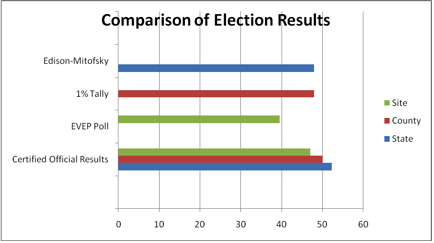
Response rates.
The percentage of voters who responded to the EVEP polling request ranged from 38% (at a site where exit poll volunteers were harassed by poll workers and forced to stand beyond the legal location for an exit poll, far from the door) to 70%. The average response rate was 56.4%.
Proposition 8 WPD.
Nine of the ten L.A. polling sites had a higher percent of “No” votes than the official numbers. The disparities ranged from -2.3% to 17.7 %, a positive percentage indicating a higher percentage of “No” votes in the EVEP than in the official results. The average WPD or discrepancy between the official results and the polling results is 7.75%. As detailed in the paper, this is considered a significant disparity.
The four possible reasons to explain the large WPDs are discussed in the paper. For the analysis, Proposition 4, which mandated parental notification and a waiting period before a minor could undergo an abortion, was used as a benchmark against which the polling results of Proposition 8 are measured. Because the two are similarly controversial social issues, it was anticipated that the populace would for the most part split on Proposition 4 (abortion) similarly to Proposition 8 (gay marriage).
The citizens’ exit polling data for Proposition 4 was within 2% of the official results; 2% is considered within the margin of error. Furthermore, the disparities between polling data and official results for Proposition 4 in some precincts favored passage of Proposition 4 and in other locations favored defeat of the proposition. This is a natural pattern which provides further indication that the polling results indeed reflect the electorate’s in-booth choices.
The differential between the official results and the polling results for Proposition 8, however, was 7.75 %, far outside the margin of error. 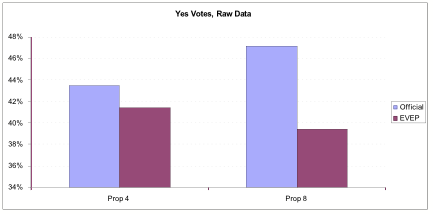
Comparison of Official Results to EVEP Results for Propositions 4 and 8
Since the need for further analysis of Proposition 8 was thus indicated, the EVEP results were then adjusted for age, gender, ethnicity/race, and party affiliation, to compensate for any demographic group(s) being over- or under-polled.
The data indicates that the WPD for Proposition 4 narrowed to 0.64%, virtually spot-on, while Proposition 8 was still well beyond the margin of error at 5.74%.
Comparison of Official Results to EVEP Results for Propositions 4 and 8, with EVEP Data
Adjusted for Party Affiliation
While this EVEP analysis strongly suggests that the official results for Proposition 8 were compromised in the tabulation process, the impact of this paper extends far beyond that particular vote and far beyond California. Voting is the bedrock protocol of any democracy, fledgling or venerable, around the globe or here at home. If the vote-counting process is not observable, that bedrock turns rapidly to quicksand.
It is too late to change the official results of Proposition 8 but it is not too late to recognize the current vulnerabilities of computerized voting throughout the United States. Our election officials who have been entrusted with the responsibility to run transparent elections are not doing so; counting votes inside black boxes renders observation of the tabulation process impossible. Even the computer log books and the like are strictly off limits to examination. The candidates and the citizens cannot know that official election results are reliable.
Electronic election equipment remains in use despite persistent evidence of computer failures, election rigging and hacking, despite the control of our elections by equipment vendors with established partisan proclivities, and despite the revelations, based on exit polling and pre-election tracking polling, that results have consistently shifted in the same direction, always to the right. Because verification by observation has been precluded by computerization, only indirect or statistical methods of verification are available.
Thus, Proposition 8 results and the EVEP analysis by Election Defense Alliance offer another opportunity among many to discover what is amiss and to make urgently needed changes. An investigation is warranted into how the fraud or gross errors happened. This knowledge is necessary for running all future elections. While it is true that reforms have been made in California and elsewhere, it appears too many serious holes remain in the system.
The evidence, in this paper and elsewhere, is strong that computerized vote-counting cannot be trusted to support our democracy. Not only is further investigation warranted but a return to a fully observable vote-counting process is imperative. Our democracy will not survive if we cannot know that our election results are accurate and honest.
The unexpected passage of Proposition 8 in California, banning same-sex marriage, has led election integrity advocates to wonder aloud if the official results were legitimate. Fortunately, two citizen groups, seeking to restore electoral integrity, Election Defense Alliance and Protect California Ballots, conducted exit polls in 12 California polling sites, 10 in Los Angeles County. The analysis of this data is presented here.
According to the official results, Proposition 8 passed overall in the state with 52.2% of the vote. In 10 L.A. county polling sites, representing 19 precincts, the official results were 47.2% Yes - 52.79% No, but the exit polls for the identical 19 precincts showed 39.46% Yes - 60.54% No. Is there a way to discern if the exit polling was flawed or the official vote count was compromised?
Proposition 4, requiring a waiting period and parental notification prior to an abortion, is clearly the most reasonable benchmark with which to compare Proposition 8, because both were “hot-button” social issues with heavily overlapping support among the electorate. Exit poll data bear this out. In the ten polling places in Los Angeles County where citizen exit polls were conducted, 66.63% voted for both propositions or against both propositions.
The official results and the exit poll results for Proposition 4 differed by only 2.06%, well within the margin of error, whereas Proposition 8, with a disparity of 7.75%, is far outside that margin. If the official votecounts were accurate and participation in the exit poll was influenced by the “politics” of those polled, we would expect a very similar effect on the results for the two Propositions, yielding very similar disparities rather than the very different disparities we found.?
Furthermore, the Proposition 8 disparity appears in nine of the 10 sites in the same direction; i.e., in 90% of the sites, the exit polling data show more votes against Proposition 8. One would expect that disparities should balance out – some in one direction, and some in the other. The very fact that this was the case in regard to Proposition 4 but not Proposition 8, together with the large difference in disparity between the two, suggests the official results for Proposition 8 are compromised.
There are four possible reasons for a large disparity between exit polls and official results:
(1) a basic flaw in the exit poll methodology;
(2) many voters lying on the questionnaires;
(3) a non-representative sample of voters responding; or
(4) the official results being erroneous or fraudulent.
As for possibilities 1 and 2, the constituencies for Propositions 4 and 8 were similar enough that it is hard to imagine a bias that would show up only in results for Proposition 8 and not in Proposition 4. The fact that the polling results accurately reflected the official count for Proposition 4 may be taken as validating both the vote count and the exit poll as conducted at the L.A. County sites.
As for possibility 3 above, the respondents actually were not a truly random sample of the voters, since some voters chose not to participate. To determine if this accounts for the large disparity, the full analysis goes further and adjusts the data for gender, race, age and party affiliation.
That is, the necessary changes are made to the polling data to assume the gender, ethnicity, age and party affiliation more accurately reflect the voting population for a given site.
Even with the data so normalized, the disparities remain too large to dismiss as random. The overall Proposition 8 disparity remains 5.74% (as opposed to 0.64% for Proposition 4 when normalized.) As seen on the bell curve below, the Proposition 8 results are still well outside the margin of error —a glaring red flag.
To answer possible criticism that it might not be accurate to apply the percentage of votes of the Republican poll respondents to those Republicans who voted but did not participate, the data is examined further. It shows that if our samples of Democratic, third-party, and Independent voters were representative of the electorate, then even if every non-participating Republican voter registered a Yes vote for Proposition 8, it would not have been mathematically possible to come out with the official results.
The only remaining explanation is possibility 4, the official results being erroneous or fraudulent. Further investigation is warranted, one that includes penetrating the proprietary secrecy behind which the voting equipment corporations have hidden their processes.
Furthermore, every candidate and every American should be alarmed enough to reject our current election conditions in which over 95% of our votes are counted electronically with no means of citizen oversight.
Our own cherished democracy—if it continues to count its votes in secret—is no more immune to anti-democratic manipulation than is the newest and shakiest democracy halfway around the world.
The Election Integrity "Superlist" E-mail Network Plan in Brief:
With your help, Election Defense Alliance proposes building a national election integrity E-mail network composed of many separate e-mail lists, each one a branch in the larger tree. Each branch will be managed by a participating individual or organization who agrees to transmit occasional election integrity messages to the addresses on the e-mail lists they manage. Note: We are not asking for lists of individual e-mail addresses. We are asking you to help us make contacts with e-mail list managers, so that election integrity messages can be transmitted to the mailing lists they manage.
RATIONALE
Information and Speech Are Still Free on the Internet (Use or Lose)
Let's make full use of internet e-mail, the only mass communications medium we have that is not subject to corporate censoring of news about fraudulent elections. The EI movement should put to full use the power of proliferating e-mail contacts to branch out beyond the core membership of our respective electoral integrity organizations. This is what it will take to build the level of mass awareness necessary to break through corporate media control and reclaim our elections and government from the corporations and "unduly electeds" who have usurped our democracy.
METHOD
Building the Election Integrity Superlist involves identifying managers of e-mail lists, persuading them to participate in a national election integrity e-mail network, and asking 10 questions about the characteristics of each list they manage.
Participation in the network is always voluntary. Each list manager will have discretionary control over which messages to send or not send.
Please note, we are not asking for lists of individual e-mail addressess (always a closely guarded resource!).
Rather, we are compiling a list of e-mail lists, and obtaining agreements from list managers to relay occasional messages of broad relevance to the election integrity cause.
All group and individual list managers participating in the network may propose messages to be sent over the network. Transmission of each message is always at the voluntary option of each participating group or list manager.
How to Participate
That's it in a nutshell. A project discussion and methodological details are presented in greater detail below.
A cover letter [251] and questionnaire forms are provided in Excel [252] and PDF [253] formats.
(Using Excel will make data import easier and is preferred, if you have Excel. The Excel form will also work in the free Open Office application that you can download from http://openoffice.org [254] ).
Please contact us if you can help Build this National EI E-mail Network [255]. No contribution is too small. Every addition to this list of lists raises the multiplying power.
Method in Medium Detail
If you will gather and send to EDA the contact information described in the following method, EDA will compile those e-mail list contact addresses into a national election integrity network directory. Messages for national distribution will be sent to this master list of list managers, who will have agreed to relay EI announcements on to the address lists they manage.
How to Begin
Think of all the political, civic, and social circles you move in, and how many of those entities have e-mail communication lists. Probably most of them do.
Next, identify who the persons are who manage e-mail communications for each of those groups.
It helps if you already know the people who manage the e-mail lists and can call them on the phone; but if not, send them a personal note at their e-mail address, including a copy of the explanatory cover letter. This is essentially cold-call salesmanship by printed word.
In your phone call or letter to list managers, explain the e-mail network idea, and ask for their agreement to carry a few initial messages over their list from Election Defense Alliance. Then ask them 10 short questions about the characteristics of their lists, enter the answers on a form, and send completed forms to [email protected] [250].
If you have a phone number for the list manager, follow up your initial e-mail with a phone call. If you don't have their phone number, request it when you write to them, and if they respond, follow up with a call.
Cover Letter
I've prepared a cover letter [251] to send to all the list managers you can identify in your region. The cover letter explains how the national EI e-mail list will work, what we are asking of them, and why the movement to establish transparent, publicly accountable electoral processes is fundamental to every desired social and political goal these other organizations wish to attain.
The cover letter, called SuperListCover_rev5.pdf, can be downloaded here [251].
Feel free to personalize the cover letter in any way that seems productive to you.
10 Questions
Two additional files will make it easier for you to collect the requested list information.
The Excel file [252] is a live spreadsheet form. This live data form is preferred, but if you don't have Excel, or a comparable spreadsheet application, you can use the printable PDF form [253] that you can fill in by hand and transmit as a fax. NOTE: The list collection forms are designed to print on legal paper (8.5 x 14") in landscape mode (horizontal).
Phase 1: Initial contacts
There are two phases to this e-mail network plan. The first phase is entirely dependent on the involvement of EDA participants and the voluntary cooperation of list managers across the country who, in response to our request and explanation of this plan, agree to transmit occasional election integrity messages to the lists of addresses they manage.
Phase 2: Opt-in subscriptions
In the second phase EDA will gradually develop its own list of subscribers who have voluntarily opted to join the EDA e-mail list, by responding to the subscription links that will be embedded in each message sent over the Superlist network.
Initially, the e-mail network will be a hybrid, consisting partly of early subscribers to EDA's own e-mail address list, but primarily composed of links to e-lists whose managers have agreed to transmist EDA messages over their own lists but who retain control of the actual addresses.
Gradually, EDA will accumulate its own subscriber base that we hope will include a majority of the persons originally contacted via messages relayed for us over other organization's mailing lists.
EDA will add individuals who voluntarily opt-in to the EDA subscription list for regular EDA organizational communications.
But, the Election Integrity Network "superlist of lists" will remain available for periodic transmission of major election integrity announcements of a nationwide significance, either as prepared by EDA, or by any other EI organizations that participate in building the list.
This could be a powerful tool of mutual benefit to all participating organizations, while building the mass civil constituency that will be necessary to bring about social change for transparent, publicly accountable elections.
We would hope that election integrity groups, as well as civil rights and social justice organizations of all kinds, would recognize the shared benefits of such a communications network, and voluntarily assist in its development and maintenance.
Please contact us if you can help Build this National EI E-mail Network [255].
Rationale and Method in Full Length
(Already convinced? Skip to Recap at the end)
Most every individual and organization participating in the election integrity movement has an e-mail list, or maybe even a large listserv, that they regularly use in their political work. Those lists could include anywhere from a dozen to several thousand names each. Beyond the EI movement, you know and probably participate in many other civic and social organizations in your region, and most of them also have e-mail lists. Draw up a list of all the lists you personally have, and as many other lists that you know or think exist for other organizations you are familiar with. Find out who the person is who manages each of those lists--either by asking people you know in the organizations, or by searching the "Contact us" information on their group's website. A webmaster is often the person who manages the group's e-mail list; or if not, will surely know who does. Whoever receives e-mail addresses of the form Info@xyz is very likely the e-mail list manager.
The Superlist information form* consists of 10 short questions to gather the key information about each e-mail list. Write (or better, phone) the list manager, introduce yourself, describe the Election Integrity Superlist idea, and ask if they would be willing to help build this network by agreeing to transmit an occasionalelection integrity message over their list(s). If their own group is an election integrity organizations, participating in the list will build public awareness of their own EI efforts. But no matter what an organization's programmatic goals are, honest elections are essential to their attainment. Mention to everyone you contact that the right to have one's vote counted as cast is the fundamental right that secures all others.
*(The Excel form (Superlist_form.xls) [252] is live and editable, and preferred for those who have Excel; the Superlist_form.PDF [253] is a static form that can be entered by hand and then faxed).
Important Distinction: E-List Contacts, not Individual Addresses
No e-mail addresses are requested other than the contact addresses for list managers. Participation is always voluntary. Each list manager will have discretionary control over which messages to send or not send. As each Alliance message is sent out, we will ask list managers to reply whether and when they sent or did not send each message proposed, and if they did not send, to please state their objections or other reasons for declining a message. This way we will gradually acquire a sense of the character of each branch in the network, and how to tailor messages for maximum transmission rates).
Network rules of the road will evolve as the list grows. Rather than attempt to answer here all policy questions that may arise, let us simply emphasize that list managers will always retain control of their lists and have the option to accept or reject transmission of any given message to their lists.
Each e-message sent over the combined e-network will be embedded with links pointing back to a subscription form at the EDA webpage, which recipients can use to subscribe directly to the EDA contact list if they wish to. This way, every message sent out over the network will have the potential to draw visitors to the EDA webpage, and to add subscribers to the EDA e-mail list that will grow into a primary component of the larger EI national e-mail network.
Geometric Growth Potential
E-mail messages are like seeds on the wind. You never know how far they will travel or how many times they will be reproduced. The geometric progression potential is enormous. For example, assume an intial message goes out to 500 addresses. Assume each recipient forwards to just 5 additional persons, and each successive recipient forwards to another 5. Assume that each successive wave takes one day to propagate. On the 5th day, the total is 312,500 messages. On the 9th day, the total is over 190 million. (Get out your calculators if that's hard to believe).
Of course, few if any messages propagate at the maximum theoretical rate. But once in circulation, any message has a potentially limitless lifespan. The more compelling the information we send out, the more likely it is to be reproduced. We will be contacting a population that, by virtue of being on the message lists we have selected, is already receptive and disposed to share the information. We are offering information that is largely absent from any other communications medium. I think we can expect fairly high transmission rates.
Network Also Builds a Subscriber Base for EDA Communications
Each outgoing message on the list will include an EDA e-mail subscription link. People who reply to the subscription link will be signaling their interest in receiving regular announcements and important news items about election activism from EDA directly. This EDA subscription list will start out small but eventually become a central component of the national EI e-mail network.
EI Network Can Continue to Grow as Shared Resource
The EDA subscription list will be used for EDA organizational communications, but the original EI network of cooperating e-list managers will not be abandoned. The network list can continue to be developed and maintained for occasional use by EDA as well as by other participating election integrity organizations, to transmit occasional announcements of nationwide significance.
As EI messages are passed along and travel beyond the pathways of the originating e-mail lists, every person who reads them can potentially forward those messages to other people in their personal address books. If these secondary message recipients belong to politically active organizations responsive to the electoral integrity cause, they can ask their own list managers to participate as new branches in the expanding EI e-mail network.
E-mails Are Our Electronic Broadsheets
Despite the corporate news establishment's continuing resistance to the notion that elections can be and have been electronically stolen, about 60% of the general population (and about 80% of registered Democrats) think it is likely, or very likely, that the 2004 election was rigged.
Sources:
These numbers have increased about 50% since the 2004 election. How is this possible? I think the explanation is that the alternative media of e-mail lists and websites have been reaching and educating an ever larger share of the population about the electoral integrity crisis.
Information and Speech Are Still Free on the Internet (Use or Lose)
Let's make full use of internet e-mail, the only mass communications medium we have that is not subject to corporate censoring of news about fraudulent elections. The EI movement should put to full use the power of proliferating e-mail contacts to branch out beyond the core membership of our respective electoral integrity organizations. This is what it will take to build the level of mass awareness necessary to break through corporate media control and reclaim our elections and government from the corporations and "unduly electeds" who have usurped our democracy.
RECAP: Ready, Set, Go
To start construction of the Election Integrity E-mail Network, download the cover letter [251] and either the Excel [252] (preferred) or the PDF version [253] of the 10-question list information form. Answer the 10 questions about each e-mail list you personally have to contribute, or that you interview a list manager about. If you don't have Excel or a comparable spreadsheet application, print the PDF, fill it in by hand, and fax the completed form (write for faxing directions). The lists of e-lists you provide will constitute the first build of the national Election Integrity E-mail Network.
Here are the 10 questions to answer on the list collection form:
Please send your completed list collection forms to this address [256].
Questions? Comments? Write to us [256].
Please contact us if you can help Build this National EI E-mail Network [255]. No contribution is too small. Every addition to this list of lists raises the multiplying power.
| Attachment | Size |
|---|---|
| Superlist_form.XLS [252] | 15.5 KB |
| SuperListCover_rev5.pdf [251] | 78.19 KB |
| Superlist_form.pdf [253] | 20.77 KB |
Stopping the theft of Election 2006 will depend upon two critical components: Detection and Response. The word will be going out to all concerned Americans to declare NO CONFIDENCE in dubious election results where the numbers don’t add up. We sense that the level of concern, indeed alarm, is such that citizens will answer in great numbers the call to protect our democracy.
It is essential that this response be informed. Just as Paul Revere looked to the lanterns (“one if by land, two if by sea”) for his message, all citizens called to action and coming together in the critical aftermath of Election 2006 will need to know what has happened and where. Although the level of scrutiny will be high and thousands have already volunteered as election observers, the reality is that computerized counting can make election theft invisible to the naked eye, no matter how many observers are deployed and no matter how vigilant they are.
Exit Polls, whether in the Ukraine or the US, remain the most powerful tool available for detecting fraud and theft, which is why the campaign to discredit them has been so determined. That analysts at EDA and cooperating organizations will require access to polling data independent of media control is obvious in the wake Election 2004, when exit polls were “adjusted” to conform to vote totals and the authentic polling data appeared only briefly on the web by mistake. That mistake will not be repeated in 2006, so the “official” exit polls will be useless at best.
Fortunately EDA has created a viable plan for non-media exit polls, professionally conducted by a major polling firm, targeted to the critical competitive federal races, and accurate to within a 2% margin. The results of these polls, like the lanterns in the Old North Church, will tell our analysts what they need to know and complement all other means of monitoring in giving a foundation to both Election Day Rapid Response and all subsequent activities.
EDA urgently needs your FINANCIAL CONTRIBUTIONS [225] to help to pay for this crucial component of Election Protection. Although we have obtained very favorable terms, the cost of commissioning a professional polling firm to conduct an exit poll for a Congressional District is about $15,000. An online survey tracking a statewide contest such as Secretary of State, or U.S. Senate, will cost about $20,000. This is a truly small price to pay for the preservation, or restoration, of our democracy—but it is a price that will never be paid if we each step back and assume that someone else will pay it. America now depends, quite literally, on you.
We can all feel the urgency. PLEASE ACT NOW TO GIVE YOUR GENEROUS SUPPORT [59] and to spread the word. We thank you.
Election Night in Maricopa
http://eda-tv.blip.tv/file/1437202/ [257]
Voter Protection Project
A 2006 Election Verification Exit Poll
A joint project of The Warren Poll, Ken Warren, Poll Director and
Election Integrity, Steve Freeman, Principle Investigator
In conjunction with Campaign Scientific, Stephanie Singer, Director
and Jonathan Simon and Bruce O'Dell, Election Defense Alliance
October 6, 2006
Proposal Overview
We will be conducting an exit poll to verify reported election results in selected precincts for the November 2006 elections. In parallel, we will be collecting registration data and election results from the precincts where we poll and tracking it up to the state level. Anomalies in this data will be an independent indication of whether irregularities have taken place. This is a pilot project so as to prepare for more comprehensive election verification efforts in future elections.
Verifying the accuracy of vote counts is essential to the democratic process. In nations where the vote count is suspect, international agencies often fund independent verification efforts. Exit polls, systematic surveys of voters who have just cast their ballots, are crucial to these efforts because they are, in the words of John Tefft, US Ambassador to Georgia, “one of the few means to expose large-scale fraud.” In nations with reliable voting systems, such as the UK and Germany, exit poll results are invariably within one or two percentage points of the official numbers.
Unfortunately, exit polls are all but dead in the US. For some time, only a single national exit poll commissioned by a media consortium of the five national news networks and Associated Press has been conducted. In 2002, the results were never released because the consortium “lost all confidence in the polls,” perhaps due to discrepancies with official counts in a slew of surprising Republican victories.
The 2004 Presidential election was marred by a 7 percentage point – nine million votes -- discrepancy nationwide. Statistical analyses by responsible teams of academics indicate count corruption rather than polling error. A few of the many indicators is that the discrepancy was significantly higher in battleground states, in Bush strongholds, and where more Election Day problems were recorded. Yet the consortium refused to release precinct level data that could have been used to investigate fraud. In 2004 we knew of the discrepancy only because of a technical glitch that prevented the pollsters from promptly uploading “corrected” results, i.e., results that have been adjusted so as to conform to the reported vote counts. In 2006 and future elections only such “corrected” data will be released even to media clients. Of course, once data are “corrected” as such, they are no longer exit poll results; rather, they misleadingly accord unwarranted legitimacy upon the official numbers.
An honest and transparent exit poll can provide confirmation or rejection of reported vote counts. Rigorous statistical design can separate bias in the polls from errors in the count. Such a survey can also resolve specific allegations of fraud in political jurisdictions and with voting technologies known to have a history of election irregularities. The entire process, survey design, raw data, and all analysis, would be open to public scrutiny.
America needs election verification. No less than (former) USSR Georgians, US Georgians have the right to know when voting machines have not yielded accurate counts and if an election has been tampered with. No less than Germans, British and emerging democracies, Americans need elections that are run fairly and that inspire confidence. Until our government provides a voting system that we can trust, a rigorous, transparent, public exit poll provides our best assurance of obtaining honest election results.
Contents
1. About Exit Polls
2. Need in the US for an Exit Poll Designed to Verify Election Integrity
3. Methodology
4. Components of the Polling Process
5. Budget: Exit Poll Items Requiring Funding
Click link [59] to open and download entire article
| Attachment | Size |
|---|---|
| FreemanExitPollProject100506.pdf [259] | 420.83 KB |
|
This is What Democracy Looks |
The whole world will be watching nextweek'selection,and Cuyahoga County's will be a major object of focus. WCPN will host World Have Your Say here in Cleveland on the 7th and 8th. Director Michael Vu was on Lou Dobbs on Sunday night and on CNN today. And wait until the new film, Hacking Democracy, airs this Thursday?
A few patriots have been tracking Cuyahoga County Board Of Elections over the past two
years and know that there is absolutely NO basis for confidence in the accurate and honest tallying of our votes by Diebold touch screen voting machines and the Diebold central tabulator. The May debacle, the missing memory cards, the discrepancies among totals, the destruction of all May election data from the memory cards, and the refusal to post election results, the utilization of electronic voting machines in general, and the Recount indictments,
are but a few of the reasons we believe it is essential to have election-day vote-count verification (to the extent to which CCBOE and Kenneth Blackwell will let us.)
For those in or near Cuyahoga County, we must be vigilant this November 7th to make sure our votes are counted accurately!
There are many opportunities for
citizens to be vigilant next Tuesday, and I'm describing yet another, one that focuses on protecting the vote count:
Vote Count Protection Project
in conjunction with Dr. Steven Freeman and Dr. Ken Warren
of www.electionintegrity.org [260]
This project seeks to verify the vote counts on election day by, first, conducting simple Election Verification Exit Polls, and
second, having "inside" people jot down the machine summary-report totals for the top 4 races and 1 issue. So we need "inside" people: poll workers, election-day technicians and
observers, to capture the "system" data and record it on a simple data collection form. We also need "outside" pollsters to ask voters to fill out a very short and simple questionnaire.
Sample data collection forms and questionnaires can be found here:
http://www.ohiovigilance.org/ProjectPost/CuyahogaPollDataCollectionForm.pdf [261]
and
http://www.ohiovigilance.org/ProjectPost/CuyahogaSampleQuestionnaire.pdf [262]
For more details
about this important project, see http://www.ohiovigilance.org [263] or email me at [email protected] [264].
I am certain this project will be a fun, interesting and rewarding experience--a civic duty more meaningful than jury duty--and you'll meet lots of good people also engaging to restore democracy. (There are other roles you can
play, as well, in the days leading up to Nov 7th and after the election. We need techies to do analysis on election day and after!)
Victoria Lovegren, Ph.D.
Founder, Ohio Vigilance
Please forward widely!
P.S. If you are not yet an "observer", we can arrange for you to get that status, in which case you can be inside the polls during the end-of-day closing procedures.
Project Post - Ohio
Now that many Ohio counties are using touch-screen voting equipment, we need, more than ever before, the ability to audit the election results!
One simple method is to have BOE's post their election restults at the polling place, so that the public can observe, tally and analyze precinct-level vote counts and compare those tallied results with the "central counts" coming from the BOE's.
Encourage your county board of elections to post their precinct-level election restults at the polling place on election night.
(If your county uses touch-screen voting machines, they may need to make a slight change in their "aggregation" processing at the end of election night. For Cuyahoga, the change is reflected in two statements added to the booth-official training manual, as seen here. [265])
We need volunteers to:
To volunteer for any of these activities, go to the volunteer-registration page [270] or send an email to: [email protected] [271], specifying which activities you would be able and willing to do.
(updated 7/11/06)
Scroll down to download audio files from Election Defense Radio and Blackbox America radio show archives
Click Here to Hear [272] What It's All About

NEW!
a statewide network of 215 community radio stations.
The following links lead to radio news stories distributed to community radio stations by Public News Service, a public interest news service supported by nonprofit public advocacy organizations.
Election Defense Alliance is a supporting member organization of PNS and its California bureau, California News Service (CANS). In addition to EDA's financial contribution (made possible by EDA's dedicated individual donors) EDA works directly with Public News Service producers to provide story leads, source referrals, and background information to bring these election integrity subjects to the attention of a wider public.
Many of the 3100+ community radio stations participating in the national PNS network are located in rural regions of the country dominated by conservative corporate newsmedia, where election integrity news is rarely heard (if at all) except through alternative, popularly-supported citizen media. Election Defense Alliance is proud to be a supporting partner of Public News Service, and the first (and only) PNS member organization contributing news content on the subject of election integrity.
Public News Service, California Bureau [316]
Election integrity radio news stories produced and broadcast with the assistance of Election Defense Alliance
Click the links below for radio recordings and transcripts for each of the stories.
E-Voting May Be Put To A Vote In California [317] Download Audio [318]
Public News Service - CA April 27, 2009
Tom Courbat, Riverside, E-voting, chain of custody, SaveRVote, referendum, EDA, DRE, electronic voting
Tags: Tom [319] Courbat, [319] E-voting [319] Referendum, [319] Riverside, [319] EDA, [319] SaveRVote, [319]
E-Voting Manufacturer Admits Voting System Flaws [320] Download Audio [321]
Public News Service - CA March 27, 2009
CA investigation into voting machines losing votes, audit log erasure, nondisclosed violations of election code by Premier E-voting vendor, citizen monitoring find errors the state canvass missed
Tags: Premier [319] Election [319] Systems, [319] Deck [319] Zero, [319] election [319] audit, [319] Humboldt [319] Election [319] Transparency, [319] ballot [319] scanning [319]
High CA Voter Turnout Leads To Some Problems At Polls [322] Download Audio [323]
Public News Service - CA November 5, 2008
Election ‘08: Rules, Regulations And Videotape [324] Download Audio [325]
Public News Service - CA November 3, 2008
CA County Launches Election Probe Of Registrar Of Voters Office [326] Download Audio [327]
Public News Service - CA October 8, 2008
Democracy Begins With Checking Your Voter Registration [328] Download Audio [329]
Public News Service - CA September 9, 2008
California Voters Say Give Third Parties a Second Chance [330] Download Audio [331]
Public News Service - CA September 4, 2008
Presidential Election Audit Finds Every Vote Doesn’t Count [332] Download Audio [333]
Public News Service - CA July 23, 2008
Richard Hayes Phillips CA book tour, Witness to a Crime, detailing his ballot examination evidence proving the theft of the presidential election in Ohio 2004
Tags: EDA, [319] R.H. [319] Phillips, [319] Ohio [319] 2004, [319] election [319] theft, [319] election [319] audit, [319] stolen [319] election, [319] Witness [319] to [319] a [319] Crime [319]
CA Electronic Voting Machines and Election Code Put to the Test [334] Download Audio [335]
Public News Service - CA July 16, 2008
About Public News Service

The Public News Service (PNS) provides reporting on a wide range of social, community, and environmental issues for mainstream and alternative media that amplifies progressive voices, is easy to use and has a proven track record of success.
Supported by over 450 nonprofit organizations and other contributors, PNS provides radio (and, increasingly, television) with high-quality news on public issues and current affairs. In 2007, the 2,540 PNS stories aired 174,500 times on over 4,000 mainstream and alternative stations across the country. (In comparison, Public Radio has just over 700 affiliates.)
The average number of airings ranged from 20 to 60 stations depending on the state. In addition, about one-third of our stories are picked up by national networks and played across the country.
Why a "Public Interest" News Service?
The Public News Service was founded for two reasons:
1. Media consolidation has resulted in fewer journalists trying to do more and more work. The result is far fewer voices on the radio, and reporters now rely on material that is provided to them. In a competitive environment, the PNS is extremely effective at providing news that journalists use on a regular basis.
2. Too often, nonprofit organizations' issues don't get covered. Press releases frequently end up in the wastebasket, and press conferences eat up staff time for limited results.
The Public News Service is a proven source of coverage on public interest issues, with little work on the part of non-profits.
Why Radio?
The average person listens to radio three hours a day, mostly in the car. The Public News Service produces timely news stories, ready to be plugged into a station's newsbreak. According to a recent Pew Research Center study, 41 percent of the public "listened to the radio yesterday."
Unlike with newspapers and TV, when people listen to the radio they do not "scan" or "skim" looking only for their interests. Therefore, radio is an excellent medium for getting your issues across, particularly to people who are hard to reach in other ways.
How the Public News Service Works
The Public News Service is a growing network of committed journalists and long-time nonprofit staffers. With annual membership, an individual, organization or foundation can pledge support for the Public News Service with the understanding that they are helping to fund an independent news service committed to the public interest. Each membership can be earmarked for reporting on specific issue categories. Over 450 public interest organizations - from those with fully developed communications programs to all-volunteer staff - support the Public News Services through membership.
Help Broadcast Election Integrity News Programming
EDA's continuing sponsorship of PNS radio news depends on financial contributions from EDA supporters. Contributions made via EDA's online donation page [336] may be earmarked for the PNS/EDA radio project, or any other EDA project you would like to support. If you would be interested in making a major donation to underwrite election integrity radio programming via Public News Service, please contact the EDA director at Dan[at]ElectionDefenseAlliance[dot]org or phone 510.275.5723.

One Year Into the Second American Revolution
Election Defense Alliance was officially launched one year ago on July 4, 2006. We were able to work on building the organization for only a short time before we had to shift all our effort to preparing for the November 7 midterm elections. In those four months we managed to accomplish a startling amount of work -- and we've continued to build on that record since.
We're extending our anniversary observances this week and next to bring this website record of EDA's achievements up to date, and to put forth our plans and projects for the months ahead, preparing for what may be the ultimate test of American electoral democracy in November 2008.
If you're new to the site, we invite you to set up an EDA web account (click the "Join" menu link [337]) and subscribe to our Announcements E-mail list [338]. If you already have a web account, please consider getting more directly involved by joining a Working Group [339].
Whether you're a new acquaintance or long-time supporter, we invite you to review EDA's first year and preview our next on the Anniversary page that follows.
• Independent Exit Polls
Determined priority races, selected strategic states, races, and counties, and commissioned exit polls costing $68,000 -- including
unannounced polls as safety checks on the 2006 California primary election for secretary of state and the U.S. Senate election in Montana, independent citizen exit polls in Pennsylvania, and a strategic sampling of 32 counties across the U.S. in the presidential election.
• Election Data Analysis
EDA was uniquely positioned to look in-depth at reported election results, and continues to assemble a national Election Data Archive [340]
• Landslide Denied
Issued press release and report [341] on the startling findings of a 3-million vote discrepancy in the 2006 midterm election results.
• Hand Counted Paper Ballot Manual [192]
Sent to the chief election officers in every state prior to the midterm election, in preparation for the paper-ballot option many states provided.
• Handbook for Progressive Media
Sent advisories to reporters preparing them to recognize how exit polls and official election results would be ‘spun,’ with suggestions and contacts about what to investigate and how.
• Promoted Coordination Among Grassroots Election Integrity Groups
Compiled and shared a roster listing contact information for all known election integrity groups across the nation.
• Contacted Veterans' Groups
Informed them of changes in regulations for overseas military voting that opened up extreme vulnerabilities to corruption, and asked them to pass the word
• Radio Interviews [342]
EDA leaders were guest speakers on about 15 different programs around the country
• Investigated and broke the story about a huge security hole [343] in the Cook County online voter registration database (IL)
• Led county monitoring group of 100 trained members observing entire pre-election, election day, election night and post-election processes; wrote comprehensive report of all violations and 52 clear recommendations. (CA)
• Conducted 4 citizen parallel election polls in OH and 12 in CA
• Participated in election monitoring and recount teams (OH, IL, NH, CA)
• Conducted election monitoring operations in two urban counties (IL)
• Supervised election protection hotline command center in San Francisco (CA)
• Obtained agreement of election officials to conduct parallel hand counts in machine-counted town elections (NH)
• Filmed New Hampshire election hand-counts for use in future training programs (NH)
• Helped coordinate the Video-the-Vote program (FL)
• Involved in several election challenges (KY, WA, and CA)
• Produced the major "We Count" election reform conference [344] with nationally prominent speakers (OH)
• Produced widely televised election integrity town hall rally in San Diego (CA)
• Sponsored educational evenings with election integrity authors Miller, Palast, and Freeman for large audiences (MA, IL, CA)
• Established a Universal Ballot Sampling [345] (UBS) protocol for hand-count checking of election results in precincts on election night
• Continued analysis of targeted '06 election contests races and reporting on emerging patterns of 'red shift'
• Continue developing reliable, replicable methodologies for independently verifying officially reported election outcomes
• Met with one Senator and 10 Representatives and/or their aides in Washington DC
• Attended several national and state-level meetings and filed testimony (NASS, EAC, TGDC)
• Made critical contributions to the Holt Bill (HR811) debate, with EDA participants among the most informed and active in educating elected representatives and the public about serious problems with the bill.
• Participated in drafting and promoting multiple public policy letters to Congress on election reform legislation
• Met with secretaries of state and state legislators (MN, OH, CA, IL, TX, NH)
• Contributed to bills and resolutions in several states (CA, MD, NH, IL, TX), including filing 6 bills for election reform, including voter choice in counting and mandatory hand-counting on election night (NH)
• Organized forums of national election integrity activists, elected officials, and the public (OH, NH, NY, NJ, CA)
• Presented the election integrity message at Camp Democracy, National Media Reform, DemFest, and Grassroots Media NYC, and Take Back America conferences
• Have taken a leading role in exposing the serious dangers of vote-by-mail
• Organized and spoke at civic forums in Oakland, Los Angeles, Cambridge, Albany, and Austin to inform the public about critical election issues and distribute educational materials
• Interviewed for more than two dozen radio and TV programs and video documentaries
• Involved in preparing evidence for multiple legal cases (CA)
Thanks to your understanding of the challenges our nation faces, and thanks to your generosity, Election Defense Alliance was enabled to accomplish all the above. EDA raised and deployed $110,000 in election defense actions.
Moving forward, EDA is applying lessons learned in this election as we plan for 2008. Initially we are turning our focus to building volunteer power in Working Groups. If you have not already, please consider joining in the work and being a representative liaison for your local election integrity group.
Election Defense Alliance was formed specifically to foster coordination and communication among regional election integrity groups, and to promote the sharing of resources and the elimination of duplicative efforts. We are structured so that grassroots activists from around the country can join together to work on solutions applicable everywhere. We do not seek to replace local groups, but rather to enhance their effectiveness.
Again our thanks for your support. Until now, everybody’s time has been volunteer; in order to move forward at a reasonable pace, EDA needs an operating budget of a minimum $150,000. Since we work out of our homes, we have minimal overhead but do need to produce materials, purchase media lists and advertising, and meet many other expenses. (For a representative list of current needs, click here [346]). Most important, we must be able to pay some salaries so that several of our Coordinators can spend full time on all the work still needed in time for the ’08 elections. We hope we can count on you for your continued financial support. Can you help us toward the approximately $12,000 needed each month?

Election Defense Alliance is a program of Columbus Institute for Contemporary Journalism, a nonprofit organization under Section 501(c)(3) of the IRS Code.
Links:
[1] http://electiondefensealliance.org/donate
[2] http://ihcenter.org/groups/re-mediaetc
[3] http://www.electiondefensealliance.org/ny_levers_volunteer
[4] http://re-mediaetc.blogspot.com/
[5] http://www.electiondefensealliance.org/pressreleases/eda_amicus_brief_doj_ny_lawsuit
[6] http://www.electiondefensealliance.org/files/Amicus_Memorandum_of_Law.pdf
[7] http://electiondefensealliance.org/files/Amicus_Curiae_Order.pdf
[8] http://electiondefensealliance.org/files/Amicus_Memorandum_of_Law.pdf
[9] http://electiondefensealliance.org/files/Amicus_Motion_for_Leave.pdf
[10] http://electiondefensealliance.org/files/Ananda_Declaration.pdf
[11] http://electiondefensealliance.org/files/Ananda_NY_08Reg&Turnout_Projections.pdf
[12] http://electiondefensealliance.org/files/Anderson_Declaration.pdf
[13] http://electiondefensealliance.org/files/ARISE_Declaration.pdf
[14] http://electiondefensealliance.org/files/Berman_Declaration121607.pdf
[15] http://electiondefensealliance.org/files/Bischoff_Declaration.pdf
[16] http://electiondefensealliance.org/files/Dean_Declaration.pdf
[17] http://electiondefensealliance.org/files/Freeman_Declaration.pdf
[18] http://electiondefensealliance.org/files/Gould_Declaration.pdf
[19] http://electiondefensealliance.org/files/Hommel_Declaration.pdf
[20] http://electiondefensealliance.org/files/Karp_Declaration.pdf
[21] http://electiondefensealliance.org/files/Lukacher_Declaration.pdf
[22] http://electiondefensealliance.org/files/Miller_Irene_Declaration.pdf
[23] http://electiondefensealliance.org/files/Miller_Mark_Crispin_Declaration.pdf
[24] http://electiondefensealliance.org/files/Novick_Irresponsible_Vendors_1.pdf
[25] http://electiondefensealliance.org/files/Novick_Irresponsible_Vendors_2.pdf
[26] http://electiondefensealliance.org/files/NY_HCPB_16county_Forecasts.pdf
[27] http://electiondefensealliance.org/files/NY_HCPB_16county_Forecasts.xls
[28] http://electiondefensealliance.org/files/Peacemakers_Declaration.pdf
[29] http://electiondefensealliance.org/files/ProtectCaliforniaBallots_Declaration.pdf
[30] http://electiondefensealliance.org/files/Shandaken_Declaration.pdf
[31] http://electiondefensealliance.org/files/Simon_Declaration.pdf
[32] http://electiondefensealliance.org/files/Stinson_Del4Change_Declaration.pdf
[33] http://electiondefensealliance.org/files/Summary_NY_Handcount_Estimate.pdf
[34] http://electiondefensealliance.org/files/Tobi_Declaration.pdf
[35] http://electiondefensealliance.org/files/Tyner_Declaration.pdf
[36] http://electiondefensealliance.org/files/UlsterCoDemWomen_Declaration.pdf
[37] http://electiondefensealliance.org/files/Zimet_Declaration.pdf
[38] http://www.electiondefensealliance.org/files/NANCYTobiDeclaration.pdf
[39] http://electiondefensealliance.org/files/NANCYTobiDeclaration.pdf
[40] http://www.electiondefensealliance.org/signup.php
[41] http://www.electiondefensealliance.org/nypetition/signatures.php
[42] mailto:[email protected]
[43] http://www.sequoiavote.com/
[44] http://studysequoia.wikispaces.com/
[45] http://www.azcentral.com/news/articles/0318az-lawsuit18-on.html
[46] mailto:[email protected]
[47] javascript:void(x=open(' http://www.tucsoncitizen.com/video/player.php?file=031408vote',%20'media',%20'toolbar=no,location=no,status=no,menubar=no,scrollbars=yes,resizable=yes,width=600,height=550'));%20x.focus();
[48] http://www.tucsoncitizen.com/
[49] http://arizona.typepad.com/blog/pima.html
[50] http://electiondefensealliance.org/tell_pima_supervisors_full_disclosure_voting_data
[51] http://arizona.typepad.com/blog/2007/12/pima-county--19.html
[52] http://www.electiondefensealliance.org/files/Pima_Court_Ruling.pdf
[53] http://www.electiondefensealliance.org/pima_election_integrity_trial_videos
[54] http://www.electiondefensealliance.org/pima_county_appeals_decision
[55] http://electiondefensealliance.org/pima_az_lawsuit_seeks_release_raw_vote_data
[56] http://www.tucsonweekly.com/gbase/Currents/Content?oid=oid%3A103686
[57] http://www.tucsonweekly.com/gbase/Currents/Content?oid=oid%3A103687
[58] http://arizona.typepad.com:80/blog/2007/11/pima-county-ele.html
[59] http://electiondefensealliance.org/http
[60] http://www.electiondefensealliance.org/election_defense_radio
[61] http://www.electiondefensealliance.org/files/iBeta_Election_Forensic_Report_Pima_Co.pdf
[62] http://www.electiondefensealliance.org/files/Pima_Election_Security_Report_101907.pdf
[63] http://electiondefensealliance.org/2004_AZ_manual_hack
[64] http://www.electiondefensealliance.org/files/Griscom_Election Fraud in Arizona_Loser Take All.pdf
[65] mailto:[email protected]
[66] http://electiondefensealliance.org/files/iBeta_Election_Forensic_Report_Pima_Co.pdf
[67] http://electiondefensealliance.org/files/Pima_Court_Ruling.pdf
[68] http://electiondefensealliance.org/files/Griscom_Election Fraud in Arizona_Loser Take All.pdf
[69] http://electiondefensealliance.org/files/Pima_Election_Security_Report_101907.pdf
[70] http://www.tucsoncitizen.com/ss/fromcomments/115236.php
[71] http://www.tucsoncitizen.com/ss/opinion/115234
[72] http://www.tucsoncitizen.com/ss/fromcomments/115235.php
[73] http://eda-tv.blip.tv/
[74] http://blip.tv/file/2004617/
[75] http://electiondefensealliance.org/2008/09/john_brakey_arrested
[76] http://eda-tv.blip.tv#1987293
[77] http://eda-tv.blip.tv/#1987293
[78] http://electiondefensealliance.org/31_RTA_Anomalies
[79] http://electiondefensealliance.org/about_john_brakey
[80] http://www.ElectioDefenseAlliance.org/investigations
[81] mailto:[email protected]
[82] http://video.google.com/videoplay?docid=8186883351933387074
[83] http://video.google.com/videoplay?docid=7304338799617243809
[84] http://video.google.com/videoplay?docid=1282511168148207359
[85] http://www.electiondefensealliance.org/about_john_brakey
[86] http://www.electiondefensealliance.org/investigations
[87] http://www.fatallyflawedthemovie.com/pages/story.html
[88] http://www.fatallyflawedthemovie.com/pages/clips.html
[89] http://www.fatallyflawedthemovie.com/pages/risnerbud.html
[90] http://impactglassman.blogspot.com/2009/02/no-one-tolerates-stolen-elections.html
[91] http://www.opednews.com/articles/No-One-Tolerates-Stolen-El-by-David-Griscom-090222-787.html
[92] http://impactglassman.blogspot.com/2007/12/concise-history-of-election-integrity.html
[93] http://www.impactglassresearchinternational.com/
[94] http://electiondefensealliance.org/Fatally_flawed_summary
[95] mailto:[email protected]
[96] http://www.azstarnet.com/metro/280076
[97] http://video.google.com/videoplay?docid=-1489723674229394965
[98] http://www.electiondefensealliance.org/files/Osmolski_Affidavit.pdf
[99] http://video.google.com/videoplay?docid=9173871560399643488
[100] http://www.electiondefensealliance.org/files/iBeta_report.pdf
[101] http://www.electiondefensealliance.org/files/Kanefield_deposition_to_sec_of_state.pdf
[102] http://ca.youtube.com/watch?v=fqlefIQVkrk
[103] http://electiondefensealliance.org/files/Pt1_Database_Password.pdf
[104] http://electiondefensealliance.org/files/Pt2_Flip_a_Diebold_Election.pdf
[105] http://www.blackboxvoting.org/BBVreport.pdf
[106] http://blog.tucsonweekly.com/wp-content/uploads/2008/08/RTAdocumentation.pdf
[107] http://blog.wired.com/27bstroke6/2008/12/unique-election.html
[108] http://www.techdirt.com/articles/20080812/0206421955.shtml
[109] http://video.google.com/videoplay?docid=2202425419631997359
[110] http://www.fatallyflawedthemovie.com/media/DrTomRyan.pdf
[111] http://www.electiondefensealliance.org/files/emails_shamos_evans.pdf
[112] http://www.electiondefensealliance.org/files/Risner_letter_and_Docs_7_14_08.pdf
[113] http://electiondefensealliance.org/files/Pt3_Criminal_Investigation_RTA.pdf
[114] http://electiondefensealliance.org/ballot_preservation_hearing
[115] http://electiondefensealliance.org/files/Citation
[116] http://www.youtube.com/watch?v=JQi54zXEW7A
[117] http://electiondefensealliance.org/files/Hearing_Transcript_011409.pdf
[118] http://electiondefensealliance.org/files/Harrington
[119] http://electiondefensealliance.org/files/Experts_Exhibits
[120] http://video.google.com/videoplay?docid=-9162452062207751657
[121] http://www.fatallyflawedthemovie.com/pages/risnerargue.html
[122] http://electiondefensealliance.org/files/Harrington Ruling.pdf
[123] http://electiondefensealliance.org/files/Citation of Authorities_010609.pdf
[124] http://electiondefensealliance.org/files/Experts_Exhibits _011309.pdf
[125] http://www.tucsonweekly.com/gbase/Currents/Content?oid=oid:121108
[126] http://www.electiondefensealliance.org/insider_election_fraud_pima_arizona
[127] http://www.electiondefensealliance.org/files/PIMA_Advisement_Ruling _052308.pdf
[128] http://www.electiondefensealliance.org/pima_democrats_win_lawsuit_releasing_voting_databases
[129] http://www.electiondefensealliance.org/arizonans_respond_database_release_order
[130] http://www.azstarnet.com/allheadlines/240594
[131] http://electiondefensealliance.org/files/PIMA_Advisement_Ruling _052308.pdf
[132] http://regulus2.azstarnet.com/comments/index.php?id=240594
[133] http://www.electiondefensealliance.org/files/BREWING_TROUBLE.pdf
[134] http://www.electiondefensealliance.org/files/BREWER_Security_Letter_PIMA_6-5-2008.pdf
[135] http://electiondefensealliance.org/<a href=
[136] http://www.azsos.gov/releases/2008/14_files/SECURITY_LETTER_PIMA_6-5-2008.pdf
[137] http://www.azsos.gov/releases/2008/pressrelease14.htm
[138] http://electiondefensealliance.org/files/BREWER_Security_Letter_PIMA_6-5-2008.pdf
[139] http://electiondefensealliance.org/files/BREWER PRESS RELEASE.doc
[140] http://electiondefensealliance.org/files/BREWING_TROUBLE.pdf
[141] http://electiondefensealliance.org/files/AZ_Transparency_Press_Release_061208.pdf
[142] http://electiondefensealliance.org/prospective-relief-hearing-Pima-RTA
[143] http://electiondefensealliance.org/eda-blogs/john_r_brakey/310809/ballot-image-scanning
[144] http://electiondefensealliance.org/Premiere-Fatally-Flawed-091609
[145] http://www.electiondefensealliance.org/files/Notice_of_Appeal.pdf
[146] http://www.electiondefensealliance.org/files/Motion_for_Stay_Pending_Appeal.pdf
[147] mailto: AUDITAZ[at]cox[dot]net
[148] http://electiondefensealliance.org/files/Motion_for_Stay_Pending_Appeal.pdf
[149] http://electiondefensealliance.org/files/Notice_of_Appeal.pdf
[150] http://video.google.com/videoplay?docid=-1218426879119486209
[151] http://video.google.com/videoplay?docid=2429578955622955799
[152] http://video.google.com/videoplay?docid=2624937678137221831
[153] http://video.google.com/videoplay?docid=3065842076090526996
[154] http://video.google.com/videoplay?docid=5509349780776531096
[155] http://video.google.com/videoplay?docid=6207109568642429330
[156] http://video.google.com/videoplay?docid=-4175279576759012912
[157] http://www.electiondefensealliance.org/files/case_opening_sheet.pdf
[158] http://www.electiondefensealliance.org/files/letter_risner_evans_6_18_07.pdf
[159] http://video.google.com/videoplay?docid=-8269488968037938855
[160] http://www.electiondefensealliance.org/files/letter_risner_evans_8_6_07-9_13_07.pdf
[161] http://www.electiondefensealliance.org/files/text_ARS16-445.pdf
[162] http://www.electiondefensealliance.org/files/email_evans_moffatt.pdf
[163] http://www.tucsoncitizen.com/ss/transportation/90624.php
[164] http://www.tucsoncitizen.com/daily/frontpage/70793.php
[165] http://www.tucsoncitizen.com/ss/local/71620.php
[166] http://www.rtamobility.com/index.php?option=com_content&task=view&id=345&Itemid=120
[167] http://www.electiondefensealliance.org/files/M_Access_Manual.pdf
[168] http://www.azsos.gov/election/Electronic_Voting_System/2007/Manual.pdf
[169] http://www.pimadems.org/votingreport/brewer_letter.htm
[170] http://www.nytimes.com/2006/05/12/us/12vote.html?partner=rssnyt&emc=rss
[171] http://www.tucsoncitizen.com/daily/opinion/53903
[172] http://ca.youtube.com/watch?
[173] http://www.electiondefensealliance.org/files/crop_scanner_invoice.pdf
[174] http://www.pimadems.org/votingreport/votingintegrity.htm
[175] http://www.electiondefensealliance.org/files/what_happened_in_rta_election.pdf
[176] http://www.electiondefensealliance.org/files/letters_risner_evans.pdf
[177] http://www.electiondefensealliance.org/files/letter_risner_evans_8_6_07.pdf
[178] http://www.electiondefensealliance.org/files/letter_friar_risner.pdf
[179] http://www.electiondefensealliance.org/files/18_RTA_Anamolies.pdf
[180] http://electiondefensealliance.org/files/18_RTA_Anamolies.pdf
[181] mailto: [email protected]
[182] https://www.createspace.com/3446633
[183] http://www.youtube.com/handsonelections
[184] http://www.electiondefensealliance.org/files/TobiTravelProposal.pdf
[185] http://www.electiondefensealliance.org/book_order_2004_stolen
[186] http://www.appliedresearch.us/sf/
[187] http://www.inthesetimes.com/about/author/10/
[188] http://www.electiondefensealliance.org/eda_store/commander
[189] http://www.electiondefensealliance.org/paypal_premium_donations
[190] http://www.opednews.com/author/author2302.html
[191] http://www.electiondefensealliance.org/were_counting_the_votes_an_election_preparedness_kit
[192] http://electiondefensealliance.org/files/CountingtheVotesDFNH.pdf
[193] http://www.democracyfornewhampshire.com/node/view/2648
[194] http://www.electiondefensealliance.org/files/NH_ElectionManual083006.pdf
[195] http://www.democracyfornewhampshire.com/node/view/3661
[196] http://www.democracyfornewhampshire.com/node/view/4260
[197] http://themonitor.wordpress.com/2007/04/15/show-details-for-april-15th-2007/
[198] http://electiondefensealliance.org/files/NH_ElectionManual083006.pdf
[199] http://electiondefensealliance.org/files/were_counting_the_votes_2006_09_02.pdf
[200] http://electiondefensealliance.org/files/TobiTravelProposal.pdf
[201] http://electiondefensealliance.org/hr_811_the_holt_ii_bill_to_amend_hava
[202] http://www.nh.gov/government/nhcong.html
[203] http://www.opednews.com/articles/opedne_nancy_to_070605_hr_811__28the_holt_bil.htm
[204] http://thomas.loc.gov/cgi-bin/query/z?c110:H.R.811:
[205] http://www.electiondefensealliance.org/five_point_proposal
[206] http://www.opednews.com/articles/opedne_nancy_to_070522_the_real_threat_from.htm
[207] http://www.opednews.com/articles/opedne_rob_kall_070608_reasons_to_reject_an.htm
[208] http://www.electiondefensealliance.org/eac_takes_aim_at_paper_ballots_NT
[209] http://www.electiondefensealliance.org/eac_gopher_bash
[210] http://www.electiondefensealliance.org/files/HR811_FloorManagersAmendment_072707.pdf
[211] http://www.electiondefensealliance.org/files/811_Revised_Voter_CON_Act.pdf
[212] http://www.democracyfornewhampshire.com/node/view/3033
[213] http://www.democracyfornewhampshire.com
[214] http://www.electiondefensealliance.org/protect_the_count
[215] http://electiondefensealliance.org/files/BBV_EDA_Protect_the_Count_08.pdf
[216] http://www.verifiedvoting.org/verifier/
[217] http://www.law.cornell.edu/constitution/index.html
[218] http://www.constitution.org/cons/usstcons.htm
[219] http://www.findlaw.com/11stategov/indexconst.html
[220] http://www.BlackBoxVoting.ORG
[221] http://www.ElectionDefenseAlliance.org
[222] http://www.ElectionDefenseAlliance.org/Protect_the_count
[223] http://www.electiondefensealliance.org/polling/signup.php
[224] http://electiondefensealliance.org/exit_polling
[225] http://electiondefensealliance.org/independent_exit_polls
[226] http://www.electiondefensealliance.org/citizens_election_verification_poll_evp
[227] http://www.electiondefensealliance.org/files/intro&exsum.pdf
[228] http://electiondefensealliance.org/EDA-Exit-Polls-2008
[229] http://electiondefensealliance.org/files/intro&exsum.pdf
[230] http://electiondefensealliance.org/files/CA-Prop8-Exit-Polls-LA-County-RHP.pdf
[231] http://electiondefensealliance.org/Was-CA-Prop-8-Election-Rigged
[232] http://www.electiondefensealliance.org/files/intro&exsum fo.pdf
[233] http://www.electiondefensealliance.org/files/intro&exsum forweb.pdf
[234] http://honestelections.us/evep/evep-downloads/index.php
[235] http://ElectionDefenseAlliance.org/files/EVEP-Prop8-Propositions-Adjusted.pdf
[236] http://ElectionDefenseAlliance.org/files/EVEP-Prop8-Summary-Tables-Presidential.pdf
[237] http://ElectionDefenseAlliance.org/files/EVEP-Prop8-Summary-Tables-Propositions.pdf
[238] http://ElectionDefenseAlliance.org/files/Prop8-EVEP-Party-Affiliation.pdf
[239] http://electiondefensealliance.org/files/EDA-2008-EVEP-Citizen-Exit-Polls.pdf
[240] http://electiondefensealliance.org/CA-Prop-8-Corrupted
[241] http://electiondefensealliance.org/witness_crime_citizens_audit_american_election
[242] http://electiondefensealliance.org/node/1827
[243] http://electiondefensealliance.org/files/Congressionial-Adjusted-Party-Affiliation.pdf
[244] http://electiondefensealliance.org/files/Senate-Adjusted-Party-Affiliation.pdf
[245] http://electiondefensealliance.org/files/New-Hampshire-Adjusted-Age.pdf
[246] http://electiondefensealliance.org/files/New-Hampshire-Adjusted-Gender.pdf
[247] http://electiondefensealliance.org/files/Pennsylvania-Adjusted-Age-Gender.pdf
[248] http://electiondefensealliance.org/about_us
[249] http://www.sos.ca.gov/elections/sov/2008_general/contents.htm
[250] mailto:[email protected]
[251] http://electiondefensealliance.org/files/SuperListCover_rev5.pdf
[252] http://electiondefensealliance.org/files/Superlist_form.XLS
[253] http://electiondefensealliance.org/files/Superlist_form.pdf
[254] http://openoffice.org
[255] http://electiondefensealliance.org/mailto
[256] mailto: [email protected]
[257] http://eda-tv.blip.tv/file/1437202/
[258] http://eda-tv.blip.tv/file/1432595/
[259] http://electiondefensealliance.org/files/FreemanExitPollProject100506.pdf
[260] http://www.electionintegrity.org/
[261] http://www.ohiovigilance.org/ProjectPost/CuyahogaPollDataCollectionForm.pdf
[262] http://www.ohiovigilance.org/ProjectPost/CuyahogaSampleQuestionnaire.pdf
[263] http://www.ohiovigilance.org/
[264] mailto:[email protected]
[265] http://www.ohiovigilance.org/ProjectPost/PostingResultsCuyahogaProcedures.pdf
[266] http://www.ohiovigilance.org/ProjectPost/ProjectPostBOELetterTemplate.pdf
[267] http://www.ohiovigilance.org/ProjectPost/ProjectPostDataCollection.pdf
[268] http://www.ohiovigilance.org/ProjectPost/DataCollectionTemplate.xls
[269] http://www.ohiovigilance.org/ProjectPost/ProjectPostRecruitingLetter.pdf
[270] http://www.wecount2006.org/postvolunteers
[271] mailto:[email protected]
[272] http://www.electiondefensealliance.org/files/EDA_Radio_Theme&Intro.mp3
[273] http://www.electiondefensealliance.org/Public_News_Service_EDA
[274] http://www.mediafire.com/?2m4vmmytjvn
[275] http://www.mediafire.com/?ymtllfgfyzz
[276] http://www.mediafire.com/?m2z2qy1ynwe
[277] http://www.mediafire.com/?yyy2kiymmiy
[278] http://www.mediafire.com/?nwjyy5nkjmg
[279] http://www.mediafire.com/?lj3q0zwwjgl
[280] http://www.mediafire.com/?yuqjlyowzjq
[281] http://www.mediafire.com/?mnyfnzmjkmm
[282] http://www.mediafire.com/?myygu3zlx3y
[283] http://www.mediafire.com/?mz3ikcliwhx
[284] http://www.mediafire.com/?j1nydtwdtog
[285] http://www.mediafire.com/?xrjugydymzm
[286] http://www.mediafire.com/?2tzytjrz1zg
[287] http://www.mediafire.com/?ntjtmgkzjdx
[288] http://www.mediafire.com/?yjmqlga2y0t
[289] http://www.mediafire.com/?ruj2imnalnt
[290] http://www.mediafire.com/?n3zymdw0tyz
[291] http://www.mediafire.com/?n2j00vtznyl
[292] http://www.mediafire.com/?helrnnkoyjt
[293] http://www.mediafire.com/?2myghkl2tzj
[294] http://www.mediafire.com/?kdmt4ckkmzy
[295] http://www.mediafire.com/?kkmlznmktte
[296] http://www.mediafire.com/?xhjytzf5mlr
[297] http://www.mediafire.com/?1ztqzzaz2qv
[298] http://www.mediafire.com/?lojcwjmmzn3
[299] http://www.mediafire.com/?dxyurwndm4w
[300] http://www.mediafire.com/?aqw0tm3w1nz
[301] http://www.mediafire.com/?4yetigqiqmm
[302] http://www.mediafire.com/?qmwjj5nmzlo
[303] http://www.mediafire.com/?znh3zq5tztj
[304] http://www.mediafire.com/?nv4iljhoafz
[305] http://www.mediafire.com/?xynjfmymngz
[306] http://www.mediafire.com/?y0nmzmeujgy
[307] http://www.mediafire.com/?zzjyxrgnyha
[308] http://www.mediafire.com/?yi4yjz4xmwj
[309] http://www.mediafire.com/?ajnqmdziiwd
[310] http://www.mediafire.com/?c0w2ntnicw1
[311] http://www.mediafire.com/?0dntdgmamnf
[312] http://www.mediafire.com/?b2kgd13o1mi
[313] http://www.mediafire.com/?ldmnzzwmg2x
[314] http://www.mediafire.com/?e0ntmbzlyjq
[315] http://www.mediafire.com/?nq50tnnzdzn
[316] http://electiondefensealliance.org/files/rss.gif
[317] http://www.publicnewsservice.org/index.php?/content/article/8711-1
[318] http://www.mediafire.com/?mjlowejja3z
[319] http://www.mediafire.com/myfiles.php#
[320] http://www.publicnewsservice.org/index.php?/content/article/8435-1
[321] http://www.mediafire.com/?ytytuzymzyy
[322] http://www.publicnewsservice.org/index.php?/content/article/6993-1
[323] http://www.mediafire.com/file/elkyzygl2m5/CANS_081105_Turnout_6993.mp3
[324] http://www.publicnewsservice.org/index.php?/content/article/6962-1
[325] http://www.mediafire.com/file/kmizydzimjz/CANS_081103_Regulations_6962.mp3
[326] http://www.publicnewsservice.org/index.php?/content/article/6673-1
[327] http://www.mediafire.com/file/ztznznmdegi/CANS_081008_RiversideAudit_6673.mp3
[328] http://www.publicnewsservice.org/index.php?/content/article/6413-1
[329] http://www.mediafire.com/file/ljyzetmljwj/CANS_080909_Registration_6413.mp3
[330] http://www.publicnewsservice.org/index.php?/content/article/6313-3
[331] http://www.mediafire.com/file/mkmd0ljiulm/CANS_080904_3rdParties_6313.mp3
[332] http://www.publicnewsservice.org/index.php?/content/article/5739-2
[333] http://electiondefensealliance.org/files/CANS_072308_rss-5739-2_0.mp3
[334] http://www.publicnewsservice.org/index.php?/content/article/5697-1
[335] http://www.mediafire.com/file/ytytuzymzyy/CANS_080716_Monterey_5697.mp3
[336] https://secure.groundspring.org/dn/index.php?aid=28156
[337] http://www.electiondefensealliance.org/Join
[338] http://visitor.constantcontact.com/email.jsp?m=1101317662862
[339] http://www.electiondefensealliance.org/workinggroups
[340] http://electiondefensealliance.org/Projects/eda_election_data_archive
[341] http://electiondefensealliance.org/major_miscount_of_vote_in_2006_election
[342] http://www.electiondefensealliance.org/edaradio
[343] http://www.electiondefensealliance.org/chicago_voter_registration_database_wide_open
[344] http://www.wecount2006.org/
[345] http://www.electiondefensealliance.org/upspr
[346] http://www.electiondefensealliance.org/donations/wishlist
[347] http://www.ElectionDefenseAlliance.org/Donate