Books and Reports
EDA recommends books, whitepapers and reports that are well researched, documented and academic in approach so that citizens will have the most authoritative information possible for understanding this important civic issue. Often the effort to analyze and report on past elections is denigrated or ignored as selective or a bitter lament by supporters of the officially declared "loser". Not so at EDA, where the key issue is whether the facts and evidence are rigorously examined and analyzed, and the conclusion as to who received the most votes or whether an erroneous outcome was certified is reached by scientific or scholarly investigation and documentation of these facts and evidence.
"Cast Out" - The Brennan Center Report on Voter Suppression in 2006
http://www.brennancenter.org/subpage.asp?key=413&tier3_key=38166
Cast Out: New Voter Suppression Strategies 2006 and Beyond
We are well-informed of Election Day problems, but disenfranchising policies silently affect hundreds of thousands of voters long before then. These new voter suppression strategies will have an enormous impact on elections in 2006 and beyond.
Click here to view the presentation.
Top Threats to the Franchise:
Crackdown on Voter Registration Drives
o Policy Brief on Restrictions on Voter Registration Drives
o For more information on the Brennan Center's work to remove barriers to voter registration, including path-breaking litigation victories in Florida and Ohio, click here
Using Databases to Keep Eligible Voters Off the Rolls
o Policy Brief on Using Databases to Keep Eligible Voters Off the Rolls
o For more information on the Brennan Center's work to ensure proper implementation of statewide voter registration databases, including our ground-breaking report and litigation victory in Washington, click here
Inaccurate Purges of the Voter Rolls
o Policy Brief on Inaccurate Purges of the Voter Rolls
o For more information on the Brennan Center's work to ensure proper purges of voter rolls, click here
Strict Documentation Requirements for Voting
o Policy Brief on Voter Identification
o Policy Brief on Proof of Citizenship
o Policy Brief on the Truth About "Voter Fraud"
o Policy Brief on Alternatives to Voter Identification
o For more information on the Brennan Center's work to ensure that
documentation requirements do not compromise the right to vote, click here
Problems With New Voting Technology
o Policy Brief on Electronic Voting Systems
o For more information on the Brennan Center's ground-breaking analysis of new problems presented by voting technology including the first-ever evaluation of security vulnerabilities and usability considerations, click here
Learn more about the other voting issues the Brennan Center works on:
o Voting Rights and Elections Project
Press Clips:
o SIT News (AK): Center Warns Against Disenfranchising Voters (September 18, 2006)
o Washington Post (DC): Major Problems At Polls Feared (September 17, 2006)
o Ms. Magazine (USA): 2006 Voter Suppression Strategy Predictions (September 14, 2006)
o MSNBC (USA): Election Changes Could Create Voting Barriers (September 13, 2006)
Cheated!
“Cheated!” draws from video and photographs to illustrate the story of the courageous citizens of Columbus, Ohio, who investigated and litigated against the massive voter suppression and fraud they experienced on Election Day, November 2, 2004. Because these hardy patriots refused to concede, they ignited a Voting Rights movement that spread like wildfire across the grassroots of America.

We begin on Election Day, November 2nd, in urban Columbus. Rain pours on unbelievably long lines of citizens at the polls determined to vote for change. There’s mass confusion as voters discover they’ve been struck from the poll books. Machines are malfunctioning; some are hopping from Kerry to Bush. Frustrated voters are forced to leave for work and family, their votes uncast. Precinct judges beg for more voting machines, but find that Franklin County Board of Elections Director Matt Damshroder and Secretary of State Kenneth Blackwell are unreachable - tied up in meetings with George Bush and Karl Rove. Election Protection attorney Bob Fitrakis, Reverend Bill Moss with his wife Ruth, filmmaker Linda and college student Marlon witness the chaos. Something is terribly wrong. Here is where the White House will be won for John Kerry or George Bush. . . but the people aren’t getting to vote.
Read more and order your copy by clicking here.
Count My Vote: A Citizen’s Guide to Voting
Count My Vote: A Citizen’s Guide to Voting
is a 2008 Election Guide for everyone who will be registering voters, working on campaigns, and of course, casting their vote.
With special sections for students, seniors, and those on the move, this state-by-state voting reference guide is filled with what everyone needs to know about their state's voting rules, voter ID laws, electronic voting machines, and how to deal with problems at the polls.
This is the hip-pocket self-defense manual that gives voters the confidence they need to handle any obstacle that would stand between them and their right to vote. We are offering this book at 40% below retail to get as many copies in circulation as possible.
Consider purchasing multiple copies to distribute to groups doing voter registration and election protection.
ESI Report on May 6 primary in Cuyahoga County, Ohio
The address for this page in the original is http://bocc.cuyahogacounty.us/GSC/election.htm
The ESI report on the Cuyahoga County June primary election, 2006, documenting among other things the failure of the VVPAT system to provide a reliable means of auditing the vote, originally appeared at : http://www.cuyahogacounty.us/bocc/GSC/pdf/esi_cuyahoga_final.pdf
To download this 234-page report from the Cuyahoga County BOE, click here for PDF .


CUYAHOGA ELECTION INVESTIGATION
The Cuyahoga County Office of Government Services Coordination has been
directed by the Board of County Commissioners to coordinate the
independent investigation of the new voting technology implemented by
Cuyahoga Board of Elections and the subsequent investigations into the
May 2nd Primary Election. Information is also provided at this site
with links to resources to help Cuyahoga County voters cast their
ballots for the November 7th general election.
If you have any questions about the information provided, please contact this office .
Voter Registration
Absentee Voting
Electronic Voting Information
Voter Identification
Investigation Reports
Register to Vote
If you are not already registered in Cuyahoga County, or have moved or
changed your name since the last election, please click below, print
out the form, fill it out and mail it to the Board of Elections. You
can also usually find registration/change of name and address cards at
your local city hall, library or high school. The Bureau of Motor
vehicles and other county offices also have such forms available. Your
signed and completed registration form must physically be at the Board
of Elections no later than October 10th at 9:00 a.m. to be eligible to
vote in the November election.
NOTE:
Registering to vote does not increase your likelihood of being called
for jury duty, as those are taken from the driver’s license and
registration rolls.
Voter Registration Form
Call
the Cuyahoga County Board of Elections at 216-443-3298 for a Voter
Registration Card to be mailed to you. Complete it and mail it back.
top of page
Absentee Voting
Ohio
law now provides that voters can cast ballots by mail through absentee
ballots. You must request an absentee ballot directly from the Board of
Elections. You can download and print the application below. You can
also call the Board of Elections directly to have one sent to you.
Absentee
ballots will be mailed starting 34 days prior to the November election.
Make sure you turn these forms in as soon as possible, physically
arriving at the Board of Elections no later than 12 Noon on Saturday,
November 4, 2006.
.
Absentee Application Form
Absentee Guide
top of page
Electronic Voting Information
This
link provides information to voters on the new electronic voting
machines (DRE’s). Should you choose to go to your polling location on
Election Day, you will be using one of these machines. Please review
the information in advance to make sure you understand the new
procedures.
Electronic Voting
top of page
Voter Identification
Ohio
House Bill 3 was passed earlier in 2006 and now requires all voters to
provide valid identification before you can cast your ballot. THIS IS A
NEW PROVISION IN OHIO. Please review the forms of acceptable
identification and make sure you bring it with you to the polls to
ensure a smooth process.
The form of identification that you may use includes your current and valid photo identification card, military identification, copy of utility bill,
bank statement, paycheck, government check, or government document
showing your name and current address. (Note: You cannot use as proof
of identification a notice that the board of elections mailed to you.)
Voters who do not have any of the above forms of identification,
including a social security number, will still be able to vote by
signing an affirmation swearing to the voter's identity under penalty
of election falsification and by casting a provisional ballot.
http://www.sos.state.oh.us/sos/PublicAffairs/VoterInfoGuide.aspx?Section=1774
top of page
Investigation Reports
CERP Final Report
ESI Final Report
Diebold Election Systems Letter and Response to ESI Report
Explanation of the Main Summary data for VVPAT information
ESI VVPAT and ESI All Camparisons
Analyzing Raw Election Archive and DRE Memory Card Data
Hacked! High Tech Election Theft in America: 11 Experts Expose the Truth
New Book Exposes Evidence Connecting Electronic Voting
with Election Fraud

Edited by Abbe Waldman DeLozier and Vickie Karp
Contact: Nettie Hartsock * 512/396-1067 * Nettie [dot] hartsock [at] gmail [dot] com
Vickie Karp * 512/775-3737 * vkarp [at] hackedelections [dot] com
Abbe DeLozier * 512/736-5802 * adelozier [at] hackedelections [dot] com
“HACKED! is a stunning expose of stolen elections and election voting manipulation. It is shocking and alarming. The book by Abbe Waldman DeLozier and Vickie Karp is designed to wake up America. I am sure it will!” Helen Thomas, Hearst Newspapers Columnist and author of Watchdogs of Democracy?
Austin, TX – Sept. 5, 2006 – Dedicated editors Abbe DeLozier and Vickie Karp break through the confusion surrounding the issue of electronic voting and stolen elections by compiling a weighty treatise, HACKED! High Tech Election Theft in America, featuring 11 recognized experts on how electronic voting has stolen our democracy. Among them: Bev Harris, Lynn Landes, Bob Fitrakis, Harvey Wasserman, Victoria Collier, Kathleen Wynne, Jeremiah Akin, and others. The contributors have been working on election reform issues for years.
DeLozier and Karp produce evidence and information leading to the conclusion that elections are being stolen in America. Every American will want to read this vital information so important to preserving our democracy.
The editors went to great lengths researching and compiling the most compelling documented evidence available on electronic vote fraud to illuminate this issue in its entirety for the public.
Learn why election fraud is bigger than Watergate
- Convicted felons have been programming our election software.
- Corporate voting machine vendors have ownership ties to top politicians, defense contractors, and foreign governments! Why?
- Elections can be rigged and probably have been for years with the stroke of a keyboard. The truth about what really happened in Ohio in the 2004 presidential election.
- States are using millions of YOUR taxpayer dollars to buy unproven, faulty voting equipment, with no recounts or citizen oversight possible.
- The shocking truth mainstream media has not covered about the electronic voting systems used by 80% of America.
HACKED relays clear examples of the shocking problems with these machines, the conflicts of interest with ownership of voting equipment vendors, and details how American taxpayers were sold a bill of goods to pay for the very election systems the editors believe are stealing their votes. It also proposes a simple, inexpensive solution to the electronic voting crisis, and explains why it is so imperative that Americans start TODAY to reclaim their elections. The book includes action steps that citizens can take to do so.
HACKED! High Tech Election Theft in America is a key read to finally understanding what’s happened to your stolen votes, and how to get them back!
Contact Editors:
HACKED! High Tech Election Theft in America
By Abbe Delozier and Vickie Karp
www.hackedelections.com
Publication Date: August 2006; PRICE:$15.00 /PAGES:248;Soft cover
ISBN#0-615-13255-3; Truth Enterprises Publishing
###
National Research Council Report: Committee on a Framework for Understanding Electronic Voting
A recently released report by the Committee on a Framework For Understanding Electronic Voting, National Research Council of the National Academies of Science delivers a knockout blow to today's electronic (computerized) voting industry and the supportive governmental structures spawned by the "Help America Vote (sic) Act (HAVA)".
This groundbreaking report concisely and coherently pulls together many threads of this complex topic, addressing the multitude of problems with machine-based voting in a number of ways. Reading the report, one is left with the undeniable conclusion that the only viable way to create security in our elections is through the use of a hand counted paper ballot system.
Specifically, this report states unequivocally that every polling place in the nation should have on hand paper ballots for hand counting because it is untenable to rely on voting machines for the following reasons:
1. They are insecure.
2. The products are shoddy and the vendors are unreliable.
3. Pollworkers can't be trained and voters can't be adequately educated to use them for Nov 2006.
4. They are not cost-effective and in fact are economically unfeasible due to the inherent life-cycle issues of software products.
5. They will never be able to be truly "certified" or properly tested.
There is nothing sterile or academic about the assessment of the situation and the recommendations thereof. Rather, the Committee weighed its conclusions base on the testimony of real-world experts such as Wendy Noren, Boone County Clerk of Missouri, whose dramatic testimony last February before the EAC pointed out the chaos into which the HAVA-generated voting industry has thrown us.
The report is groundbreaking too, in that--unlike all other reports of its kind--it actually includes instructions for hand counting, effectively inserting this time honored method into the public record and discourse on this subject. No longer can computerized voting proponents disregard the hand count methodology as a viable and integral part of any discussion and debate on this topic. These instructions, shown below in an excerpt from the report, come from the New Hampshire Secretary of State's office.
Download the report (you need to provide your contact information to download) and pass it around. And be proud of the patriotic integrity brought by our New Hampshire representation to the Committee.
Hand Count Method for Counting Ballots
The report includes the following description of handcounting methodology used in the Granite State (the tally method is seen in the Wilton and Lyndeborough videos, and the sort/stack/count method in the State Recount video):
Counting paper ballots is inherently manual, but there are better and worse ways of doing it. One common method is based on ballot reading and tally marks. One member of a two-person team reads the ballot, declaring those legal votes apparent from the voter’s marks. The second team member places a mark on his/her tally sheet for the candidate receiving a vote. This method involves the possibility of a mistake because the ballot is examined only once or a mistake because only one person is doing the tallying. Since this method commonly involves reading through the entire ballot, the ballot reader's eye and brain are not focused on looking for a single type of data, and thus the reader must expend mental effort to distinguish among the contests in which choices are made.
At least one state (New Hampshire), in its state recounts, has been using another process that seems to be less subject to error.
This process, based on the use of ballot sorting and piles, involves one member of a two-person team picking up the ballots and placing them in piles corresponding to each choice in a particular race. The other team member observes each ballot as it is placed in a pile. After the sorting process is complete, one team member counts each pile in stacks of 25 and then the other team member recounts each stack.
This process enables at least two persons to simultaneously examine each ballot at least once, and to keep things simple by identifying choices in a single race at a time. If one person makes a mistake, the other can catch it. This method is often modified so that each ballot is rechecked during the stack-counting process. Hence, each ballot can be seen two times by each member of the team, for a total of up to four views of each mark on a ballot in each race.
The ballot sorting and pile method, which involves as many examinations of the same ballot as there are contests, is noticeably faster than the ballot reading and tally mark approach.
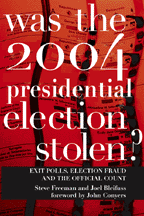
Was the 2004 Presidential Election Stolen?
BookPage
With a foreword by U.S. Representative John Conyers, Jr.
Was the 2004 Presidential Election Stolen?
exit polls, election fraud, and the official count
By Steven F. Freeman and Joel Bleifuss
“Freeman and Bleifuss document the final proof of the most monumental theft in American history.”
—Robert F. Kennedy, Jr.
Read more about Steven Freeman here and Joel Bleifuss here
This book available through Election Defense Alliance.
Click Here to Place Order.
"This book discusses a contentious, but not a partisan issue. People differ strongly about whom they want in the White House, but almost everybody wants whoever is there to be seen as having been rightfully elected . . . Only those who simply and reflexively assert the explanation with
which they're most comfortable will dismiss this careful and judicious book as the work of conspiracy theorists."
—John Allen Paulos
author of Innumeracy and A Mathematician Reads the Newspaper
"Freeman and Bleifuss shape the raw data into an image of all that the Founders warned us against."
—U.S. Representative John Conyers, Jr.
from the Foreword, "Praise for Was the 2004 Presidential Election Stolen?"
“After Steven Freeman first pointed to the statistical improbability of the discrepancy between 2004 Election Day exit polls, which forecast a Kerry victory, and the officially reported results, opinion leaders accepted with relief the mea culpa offered months later by exit pollsters Joe Lenski and Warren
Mitofsky. The careful analyses presented in this book demonstrate that the pollsters’ explanation is utterly unsatisfactory.
Indeed, the additional evidence that Freeman and Bleifuss develop is even more disquieting than the original discrepancy. Their book deserves to stimulate follow-up investigations into the threat to our democracy posed by insecure electronic voting machines, and into the possibility that their vulnerability was exploited in 2004 with fateful results. As a citizen, I very much hope that the answer is ‘no,’ but it is time for mainstream scholars, journalists, and public officials to stop avoiding the question.”
—Jack H. Nagel
Steven Goldstone Endowed Term Professor of Political Science, University of Pennsylvania
"Freeman and Bleifuss are true patriots. They understand that our country cannot survive as a viable democracy if our election processes are corrupted. They responsibly and insightfully investigate evidence suggesting that the 2004 presidential
election may have been stolen, using as a focal research question: either the exit polls were unusually way off or the votes were not accurately counted. Concerned Americans should not ignore this intelligent book."
—Kenneth Warren,
Professor of Political Science, St. Louis University, President of The Warren Poll
“In the aftermath of the 2004 election, I was convinced that the exit polls had got it wrong, that George Bush had won the popular and electoral vote, and that arguments to the contrary were little more than a combination of sour grapes and conspiracy theory. After reading this book, I’m no longer so sure. When asked ‘was the 2004 election stolen?’ the only honest answer I can now give is ‘I don’t know.’ That is a sad commentary on the state of elections, election polling, the news media and academic research in the United States and it needs to be remedied.”
—Michael X. Delli Carpini,
Dean, The Annenberg School for Communication, University of Pennsylvania
‘Freeman and Bleifuss have made a critically important contribution to the debate over election accuracy and integrity in the United States. Their book offers the most thorough account to date of the large and
growing body of evidence indicating that the 2004 presidential election was stolen. They cover the evidence of voter suppression, bias in election policy and administration, disparities between exit polls and election returns, and much more. While making these and
other complex subjects accessible to non-experts, Freeman and Bleifuss also discuss larger questions about the role of elections, election administration, and media oversight in modern representative government. They demonstrate that American democracy itself is in jeopardy.
-- Lance deHaven-Smith
Professory of Public Administration and Policy, Florida State University
“This is the book I have been waiting for. Freeman and Bleifuss are reasonable, balanced, and insistant--addressing the questions about the 2004 elections that won't go away. They specifically target the exit polls and explore how these
exit polls (the gold standard of polling) could have been so far off from the official count in so many states. Readers will have the opportunity to step outside a comfortable conventional wisdom, not into a world of conspiracies but into the territory of careful searching,
combining the best features of science and true investigative journalism."
—Karen Parker Lears, Associate Editor Raritan Review
“If you seek a very accessible guide to the 2004 election, starting with election night and proceeding through all the major issues, I can't make a higher recommendation than this book…”
—Paul R. Lehto, votersunite.org
Twenty months after the 2004 presidential election, Was the 2004 Presidential Election Stolen? is the first sustained investigation of what really happened on the first Tuesday of November 2004. Scrutinizing the widest spectrum of facts and theories that have emerged to explain the discrepancy between the exit poll results and the official count, authors Steve Freeman and Joel Bleifuss tell the story of our electoral democracy at this moment in its history without fear or favor.
The story they have to tell is a damning one—one that has profound implications for the 2006 and 2008 elections, indeed for the future of American democracy:
• Was there something wrong with the way that exit polls are conducted in the United States or does the problem lie with a lack of security at the ballot box? In their book, Freeman and Bleifuss plumb both the history of exit polling and the state of the art today. The Election Day 2004 exit polls showed Kerry winning nearly every battleground state, in many cases by sizable margins. So why did the exit polls differ so substantially from the official count? In elections in Germany and the United Kingdom, exit polls accurately predict the outcome of national elections. And in the Ukraine that same month, an exit poll discrepancy was used to overturn the official results.
• Did the implementation of electronic voting systems pave the way for election fraud in 2004? Freeman and Bleifuss examine the vulnerability of new ballot technologies. In 2004, 64 percent of voters cast ballots on
either electronic voting systems or optical-scan voting systems. A September 2005 study by the General Accountability Office found that such systems had security problems that “could allow unauthorized personnel to disrupt operations or modify data and programs that are
critical to the accuracy and the integrity of the voting process.”
• Why were the exit polls so wrong? The pollsters who conducted the exit polls, Joe Lenski and Warren Mitofsky, produced a 77-page report that attempts to explain why the exit poll discrepancy occurred. Freeman and Bleifuss
examine that report in detail and demonstrate that the pollsters’ analysis does not stand up under scrutiny. “Lenski and Mitofsky found it more expedient to provide an explanation unsupported by theory, data or precedent than to impugn the machinery of American democracy as
practiced in the 2004 presidential election,” they write.
• Freeman and Bleifuss also analyze the Conyers Report and Democratic National Committee report, as well as earlier reports such as those on African American vote suppression conducted by the U.S. Commission on Civil Rights—all of which cast doubt on the integrity of the 2004 presidential election. The authors pay particular attention to Ohio, the critical battleground state. In Ohio, an extraordinary variety of electoral malfeasance is documented, including various forms of vote suppression, ballot “spoilage,”and institutionalized disenfranchisement—all of which amounted to more than enough to swing the election. So why weren’t the investigative arms of our government and the press more in evidence? Freeman and Bleifuss explore the reasons.
Freeman and Bleifuss present their case with scientific precision in clear and easy to understand language. Advance readers like the distinguished mathematician John Allen Paulos are already calling Was the 2004 Presidential Election Stolen? a “careful and judicious book” in recognition of the effort of the authors to rise above partisan politics.
STEVEN F. FREEMAN's
analyses, together with a study by the University of California, Berkeley's sociology and demography departments, are recognized to have been the first serious attempts to examine the validity of the outcome of the 2004 presidential election.
Freeman holds a Ph.D. from MIT's Sloan School of Management. He is on the faculty of the University of Pennsylvania's Center for Organizational Dynamics, where he teaches research methods and survey design (a domain that includes polling.) He has received four national awards for his research.
JOEL BLEIFUSS
is editor of In These Times. An investigative reporter and columnist, his articles have appeared in The New York Times, Utne Reader, The Philadelphia Inquirer, and Dissent, among many others.
Was the 2004 Presidential Election Stolen?
Exit Polls, Election Fraud, and the Official Count
by Steven F. Freeman & Joel Bleifuss
Foreword by U.S. Representative John Conyers, Jr.
Publication Date: June 30th, 2006
284 pages | Paperback | $17.95
www.sevenstories.com
What Happened in Ohio? A Documentary Record of Theft and Fraud in the 2004 Election
|
|
A Documentary Record of Theft and Fraud in the 2004 Election
In this first comprehensive look at the most critical states voting process in the 2004 residential election, three pathbreaking investigative journalists (one a member of the legal team that sued the
state of Ohio for election fraud), compile documentary evidence of massive potential theft and fraud in the presidential voteproblems that may have changed the outcome of the presidential election in Ohio, and thus the nation.
As you can see by reviewing the documents below, What Happened in Ohio?
includes trucking receipts that show voting machines were pulled back from minority districts; ballots that contain evidence of tampering; mathematical analysis demonstrating the statistical impossibility of voting totals; testimonials from hundreds of voters, campaign workers,
and poll workers about conditions that effectively disenfranchised thousands of voters; copies of flyers instructing Democrats to vote on Wednesday; official letters sent to tens of thousands of longtime voters incorrectly informing them they had been deemed inactive and ineligible to vote; photos taken of the original exit poll data broadcast on election night before it was retroactively corrected by the networks; and much, much more.
For anyone suspicious of the Ohio vote, here's the evidence you've been waiting for.
Chapter 1: Suppressing the Vote
|
1.1
|
|
JPG 441 kb
|
|
1.2.1
|
|
Word 21 kb
|
|
1.2.2
|
|
Word 22 kb
|
|
1.3
|
|
Word 27 kb
|
|
1.4
|
|
JPG 729 kb
|
|
1.4.1
|
|
Word 27 kb
|
|
1.5
|
|
JPG 598 kb
|
|
1.6
|
|
JPG 546 kb
|
|
1.7
|
|
JPG
232 kb
|
|
1.8
|
|
Word 29 kb
|
|
1.9.1
|
|
PDF
4 kb
|
|
1.9.2
|
|
Word 217 kb
|
|
1.10
|
|
JPG 665 kb
|
|
|
|
JPG 222 kb
|
|
|
|
JPG 739 kb
|
|
|
|
JPG 833 kb
|
|
|
|
JPG 498 kb
|
|
|
|
JPG 506 kb
|
|
|
|
JPG 174 kb
|
|
1.11
|
|
JPG 100 kb
|
|
1.12
|
|
Word 21 kb
|
|
1.13
|
|
PDF 3.2 MB
|
|
1.14
|
|
Word 25 kb
|
|
1.15
|
|
Word 22 kb
|
|
1.16
|
|
Word 25 kb
|
|
1.17
|
|
Word 22 kb
|
|
1.18
|
|
JPG 370 kb
|
|
1.19
|
|
JPG 495 kb
|
|
1.20.1
|
|
JPG 366 kb
|
|
1.20.2
|
|
JPG 326 kb
|
|
1.21
|
|
Word 25 kb
|
|
1.22
|
|
PDF 141 kb
|
|
|
|
PDF 140 kb
|

About the Authors
Bob Fitrakis
is a professor of political science at Columbus State Community College, a lawyer, and the executive director of the Columbus Institute for Contemporary Journalism . He lives in Columbus, Ohio, and currently is running as the Green Party candidate for Governor of Ohio .
Steve Rosenfeld
is a journalist and senior producer of The Laura Flanders Show on Air America.
He lives in San Francisco.
Harvey Wasserman
is a senior editor and columnist for FreePress.org and the author of many books.
He lives in Columbus, Ohio.
|
|
|
Security Assessment of the Diebold Optical Scan Voting Terminal
A. Kiayias L. Michel A. Russell A. A. Shvartsman
UConn VoTeR Center and
Department of Computer Science and Engineering,
University of Connecticut
with the assistance of
M. Korman, A. See, N. Shashidhar, D. Walluck
Technical report: uconn-report-os.pdf
October 30, 2006
Security Assessment of the Diebold Optical Scan Voting Terminal
We present an independent security evaluation of the AccuVote Optical Scan voting terminal (AV-OS). We identify a number of new vulnerabilities of this system which, if exploited maliciously, can invalidate the results of an election process utilizing the terminal.
Furthermore, based on our findings an AV-OS can be compromised with off-the-shelf equipment in a matter of minutes even if the machine has its removable memory card sealed in place.
The basic attack can be applied to effect a variety of results, including entirely neutralizing one candidate so that their votes are not counted, swapping the votes of two candidates, or biasing the results by shifting some votes from one candidate to another. Such vote tabulation corruptions can lay dormant until the election day, thus avoiding detection through pre-election tests.
Based on these findings, we describe new safe-use recommendations for the AV-OS terminal.
Specifically, we recommend installation of tamper-resistant seals for (i) removable memory cards, (ii) serial port, (iii) telephone jacks, as well as (iv) screws that allow access into the terminal’s interior; failure to seal any single one of these components renders the terminal susceptible to the attack outlined above.
An alternative is to seal the entire Optical Scan system (sans ballot box) into a tamper-resistant container at all times other than preparation for election and deployment in an election. An unbroken chain of custody must be enforced at all times. Post-election audits are also strongly advised.
(Look for download link under heading "Attachment" below)
The Diebold AccuVote Optical Scan voting terminals described in this report are going to be used in November 2006 election in several precincts in the State of Connecticut. The terminals are provided by the LHS Associates of Massachusetts. VoTeR Center personnel assisted the Office of the Connecticut Secretary of the State in developing safe use procedures for the Optical Scan terminals for this election. The procedures in place for the election includes strict physical custody policy, tamper-resistant protection of the equipment, and random post-election audits.
Analysis of the proposed "Count Every Vote" bill (federal legislation)
Contact: Nancy Tobi, [email protected]
The “Count Every Vote" bill was recently resurrected by Senator Clinton
and instantly embraced by People for the American Way and other good liberal
groups enamored of sweeping federal election reform bills. And faster than you
can say “centralized power” election reform activists began praising the bill
and exhorting one another to support it. But one thing we election activists
need to get through our heads: sweeping election reform at the federal level is
always a disastrous path. History has proven this time and time again. You can
read about that here .
I think it's great for people to get excited about legislation, but does
anyone actually read these bills before promoting them far and wide?
Maybe not. So, here we go. I have taken the liberty of going through the
entire Clinton
bill in its previous iteration from the last Congressional session. If the good
Senator plans to revise it, we have not been informed of this, so we’ll just
assume that it is staying as is for now.
The "Count Every Vote" bill is what is known as a “Christmas Tree”
bill. A little something for everyone is hanging off it. This means the bill
is, in and of itself, complex. Complexity in legislation is always a red flag,
because it easily obscures things. Items you might not want are easily hidden
in the complexity. So in the interest of untangling some of the threads, I am
simply listing below sections from the bill itself with my own comments, in
italics, beneath that section.
The original text of the bill can be found here:
http://www.govtrack.us/congress/bill.xpd?bill=s109-450
-------------------------------
S. 450 [109th]: Count Every Vote Act of 2005, 109th CONGRESS, 1st Session
To amend the Help America
Vote Act of 2002 to require a voter-verified paper record, to improve
provisional balloting, to impose additional requirements under such Act, and
for other purposes.
The bill is going to impose new requirements on top of the already
burdensome and unachievable HAVA requirements, which have broken our nation’s
election systems.
IN THE SENATE OF THE UNITED STATES, February 17, 2005
Mrs. CLINTON (for herself, Mrs. BOXER, Mr. KERRY, Mr. LAUTENBERG, and Ms.
MIKULSKI) introduced the following bill; which was read twice and referred to
the Committee on Rules and Administration
A BILL To amend the Help America Vote Act of 2002 to require a
voter-verified paper record, to improve provisional balloting, to impose
additional requirements under such Act, and for other purposes.
Be it enacted by the Senate and House of Representatives of the United States of America
in Congress assembled,
SECTION 1. SHORT TITLE; TABLE OF CONTENTS.
(a) Short Title- This Act may be cited as the `Count Every Vote Act of
2005'.
TITLE I--VOTER VERIFICATION AND AUDITING
SEC. 101. PROMOTING ACCURACY, INTEGRITY, AND SECURITY THROUGH
PRESERVATION OF A VOTER-VERIFIED PAPER RECORD OR HARD COPY.
This entire section is devoted to perpetuating the myth of DREs and
VVPATs. If you didn’t like it in Holt, you won’t like it here. But just wait
until you see what they have in mind for expanding HAVA to meet the needs of
“language minority” voters. It’s the old TEXT CONVERSION DEVICE.
(b) Voter-Verification of Results for Individuals With Disabilities
and Language Minority Voters- Paragraph (3) of section 301(a) of the Help
America Vote Act of 2002 (42 U.S.C. 15481 (a)(3)) is amended to read as follows:
`(3) ACCESSIBILITY FOR INDIVIDUALS WITH DISABILITIES AND FOR LANGUAGE
MINORITIES-
`(A) IN GENERAL- The voting system shall--
`(i) be accessible for individuals with disabilities, including nonvisual
accessibility for the blind and visually impaired, in a manner that provides
the same opportunity for access, participation (including privacy and
independence), inspection, and verification as for other voters;
`(ii) be accessible for language minority individuals to the extent required
under section 203 of the Voting Rights Act of 1965 (42 U.S.C. 1973 aa-1), in a manner that provides the same
opportunity for access, participation (including privacy and independence),
inspection, and verification as for other voters;
Yes, this expands the unachievable HAVA requirements to even more open
ended and unachievable requirements, which will doom the states to failure.
Technology can not be created to meet the myriad of language requirements, just
as it couldn’t meet all disability requirements. The Federal government is
enacting laws that are IMPOSSIBLE, and setting themselves up to take over our
elections by establishing a situation in which the states have no choice but to
violate the impossible law.
Are you ready to surrender state sovereignty to the federal
government?
`(iii) satisfy the requirement of clauses (i) and (ii) through the use of at
least one direct recording electronic voting system or other voting system
equipped for individuals with disabilities at each polling place; and
`(iv) if purchased with funds made available under title II on or after
November 1, 2006, meet the voting system standards for disability access (as
outlined in this paragraph).
`(B) VERIFICATION REQUIREMENTS- Any direct recording electronic voting
system or other voting system described in subparagraph (A)(iii) shall use a
mechanism that separates the function of vote generation from the function of
vote casting and shall produce, in accordance with paragraph (2)(A), an
individual paper record which `shall be used to meet the requirements of
paragraph (2)(B);
`(ii) shall be available for visual, audio, and pictorial inspection and
verification by the voter, with language translation available for all forms of
inspection and verification in accordance with the requirements of section 203
of the Voting Rights Act of 1965;
The talking and painting ballot: This is requiring technology that 1)
doesn’t exist 2) can not possibly exist to the extreme requirements shown here
(imagine the cost and complexity of technology that can translate into any
language on earth plus into pictures, every word on every ballot for every
ballot design in the nation) 3) if it could be invented would be so
prohibitively expensive that public election jurisdictions would have no budget
to support it, and 4) would be so complex that citizen oversight of the
election would be rendered completely impossible.
`(iii) shall not require the voter to handle the paper; and
So now, in addition to talking and painting ballots, we need ballots
with hands. Yes, they actually want a requirement for the ballot to drop itself
into the ballot box unaided by humans.
`(iv) shall not preclude the use of Braille or tactile ballots for those
voters who need them.
The requirement of clause (iii) shall not apply to any voting system certified
by the Independent Testing Authorities before the date of the enactment of this
Act.
`(C) REQUIREMENTS FOR LANGUAGE MINORITIES- Any record produced under
subparagraph (B) shall be subject to the requirements of section 203 of the
Voting Rights Act of 1965 to the extent such section is applicable to the State
or jurisdiction in which such record is produced.'.
This expands HAVA to include more impossible requirements from the
Voting Rights Act now. Voting Rights are a good thing, to be sure. We are
fighting for them. But these open-ended and unachievable requirements conflict
with, and in any reasonable case, would negate, other equally important voting
rights, such as security, accuracy, and citizen oversight.
---------------------------------------
`(9) PROHIBITION OF USE OF UNDISCLOSED SOFTWARE IN VOTING SYSTEMS- No voting
system shall at any time contain or use any undisclosed software. Any voting
system containing or using software shall disclose the source code, object
code, and executable representation of that software to the Commission, and the
Commission shall make that source code, object code, and executable
representation available for inspection upon request to any citizen.
Here we have the no-COTS (Commercial off the shelf) waiver predicament.
Since every voting machine in existence uses COTS right now, the prohibition of
undisclosed software with no COTS waiver would require the replacement of every
voting machine in the country with equipment that doesn’t yet exist: COTS-less.
So that’s great if the nation is prepared to go to hand counted paper ballots
everywhere. Unfortunately, since the nation is not yet ready for that
transition, this provision creates a situation where states must run elections
using illegal equipment, setting them up for litigious hell and chaos to our
nation.
`(10) PROHIBITION OF USE OF WIRELESS COMMUNICATION DEVICES IN VOTING
SYSTEMS- No voting system shall use any wireless communication device.
OK – we like this provision. It can stay.
`(11) CERTIFICATION OF SOFTWARE AND HARDWARE- All software and hardware used
in any electronic voting system shall be certified by laboratories accredited
by the Commission as meeting the requirements of paragraphs (9) and (10).
With this provision, Clinton et al wish to perpetuate the EAC
Certification Ponzi scheme, which, as we know, is a scheme wherein American
taxpayers continue to pay for voting equipment that never meets the impossible
Certification standards and testing requirements established by the EAC, and in
which the States effectively lose their sovereignty because the EAC gains de
facto regulatory control over the nation’s voting equipment. For more
information on the Ponzi Scheme, see: http://www.democracyfornewhampshire.com/node/view/3571
`(12) SECURITY STANDARDS FOR MANUFACTURERS OF VOTING SYSTEMS USED IN FEDERAL
ELECTIONS-
Security standards for vendors is a good thing, but the recertification
of altered software provides a logistical problem….
`(iv) In the same manner and to the same extent described in paragraph (9),
the manufacturer shall provide the codes used in any software used in
connection with the voting system to the Commission and may not alter such
codes once certification by the Independent Testing Authorities has occurred
unless such system is recertified.
The problem here is that inevitably, because of the nature of software,
and because of the nature of elections, changes always occur in one or the
other. If a state must then retest and recertify every change, it becomes quite
a costly affair. Testing costs for one product alone have been estimated by the
EAC itself in a public meeting as rising to between $500,000 and $1
million. Does every state need to pay these costs following every ballot
change requiring a software change?
SEC. 102. REQUIREMENT FOR MANDATORY RECOUNTS.
On and after the date of the enactment of this Act, the Election Assistance
Commission shall conduct random unannounced manual mandatory recounts of the voter-verified
records of each election for Federal office (and, at the option of the State or
jurisdiction involved, of elections for State and local office held at the same
time as such an election for Federal office)
Before we go on, let’s think about this. The bill wants us to invite the
Election Assistance Commission, four people hand picked by the President of the
United States,
to conduct recounts of our federal, state, and local elections? Unannounced and
at their discretion? This doesn’t pass the smell test for any democracy loving
Patriot.
in 2 percent of the polling locations (or, in the case of any polling
location which serves more than 1 precinct, 2 percent of the precincts) in each
State and with respect to 2 percent of the ballots cast by uniformed and
overseas voters immediately following the election and shall promptly publish
the results of those recounts in the Federal Register. In addition, the
verification system used by the Election Assistance Commission shall meet the
error rate standards described in section 301(a)(5) of the Help America Vote
Act of 2002.
Now, let’s think about these error rates. The Voting System Standards
the bill refers to require the following with respect to acceptable error rates
for voting equipment:
For each processing function indicated above, the system shall achieve a
target error rate of no more than one in 10,000,000 ballot positions, with a
maximum acceptable error rate in the test process of one in 500,000 ballot
positions.
If there exists any equipment to meet this worthy, yet impossible,
standard, we don’t know about it. In April 2006, prior to the May 2 primary,
the Cuyahoga County Commission contracted with the
Election Science Institute (ESI) to conduct a comprehensive review of how their
new voting system actually worked on an election day. ESI’s report, including
the performance of the Diebold Accuvote TSX voting system, was released by the Cuyahoga County Commissioners: “…members of the
manual count team found that 10 percent of the paper ballots were physically
compromised in some way.” (Election Science Institute, 08/22/2006)
In other words, the Cuyahoga
County study showed a 1
in 10 error rate, not a 1 in 10 million. So we are off by 1 MIL times the
standard.
SEC. 103. SPECIFIC, DELINEATED REQUIREMENT OF STUDY, TESTING, AND
DEVELOPMENT OF BEST PRACTICES.
We think study is a good thing, and should be enacted. In fact, we think
study should have been enacted prior to the proliferation of HAVA-paid-for
voting equipment that broke our election systems and did not meet the most
basic voting requirements for security, transparency, and accuracy, never mind
accessibility.
`SEC. 247. STUDY, TESTING, AND DEVELOPMENT OF BEST PRACTICES TO
ENHANCE ACCESSIBILITY AND VOTER-VERIFICATION MECHANISMS FOR DISABLED VOTERS.
`The Election Assistance Commission shall study, test, and develop best
practices to enhance accessibility and voter-verification mechanisms for
individuals with disabilities.'.
As above, this is probably the best and only thing that should come out of
Federal election reform. EXCEPT we don’t want the EAC to exist anymore, so we
would turn this task over to the GAO or another entity, which should convene a
taskforce including all stakeholders and ordinary citizens as well.
SEC. 104. VOTER-VERIFICATION AND AUDIT CAPACITY FUNDING.
This section is authorizing the EAC to pay out $500 Million to the
states so they can “improve” their DRE equipment and make it VVPAT. Even if you
thought this was a good idea, the sum is not enough, making the whole thing
another unfunded mandate.
SEC. 105. REPORTS AND PROVISION OF SECURITY CONSULTATION SERVICES.
The EAC has already been conducting a “Death by Bureaucracy” campaign
against our State election offices. Under the threat of Department of Justice
intervention, our state election offices spend countless hours completing
bureaucratic reporting requirements for the EAC. Now, we are all in favor of
accountability, but bureaucratic requirements must be reasonable and achievable
and must not come at the cost of election administration itself.
SEC. 106. IMPROVEMENTS TO VOTING SYSTEMS.
This section deals with the unachievable error rates mentioned above,
and brings in the matter of “residual votes.” The residual vote benchmark
refers to under- and over-voting, and is controversial in that it is often used
in legal cases to justify the use of DREs. We contend this issue requires study
and not mandates.
TITLE II--PROVISIONAL BALLOTS
SEC. 201. REQUIREMENTS FOR CASTING AND COUNTING PROVISIONAL BALLOTS.
This section tries to clean up the processing of provisional ballots.
This is, in and of itself not a bad thing, but we’d like to get rid of the
concept of “provisional ballots” altogether. It is a black hole for fraud.
States are encouraged to implement election day registration, and the Federal
requirement for provisional ballots in election day registration states ought
to be abolished.
TITLE III--ADDITIONAL REQUIREMENTS UNDER THE HELP AMERICA VOTE ACT OF 2002
Subtitle A--Shortening Voter Wait Times
We can live with this provision. It appears to have good intent and to
cause no harm.
--------------------------
SEC. 311. NO-EXCUSE ABSENTEE VOTING.
There is no justification for federal law to pre-empt state law on the
matter of absentee voting. Absentee voting, while a lovely idea, does
constitute a security risk in the chain of custody in elections. States must
determine their own needs and requirements for absentee voting without federal
intervention.
Subtitle C--Collection and Dissemination of Election Data
This entire section could be replaced with the Freedom of Access to
Election Information as defined clearly and succinctly in the Request By Voters
on www.wethepatriots.org .
Here it is:
1) FREEDOM OF ACCESS TO ELECTIONS INFORMATION – Amend HAVA to require
elections-related information at the local, state and federal levels be made
available to any person under the civil rights principles embodied in the
Freedom of Information Act in a way that addresses the special circumstances in
elections.
a. All information necessary to validate elections must be produced by the
voting system and its accompanying elections procedures;
b. When information to validate the election is requested, it must be
provided before recount and contest periods have expired;
c. The information must be provided in a usable and cost-effective manner;
d. There will be no restrictions imposed by proprietary claims, nor shall
access to information be placed outside of governmental custody.
Subtitle D--Ensuring Well Run Elections
Training is not a bad thing, we can live with this provision.
SEC. 332. IMPARTIAL ADMINISTRATION OF ELECTIONS.
We like this provision as well.
SEC. 341. STANDARDS FOR PURGING VOTERS.
These problems would be eliminated with election day registration, but
barring that, this provision is supportable except for the references to
empowering the EAC with this authority. The EAC as a four person commission
appointed by the President is an undemocratic, nonrepresentational,
consolidation of Executive power and must be abolished.
SEC. 351. ELECTION DAY REGISTRATION.
We like election day registration. But we like state sovereignty as
well. And this provision empowers the EAC again to enforce state election laws.
This is unacceptable. We would like each state to rise to the challenge of
providing election day registration, but we will not pay the cost of the loss
of state sovereignty, as embodied in this provision, to make this happen.
SEC. 352. EARLY VOTING.
As with absentee voting, there are security risks involved in enabling
early voting. Each state must decide on its own and not be pre-empted by
the federal government in the administration of its own elections.
TITLE IV--VOTER REGISTRATION AND IDENTIFICATION
Again, this is an unnecessary federal intervention in the conduct of
elections. Each state must decide on its own and not be pre-empted by the
federal government in the administration of its own elections. The US Constitution
wisely decentralized power by endowing the States with authority over the
conduct of elections. This bill has too many pre-emptive provisions. This is a
risky strategy for lovers of democracy, which relies on decentralized power and
checks and balances.
`SEC. 249. STUDY ON INTERNET REGISTRATION AND OTHER USES OF THE
INTERNET IN FEDERAL ELECTIONS.
Now what the heck is this in here for? I don’t want my money used for
this boondoggle. Democracy depends on COMMUNITY. We need to connect our votes
with our lives, and when we vote in our community-based elections, we know it
matters, and we can see that it COUNTS. Staying in your community keeps things
in balance and in check. We take care of things when we are part of the
community. As my woodland friends like to say, “you don’t shit where you live.”
SEC. 402. ESTABLISHING VOTER IDENTIFICATION.
No thanks, I don’t want the EAC making decisions that my state
legislature can make with input from and accountability to me and my fellow
citizens. Besides, this provision is cementing photo identification into the
system. Under the guise of paying for it. No thanks.
SEC. 403. REQUIREMENT FOR FEDERAL CERTIFICATION OF TECHNOLOGICAL
SECURITY OF VOTER REGISTRATION LISTS.
On the face of it, this sounds like a good idea. But so did the idea of
certifying voting machines, and we see where that has led us. I vote for
further study before sending any more of my taxpayer dollars to the federal
government to carry out more voting equipment certification schemes.
TITLE V--PROHIBITION ON CERTAIN CAMPAIGN ACTIVITIES
SEC. 501. PROHIBITION ON CERTAIN CAMPAIGN ACTIVITIES.
Okay, this pretty much makes sense. But I’m not sure it belongs in this
bill. Should probably be dealt with in a separate bill that can give it the
full study.
SEC. 601. ENDING DECEPTIVE PRACTICES.
Okay, this also pretty much makes sense, but may not belong in this
bill. Should probably be dealt with in a separate bill that can give it the
full study. Obama tried that, but he brought in the EAC to oversee
things. Unacceptable for all the reasons already explained above.
SEC. 701. VOTING RIGHTS OF INDIVIDUALS CONVICTED OF CRIMINAL
OFFENSES.
Okay, this also pretty much makes sense, but may not belong in this
bill. Should probably be dealt with in a separate bill that can give it the
full study.
TITLE VIII--FEDERAL ELECTION DAY ACT
Not a bad idea. But I’m not sure it belongs in this bill. Should
probably be dealt with in a separate bill that can give it the full study.
SEC. 803. STUDY ON ENCOURAGING GOVERNMENT EMPLOYEES TO SERVE AS POLL
WORKERS.
Not a bad idea, except it further relies on the EAC. Also, I’m not sure
it belongs in this bill. Should probably be dealt with in a separate bill that
can give it the full study.
SEC. 901. TRANSMISSION OF CERTIFICATE OF ASCERTAINMENT OF ELECTORS.
Not sure what this is accomplishing. It seems to want to speed up
reporting information or something.
SEC. 1001. STRENGTHENING THE ELECTION ASSISTANCE COMMISSION.
OK – the title says it all. This provision can not stand. We need to
abolish and not strengthen the democracy-demolishing entity called the EAC.
`SEC. 209. SUBMISSION OF BUDGET REQUESTS.
On the face of it, this is fine. But we need to abolish the
democracy-demolishing entity called the EAC. We need to revisit the role of
NIST and its authority with respect to voting systems as well.
Black Box Voting: Vote Tampering in the 21st Century, Bev Harris, (Talion Books 2004)
Bev Harris's landmark classic about the utter lack of security of DRE voting machines and the GEMS central tabulator software. The book is based on her early efforts to research the issue wherein she found Diebold software and files on the internet, completely unsecured, and was able to download and examine the sytem tablulator and other aspects of the programming, as well as have computer experts from major universities examine the code.
Brennan Center Reports on Voting Technology
Publications related to Voting Technology
8 Matches

The Machinery of Democracy: Voting System Security, Accessibility, Usability, and Cost
Publication
Published 10/10/2006
Issue: Voting Rights & Elections
First ever comprehensive, empirical analysis of electronic voting systems.

The Machinery of Democracy: Voting System Accessibility
Publication
Published 10/10/2006
Issue: Voting Rights & Elections

The Machinery of Democracy: Voting System Usability
Publication
Published 8/28/2006
Issue: Voting Rights & Elections

The Machinery of Democracy: Protecting Elections in an Electronic World
Publication
Published 6/27/2006
Issue: Voting Rights & Elections

The Machinery of Democracy: Protecting Elections in an Electronic World (Executive Summary)
Publication
Published 6/27/2006
Issue: Voting Rights & Elections
Secure Electronic Voting RFP Kit
Publication
Published 6/29/2004
Issue: Voting Rights & Elections
Recommendations for Improving Reliability of Direct Recording Electronic Voting Systems
Publication
Published 6/28/2004
Issue: Voting Rights & Elections
Policy Brief on Electronic Voting Systems
Publication
Issue: Voting Rights & Elections
CIA Security Expert Warns EAC Against E-Voting
http://www.mcclatchydc.com/226/story/64711.html
Most Electronic Voting Isn't Secure, CIA Expert Says
By Greg Gordon | McClatchy Newspapers March 24, 2009
WASHINGTON — The CIA, which has been monitoring foreign countries' use of electronic voting systems, has reported apparent vote-rigging schemes in Venezuela, Macedonia, and Ukraine and a raft of concerns about the machines' vulnerability to tampering.
Appearing last month before a U.S. Election Assistance Commission field hearing in Orlando, Fla., a CIA cybersecurity expert suggested that Venezuelan President Hugo Chavez and his allies fixed a 2004 election recount, an assertion that could further roil U.S. relations with the Latin leader.
In a presentation that could provide disturbing lessons for the United States, where electronic voting is becoming universal, Steve Stigall summarized what he described as attempts to use computers to undermine democratic elections in developing nations. His remarks have received no news media attention until now.
'Wherever the vote becomes an electron and touches a computer, 
that's an opportunity for a malicious actor potentially to . . .
make bad things happen.'
Stigall told the Election Assistance Commission, a tiny agency that Congress created in 2002 to modernize U.S. voting, that computerized electoral systems can be manipulated at five stages, from altering voter registration lists to posting results.
"You heard the old adage 'follow the money,' " Stigall said, according to a transcript of his hour-long presentation that McClatchy obtained. "I follow the vote. And wherever the vote becomes an electron and touches a computer, that's an opportunity for a malicious actor potentially to . . . make bad things happen."
Stigall said that voting equipment connected to the Internet could be hacked, and machines that weren't connected could be compromised wirelessly. Eleven U.S. states have banned or limited wireless capability in voting equipment, but Stigall said that election officials didn't always know it when wireless cards were embedded in their machines.
Download CIA Expert's Advice to the EAC Click READ MORE to continue
While Stigall said that he wasn't speaking for the CIA and wouldn't address U.S. voting systems, his presentation appeared to undercut calls by some U.S. politicians to shift to Internet balloting, at least for military personnel and other American citizens living overseas. Stigall said that most Web-based ballot systems had proved to be insecure.
The commission has been criticized for giving states more than $1 billion to buy electronic equipment without first setting performance standards. Numerous computer-security experts have concluded that U.S. systems can be hacked, and allegations of tampering in Ohio, Florida and other swing states have triggered a campaign to require all voting machines to produce paper audit trails.
The CIA got interested in electronic systems a few years ago, Stigall said, after concluding that foreigners might try to hack U.S. election systems. He said he couldn't elaborate "in an open, unclassified forum," but that any concerns would be relayed to U.S. election officials.
Stigall, who's studied electronic systems in about three dozen countries, said that most countries' machines produced paper receipts that voters then dropped into boxes. However, even that doesn't prevent corruption, he said.
Turning to Venezuela, he said that Chavez controlled all of the country's voting equipment before he won a 2004 nationwide recall vote that had threatened to end his rule.
When Chavez won, Venezuelan mathematicians challenged results that showed him to be consistently strong in parts of the country where he had weak support. The mathematicians found "a very subtle algorithm" that appeared to adjust the vote in Chavez's favor, Stigall said.
Calls for a recount left Chavez facing a dilemma, because the voting machines produced paper ballots, Stigall said.
"How do you defeat the paper ballots the machines spit out?" Stigall asked. "Those numbers must agree, must they not, with the electronic voting-machine count? . . . In this case, he simply took a gamble."
Stigall said that Chavez agreed to allow 100 of 19,000 voting machines to be audited.
"It is my understanding that the computer software program that generated the random number list of voting machines that were being randomly audited, that program was provided by Chavez," Stigall said. "That's my understanding. It generated a list of computers that could be audited, and they audited those computers.
"You know. No pattern of fraud there."
A Venezuelan Embassy representative in Washington declined immediate comment.
The disclosure of Stigall's remarks comes amid recent hostile rhetoric between President Barack Obama and Chavez. On Sunday, Chavez was quoted as reacting hotly to Obama's assertion that he's been "exporting terrorism," referring to the new U.S. president as a "poor ignorant person."
Questions about Venezuela's voting equipment caused a stir in the United States long before Obama became president, because Smartmatic, a voting machine company that partnered with a firm hired by Chavez's government, owned U.S.-based Sequoia Voting Systems until 2007. Sequoia machines were in use in 16 states and the District of Columbia at the time.
Reacting to complaints that the arrangement was a national security concern, the Treasury Department's Committee on Foreign Investment in the United States launched an investigation. Smartmatic then announced in November 2007 that it had sold Sequoia to a group of investors led by Sequoia's U.S.-based management team, thus ending the inquiry.
In the former Soviet republic of Georgia, Stigall said, hackers took resurrecting the dead to "a new art form" by adding the names of people who'd died in the 18th century to computerized voter-registration lists. Macedonia was accused of "voter genocide" because the names of so many Albanians living in the country were eradicated from the computerized lists, Stigall said.
He said that elections also could be manipulated when votes were cast, when ballots were moved or transmitted to central collection points, when official results were tabulated and when the totals were posted on the Internet.
In Ukraine, Stigall said, opposition leader Viktor Yushchenko lost a 2004 presidential election runoff because supporters of Russian-backed Prime Minister Viktor Yanukovych "introduced an unauthorized computer into the Ukraine election committee national headquarters. They snuck it in.
"The implication is that these people were . . . making subtle adjustments to the vote. In other words, intercepting the votes before it goes to the official computer for tabulation."
Taped cell-phone calls of the ensuing cover-up led to nationwide protests and a second runoff, which Yushchenko won.
Election Assistance Commission officials didn't trumpet Stigall's appearance Feb. 27, and he began by saying that he didn't wish to be identified. However, the election agency had posted his name and biography on its Web site before his appearance.
Electronic voting systems have been controversial in advanced countries, too. Germany's constitutional court banned computerized machines this month on the grounds that they don't allow voters to check their choices.
Stigall said that some countries had taken novel steps that improved security.
For example, he said, Internet systems that encrypt vote results so they're unrecognizable during transmission "greatly complicates malicious corruption." Switzerland, he noted, has had success in securing Internet voting by mailing every registered citizen scratch cards that contain unique identification numbers for signing on to the Internet. Then the voters must answer personal security questions, such as naming their mothers' birthplaces.
Stigall commended Russia for transmitting vote totals over classified communication lines and inviting hackers to test its electronic voting system for vulnerabilities. He said that Russia now hoped to enable its citizens to vote via cell phones by next year.
"As Russia moves to a one-party state," he said, "they're trying to make their elections available . . . so everyone can vote for the one party. That's the irony."
After reviewing Stigall's remarks, Susannah Goodman, the director of election reform for the citizens' lobby Common Cause, said they showed that "we can no longer ignore the fact that all of these risks are present right here at home . . . and must secure our election system by requiring every voter to have his or her vote recorded on a paper ballot."
MORE FROM MCCLATCHY
Glitches, machine breakdowns hamper voting in five states
Computer expert denies knowledge of '04 vote rigging in Ohio
Warning on voting machines reveals oversight failure
Did Washington waste millions on faulty voting machines?
Fooled Again, by Mark Crispin Miller, (Basic Books 2005)
Media critic and NYU professor, Mark C. Miller, takes an in-depth look at the stolen 2004 election featuring overviews of all the vote suppression, vote padding and other vote count manipulation that played such an important role in the presidential election across the country. Instead of covering the election fraud, the media seemed to do everything in it's considerable power to avoid covering the copious evidence of fraud, as well as the stories of the embattled citizen activists and third party candidates who attempted to fight back.
GAO Report on Electronic Voting (September 2005)
Government Accountability Office (GAO) Report [on Electronic Voting] September 2005
This report essentially validated concerns originally brushed aside as coming from "sore losers" and "conspiracy theorists." The GAO is one of the few nonpartisan, incorruptible institutions left, and their indictment is extremely serious. However, the report received virtually no media coverage, except for on the web.
GAO REPORT ON E-VOTING
Jim March: Report on Fraudulent Certification of Diebold Touchscreens
Report on Fraudulent Certification of Diebold Touchscreens
Click here for PDF
PFAW: Shattering the Myth - An Initial Snapshot of Voter Disenfranchisement (Dec. 2004)
Click here for the PDF file "Shattering the Myth: An Initial Snapshot of Voter Disenfrancisement in the 2004 Elections" by People for the American Way.
Quick Intro to Black BoxVoting and What Went Wrong in Ohio
• Black Box Voting: Ballot Tampering in the 21st Century
By Bev Harris. Talion Press, 2004.
• What Went Wrong in Ohio: The Conyers Report on the 2004 Presidential Election.
Edited by Anita Miller. Academy Chicago Publishers, 2005.
Reviews by Sheila Parks
Originally published by Tikkun Magazine online, at http://www.tikkun.org/magazine/reviews/article.2006-01-06.7975946864
In Black Box Voting and What Went Wrong in Ohio, Bev Harris and Michigan Congressman John Conyers present data that are chilling indictments of our election system. Harris discusses electronic voting machines and the fraud and error they have enabled in elections. Conyers - a Democrat - highlights the disenfranchisement of African-American, low-income, and Democratic communities through voter suppression by government power and campaign organizations; he also discusses problems associated with electronic voting machines.
A striking example from Harris: In March, 2002, Diebold Election Systems, one of the largest manufacturers of electronic voting machines, received a $54 million dollar contract to place these machines in the entire state of Georgia. Harris found “40,000 secret files on an unprotected” Internet site of Diebold. One of the files was called “rob-georgia.zip.” “Rob-georgia.zip” contained a patch for the Windows CE operating system that went unchecked and uncertified by any government official. With specific documentation, Harris states, “Talbot Iredale, senior vice president of research and development for Diebold…modified the Windows CE operating system used in Georgia.” Harris concludes that a single man had unchecked access to modify the operating system on which the votes were counted – a major security breach. Her investigation showed that commuter commands had been replaced on all 22,000 machines in Georgia “right before the election without anyone examining what the new commands actually do.”
In November, 2002, there were six Georgia contests in which Republicans won upset victories, the most notable being the race that Senator Max Cleland lost to conservative Republican Saxby Chambliss. A year after the publication of her book, Harris and her organization Black Box Voting, along with computer experts Harri Hursti and Hugh Thompson, publicly hacked Diebold optical scan electronic voting machines in Leon County, Florida in the presence of election supervisor Ion Sancho, thereby demonstrating the ease with which electronic voting machines can be rigged.
Conyers provides specifics about Ohio – e.g. that voters in some African-American and Democratic communities had to wait in line ten hours to vote. Conyers argues that many of the problems in Ohio involved “intentional misconduct and illegal behavior,” with Secretary of State Kenneth Blackwell playing a major role. One of many examples is Blackwell’s restricting of provisional ballots, which disenfranchised “tens, if not hundreds, of thousands” of mostly minority and Democratic voters. Blackwell was co-chair of the Bush-Cheney campaign in Ohio. Because of the numerous illegal activities, Conyers states that the Ohio electors “cannot be considered lawfully certified...” Conyers details the eye-opening story of Sherole Eaton, Deputy Director of Elections for Hocking County [a whistleblower, since fired]. She reported that she saw Michael Barbian Jr., a representative of Triad Governmental Systems, Inc., modify the vote tabulator for the Hocking County computer prior to the Ohio recount announcement. Conyers adds that Psephos Corporation, a Triad affiliate, “supplied the notorious butterfly ballot used in Palm Beach County, Florida in the 2000 Presidential election.”
We must acknowledge and end the racism that plagues our country and voting system. The Voting Rights Act must be enforced and renewed by 2007. We must change to a system of hand marked, hand counted paper ballots (HCPB). Used in a number of democracies throughout the world and in some municipalities in the United States, HCPB are an excellent alternative to the current extensive use of electronic voting machines, which can be rigged regardless of how many mandated random audits are held, at whatever percent, on any machines – touch-screens or optical scans. Ballots must be counted correctly the first time. To audit HCPB, votes are counted by hand again, immediately after the first hand count. HCPB require safeguards, but these are more easily provided than making electronic voting machines that cannot be rigged.
If not now, when?


