Click "Members" To Visit


 Printer-friendly version
 Send to friend
EDA Elections Investigator John Brakey Acquitted on Trespassing Charge
Yesterday (4.16.09) in Pima County Superior Court, Judge Luis Castillo dismissed trespassing charges filed against election observer John Brakey by the Pima County Elections Director, Brad Nelson. In so ruling, Judge Castillo also said Nelson was "over-reaching" when he had Brakey arrested during the Pima County primary audit of 2008.
This video is part of the EDA TV videolog collection online at: http://eda-tv.blip.tv/
The URL for this particular video is: http://blip.tv/file/2004617/
BACKGROUND:
While monitoring a handcount of ballots from the September 3rd Arizona primary, in his capacity as an official election observer for the Democratic and Libertarian parties, EDA Investigations Co-Coordinator John Brakey was arrested and ejected from the Pima County election headquarters on orders of Pima County Elections Director Brad Nelson.
Brakey had noticed that several of the incoming bags containing ballots from the precincts had unsecured or missing seals. The seal failures appeared to be the result of pollworkers not knowing how to properly lock them.
Brakey then wondered whether the serial numbers on the bag seals matched the serial numbers recorded by the precinct pollworkers when they sealed the ballots. One question led to another, and Brakey ended up in handcuffs.
Video: http://electiondefensealliance.org/2008/09/john_brakey_arrested
These clips are part of the Pima/RTA election investigation story soon to be released as Fatally Flawed, a feature documentary film produced by EDA in association with Sound and Fury Productions, Inc.
See the trailer here: http://eda-tv.blip.tv/#1987293
Update 4/17/09: Letter from Attorney Bill Risner, John Brakey's legal counsel
Justice of the Peace Jose Luis Castillo entered a judgment of acquittal on the trespassing criminal charges against John Brakey yesterday afternoon. No defense witnesses were necessary as the case was dismissed at the end of the prosecution case. The judge specifically noted that Mr. Brakey's efforts were helpful to improving ballot auditing procedures. Importantly he found that Brad Nelson had "overreached" in ordering Brakey arrested.
John Brakey was a Democratic Party observer when arrested. I am proud that he stood his ground against the bully Brad Nelson. Here is what happened, according to Brad Nelson's testimony.

SaveRVote Report Fills in Missing Pieces of the 2008 Election
April 14, 2009
"Missing Pieces," a devastating citizen review of the 2008 presidential election conducted in Riverside County, CA, will be presented to the Riverside County Board of Supervisors and the press today at 1:30 p.m. by SaveRVote founder (and EDA Election Monitoring Coordinator) Tom Courbat.
(Proceedings will be streamed live over the Internet via this URL: http://bosvideo.co.riverside.ca.us/ppportal/agenda/webcast.aspx ).
Download Photographic Slideshow
 The report, prepared by Courbat and the citizen volunteers of the SaveRVote election monitoring organization, documents violations of election law and egregious failures by the Riverside County Registrar of Voters, Barbara Dunmore, and her departmental staff, to secure, track, or even properly count the ballots in the November 2008 presidential election.
SaveRVote monitors on election day and night photographed evidence of election law violations, logged missing memory cards ("electronic ballot boxes"), and in their subsequent 5-month examination of Riverside County election records, found vote counting and ballot auditing errors in official county election reports numbering in the tens and even hundreds of thousands.
The exhaustively documented Missing Pieces report, presented in its entirety here on the EDA website, consists of an executive summary, findings and recommendations, a slideshow of photographic evidence, and a spreadsheet analysis of oversized precincts exceeding legal limits.
SaveRVote concludes its report urging the Riverside County Board of Supervisors to commission an independent auditing firm to conduct a true forensic audit of the county's election canvass process, as well as a computer systems security audit of the county's Sequoia voting system by independent qualified experts.
More than 120 citizen volunteers with SaveRVote examined 20,000 election documents in what is believed to be the most comprehensive forensic review ever performed on a single county election system.
Pima RTA Election: 31 Anomalies for Investigation
31 Facts and Anomalies Pertinent to the Pima County RTA Election
1. On the day of the RTA election (Tuesday, May 16, 2006) there was a very high and unusual number of failures of Diebold precinct-based optical scan voting machines. Pima County tried to cover up these machine failures. On election night, the Pima Election Department reported to the newsmedia that 35 precinct optical scanners had failed. A county memo two weeks later stated that 75 machines had failed. Now it appears from examination of the election database that 149 scanners failed.
2. A Microsoft Access manual was seen and photographed in the vote tabulation room on election night by former Representative Ted Downing. Use of MS Access on an election computer was and is illegal. Downing described a Microsoft Access manual being referenced by election department technician Bryan Crane in blatant violation of election law. Downing then called Donna Branch-Gilby, at that time the Chair of the Pima County Democratic Party, and asked her to bring a camera. Donna came with her husband, Bob Gilby, and took pictures of the Microsoft Access manual sitting open next to the central tabulator.
3. Because of the problems and unusual procedures Downing had observed during the election night count, he requested that Pima Election Director Brad Nelson make a backup of the election database, put it in an envelope, sign it, and take it to the sheriff's office to be held in secure custody. Nelson refused.
Goddard's Election Investigation Highly Suspicious -- of the Observers
Pima County RTA Investigation: Who Are The Suspects?
By John R Brakey Thursday, April 09, 2009
This week Arizona Attorney General Terry Goddard is supervising a recount of the (2006) RTA transit bond election as part of a criminal investigation to discover whether results from that election were rigged. The truth lies within 105 boxes of ballots.
As election integrity activists, we verify and seek only the truth regardless of the outcome. We think of ourselves as partners with our elected officials in search of solutions that will subject future elections to proper public oversight in order to ensure their integrity.
"One person, one vote" is the basis of our democracy. We shouldn't have to wonder if our votes are being counted correctly; but it's also true that only through our active exercise of our rights will our democracy survive and flourish. Citizenship is every person's highest calling. The responsibility of citizenship, I've learned, is practiced with what I like to call the Four C's: Character, Capacity, Credibility, and Civility.
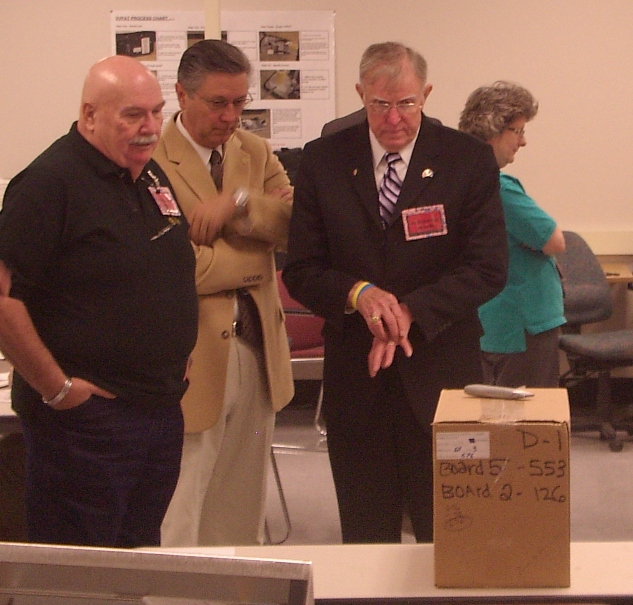
At times, it seems that to be an election observer, a little Courage is needed as well. For the privilege of doing our civic duty as citizen observers, monitoring the Maricopa election workers through a glass window as they hand count ballots from the 2006 RTA election, we must walk through a gauntlet of security checks, many times, daily.
We have to wonder why this level of surveillance is necessary in a public area? What threat do we represent? A system that intimidates citizen participation is not what good government was meant to be.
We should not have to feel like we are the suspects. Let there be no doubt, that is how others and I were made to feel in the public viewing area. Our bodies and belongings were thoroughly searched every time we entered the area. We were constantly watched by two sheriff's deputies and an additional (armed) man from the attorney general's office. We experienced a constant, calculated insult as each of us was followed everywhere by a 'minder' from law enforcement, even to the bathroom.
Even though we viewed the count through a window that prevents any close-up look at the ballots and does not allow us to hear anything inside the counting area, we were not permitted to use cell phones or modems. We have to wonder why. When practicing good citizenship, one should not be treated as or made to feel like a suspect.
Republican Party recount observer Bob Hancock (left) and Democratic Party observer Ben Love (right) behold evidence of the AG's shoddy ballot custody (see closeup of improperly sealed ballot box below) while themselves being closely monitored by an unidentified officer (middle) from the attorney general's office -- one of five plainclothes AG officers armed with handguns tailing every election observer both inside and outside of the ballot counting room. Under Attorney General Goddard's procedures, official recount observers are prohibited from taking any notes (even pens and paper are banned) and in fact, are not even allowed to stand close enough to read the ballots, poll tapes, or any other evidence that they are supposedly there to witness and verify.
Yesterday (4.7.09) observers Hancock and Love were told by the attorney general's officer in charge of the recount, Special Agent Meg J. Hinchey of the Special Investigations Division, that the Pima ballots have been held in the Maricopa County Election Department since Attorney General Goddard secretly ordered them removed from Pima County in February. That announcement contradicts previous declarations by the AG's office and Maricopa Elections Department that the attorney general's office has been in possession of the ballots. Attorney General Goddard is the only one who really knows for sure where the Pima ballot evidence has been for the past two months, and he has yet to give any public accounting of the ballot chain of custody.
April 7: MN Senate Recount Live Video Updates
April 9: No Final Ruling Yet in MN Election Contest
GOP indicates Coleman campaign will ask for additional recount of 4100 ballots
Check The Update's Twitter or Live Blog for updates at http://www.twitter.com/theuptake
* * *
Franken Extends Lead Over Coleman to 312 Votes in Election Contest Recount
By KEVIN DUCHSCHERE, Star Tribune
Last update: April 7, 2009 - 12:41 PM
Democrat Al Franken today extended his lead over Republican Norm Coleman in the U.S. Senate election, following the counting of about 350 formerly rejected absentee ballots this morning by a three-judge panel.
Unofficially, Franken took 198 of the ballots, while Coleman added 111. The ballots added about 87 to Franken’s recount lead, enlarging his margin over Coleman to more than 312.
=====================
Hand-recounting of the ballots in the 2008 election for U.S. Senate in Minnesota, being contested by Republican candidate Norm Coleman against apparent winner, Democratic candidate Al Franken, is proceeding today, April 7, 2009.
The live video coverage below is provided by the citizen journalism project, The Uptake, http://theuptake.org/
Video will take a little while to load.
While the official recount is in recess, The Uptake will be providing recaps and information about their project.
Notice that in the video control bar, you can select LIVE for live feed, and also ON DEMAND, which opens a menu for other feed content,
such as a print blog, recount documents, and other information that will bring you up to date on the current status of the contest recount.
Observers Shut Out of Pima Recount
Attorney General's "criminal investigation" procedures break ballot custody and make meaningful public observation impossible
RTA Recount Situation Report: 3:00 p.m. Monday April 6th
(aka: “The Official Chronicles Of The Bored To Tears, Part One”)
by Jim March
A total hand-recount of what are alleged to be the ballots voted in the 2006 Pima County Regional Transportation Authority (RTA) bond measure election is being conducted as I write.
Eight teams of three people each (all Maricopa Elections Division employees) are doing the “sort and stack” method to pile ballots in three piles for each ballot question. It's impossible to overstate how tightly the information flow is controlled here, or how “nontransparent” the process is.
The “short form” is that the preliminary counts are matching the official final totals from 2006, in broad strokes.
“Ballot forensics” is going to be a factor here, and the chain of custody of these ballots (read: could they be fake?) is open to serious question.
 Background
For those just joining us: This bond measure of May 2006 involved $2 billion worth of transportation contracts, which in turn affected “housing boom” issues. We now know there was a ton of fraud in the late lamented real estate boom; the question now is, was there also fraud in setting the preconditions for that boom, such as the RTA bond measure?
Long-distance photo taken through a window with optical zoom, by Jim March
AZ Attorney General Terry Goddard finally took a serious role by declaring the hand-count. But the way he handled it violated every standard possible in election transparency, and continues to do so.
Goddard will tell you that he doesn't need to be transparent at all because this isn't an election-related recount. He's partially right: this recount is connected to a criminal investigation aimed at the people who run elections in Pima County.
Bowen Decertifies Premier GEMS Ver. 1.18.19 in California
Source: California Secretary of State
Secretary of State Debra Bowen Withdraws State Approval of Premier Voting System
Legislation to Require Disclosure of Product Flaws Clears First Hurdle
SACRAMENTO – Secretary of State Debra Bowen today announced she has withdrawn state approval of Premier Election Solutions’ Global Election Management System (GEMS) version 1.18.19, which contains serious software flaws.
Premier GEMS 1.18.19 contains the “Deck Zero” anomaly, a software error that can delete the first batch of optically scanned ballots under certain circumstances without alerting elections officials to the deletion.
In addition, the system’s audit logs fail to record important events and “clear” buttons permit deletion of key records, both of which violate federal standards.

The Secretary of State’s office conducted an independent investigation into the GEMS 1.18.19 system and held a public hearing on the matter March 17, at which a Premier representative said the company had no objection to discontinuing the system’s use in California. Secretary Bowen reached her decision after analyzing the investigation findings and evaluating the written and oral public testimony on the system.
“Clearly, a voting system that can delete ballots without warning and doesn’t leave an accurate audit trail should not be used in California or anywhere,” said Secretary Bowen, California’s chief elections officer.
“I am putting together a comprehensive plan to examine the audit logs of other voting systems to determine if they suffer similar problems. Having a reliable audit log is critical to ensuring that every Californian’s vote is counted as it was cast.”
The “Deck Zero” flaw caused 197 ballots to be inadvertently deleted from Humboldt County’s initial results in the November 4, 2008, General Election. Humboldt County corrected its election results when it discovered the software error. Two other California counties, San Luis Obispo and Santa Barbara, used the same software for the November 4 election but encountered no similar problems in counting ballots.
Of the three counties that used Premier GEMS 1.18.19, Humboldt County has decided to switch to another vendor.
San Luis Obispo and Santa Barbara counties have accepted Premier’s offer to upgrade their systems to a newer GEMS version that is approved for use in California.
Premier Exacts Revenge on Humboldt County
The following article was first published at http://parke.dreamhosters.com/s9y/a/ 5 and subsequently distributed to the California Election Protection Network and published as a featured guest post at Bradblog.com at: http://www.bradblog.com/?p=7016 on 3.25.09. The original article is reprinted here by permission with appreciation to Parke Bostrom, and to Brad Friedman of Bradblog.com.
Diebold Nukes Humboldt!
by Parke Bostrom
At the California Secretary of State's public hearing regarding the possible decertification of GEMS 1.18.19 related to the Deck Zero covert deletion of 197 ballots in the November election, the audit log's magical "clear" button, and the GEMS's audit logs failing to show when ballots were manually deleted by the operator, Diebold/Premier representatives tried to shift blame for the 197 deleted ballots onto Humboldt County Registrar of Voters Carolyn Crnich.
Crnich responded, "If you're saying that your system needs to be checked every damn time we turn it on, I agree with you."
Crnich's use of an expletive seems to have pushed Diebold/Premier's legal counsel over the edge, causing them to reach for and firmly press the "nuke" button.
Several days after returning to Humboldt, Crnich received two letters from Premier. Both letters arrived in a single envelope, but unlike Premier Khrushchev's two letters to President Kennedy, Crnich did not get to choose which letter to respond to.
'Apparently, section 25 allows Diebold/Premier
to terminate Humboldt County's annual license
. . . on 90 days' notice'
The first letter, dated March 17th, was regarding section 25 of the DIMS license agreement. The license agreement was signed on April 27th, 1999. Apparently section 25 allows Diebold/Premier to terminate Humboldt County's annual license to use the DIMS voter registration system on 90 days notice. Additionally the letter went on to revoke all of Humboldt County's licenses to use any Diebold/Premier election systems and software following the May 19th statewide special election. Diebold/Premier also required that many pieces of equipment would have to be returned. (Click READ MORE to continue)
Related Coverage
3.27.09: California News Service radio story: PLAY AUDIO (1 min.)
3.20.09: http://www.electiondefensealliance.org/Finley_Makes_Case_Against_Premier
3.17.09: http://www.electiondefensealliance.org/CA_Premier_ZeroDeck_Hearing_031709
7.16.08: Election Defense Radio interview with Humboldt Election Transparency Project and Registrar Carolyn Crnich
Humboldt Election Transparency Project
Lost Ballots and Brunner's Conflicting Interests in Ohio
2004 Ballots Already Lost; 2010 Senate Seat Yet to Lose
Michael Collins
Ohio election politics now rival the political hardball of Texas, Illinois, and Florida at their best. As a result, the state's Democratic Party may once again snatch defeat from the jaws of victory in the 2010 election cycle. Through a bid for the open United States Senate seat, the self-described election reform Secretary of State, Jennifer Brunner puts two critical goals of Ohio Democrats at risk.
Brunner's Candidacy a Conflict of Interest for Party and Office
The first is the Senate seat held since 1999 by Republican George V. Voinovich who announced plans to retire at the end of his term this January. This provided a short-lived advantage for a unified Senate candidacy by Democrats. But the unity ended when the candidacy of Lt. Governor Lee Fisher, the party favorite, was challenged by Ohio Secretary of State Jennifer Brunner.
Election 2008 turned the tables on Ohio Republicans. President Obama's 51 - 48% win inverted the questionable 2004 outcome, the Bush 51% to 49% "win" over Sen. John Kerry (D-MA). Obama not only reversed the 2004 results, his 2.9 million vote total is the highest ever in Ohio, a state with static population growth since 2000.
The Brunner candidacy threatens an Ohio Senate win by Democrats in 2010.The absence of a contested primary is always preferred by either party. Lt. Gov. Lee Fisher (D) has the solid endorsement of top Ohio Democrat Gov. Ted Strickland. Strickland and Fisher ran as a team to defeat the Republican Governor-Lt. Governor ticket 60% to 35%. Brunner will divide the party in the primary election. Those costs and efforts will reduce money for the general election.
Ohio currently has 18 members of Congress, with a 10-to-8 advantage for Democrats. Had Brunner chosen to run for re-election as Secretary of State, Democrats would have been virtually guaranteed an advantage on the state Apportionment Board. With her departure, control of the three member board would be up for grabs should Republicans win the Secretary of State contest.
Brunner offers up a slow pitch for any future opponent by holding onto her office as the chief elections official of Ohio. She'll be running in a primary and general election (if she wins the primary then resigns) that she's preparing for right now as the chief elections official. Former Republican Secretary of State Blackwell was severely criticized for massive conflict of interest when he did the same thing in 2006.
The Lost '04 Ohio Ballots and Brunner's Record as SoS
Jennifer Brunner was a local judge before running for Ohio Secretary of State. She ran for and won that office as a Democrat in 2006, part of a sweep of state executive offices for the Democrats. She replaced J. Kenneth Blackwell, the most controversial Secretary of State in any state for decades. The resolutely partisan Blackwell ignored multiple warnings that helped create a catastrophe in the 2004 presidential election. This is well documented as was the pattern of election fraud throughout the country.
Brunner's qualifications for the United States Senate seat depend largely on her record as Secretary of State. How did she do?
CIA Security Expert Warns EAC Against E-Voting
Most Electronic Voting Isn't Secure, CIA Expert Says
By Greg Gordon | McClatchy Newspapers March 24, 2009
WASHINGTON — The CIA, which has been monitoring foreign countries' use of electronic voting systems, has reported apparent vote-rigging schemes in Venezuela, Macedonia, and Ukraine and a raft of concerns about the machines' vulnerability to tampering.
Appearing last month before a U.S. Election Assistance Commission field hearing in Orlando, Fla., a CIA cybersecurity expert suggested that Venezuelan President Hugo Chavez and his allies fixed a 2004 election recount, an assertion that could further roil U.S. relations with the Latin leader.
In a presentation that could provide disturbing lessons for the United States, where electronic voting is becoming universal, Steve Stigall summarized what he described as attempts to use computers to undermine democratic elections in developing nations. His remarks have received no news media attention until now.
'Wherever the vote becomes an electron and touches a computer, 
that's an opportunity for a malicious actor potentially to . . .
make bad things happen.'
Stigall told the Election Assistance Commission, a tiny agency that Congress created in 2002 to modernize U.S. voting, that computerized electoral systems can be manipulated at five stages, from altering voter registration lists to posting results.
"You heard the old adage 'follow the money,' " Stigall said, according to a transcript of his hour-long presentation that McClatchy obtained. "I follow the vote. And wherever the vote becomes an electron and touches a computer, that's an opportunity for a malicious actor potentially to . . . make bad things happen."
Stigall said that voting equipment connected to the Internet could be hacked, and machines that weren't connected could be compromised wirelessly. Eleven U.S. states have banned or limited wireless capability in voting equipment, but Stigall said that election officials didn't always know it when wireless cards were embedded in their machines.
Download CIA Expert's Advice to the EAC Click READ MORE to continue